

"Later, as he sat on his balcony eating the dog, Dr. Robert Laing reflected on the unusual events that had taken place within this huge apartment building during the previous three months."
This week sees the launch of The Leave Alliance. It's already a great achievement by an organization with such little regard by the "eurosceptic aristocracy" and indeed by extension SW1 Establishment. Also this week marks the release of the film adaptation of J.G Ballard's novel, written in 1975: High Rise by the British director Ben Wheatley. I really enjoy J.G. Ballard's novels. It resonates so strongly with something of my own personality, as it may also do so with others? What is that? A glimpse of what this might be is found in a minor interview:
An Investigative Spirit: Travis Elborough talks to J.G Ballard
TE: In several of your novels you have used a small community, the residents of a luxury housing development or a high-rise block for example, as a microcosm with which to explore the fragility of civil society. Do you think that your preoccupation with social regression, de-evolution even, stems from your childhood experiences in the internment camp when you saw first hand, how easily the veneer of civilization could slip away?
JGB: Yes, I think it does; although anyone who has experienced a war first hand knows that it completely overturns every conventional idea of what makes up day-to-day reality.

In the previous blog, EU: From Common Market To EU Constitution, it was noted in diagram form the genesis of the EU or Supranationalism in the architect of the EU, Jean Monnet and his experiences of war. A very important blog by Dr. RAE North EU Referendum: the genesis of obsolescence:-
"In fact, the First World War was far more important to the intellectual genesis of the EU than the Second, something that Booker and I observed in The Great Deception (see p.14 et seq).
And if there was one historical event which more than any other inspired what was eventually to become the European Union, it was the battle which had raged around Verdun the First World War. For the British the defining battle of that war was the Somme in the summer of 1916.
Present for several months fighting for the other side was the father of Germany's future Chancellor, Helmut Kohl. So deep was the wound Verdun inflicted on the psyche of France that the following year her army was brought to mutiny. Its morale would never fully recover.
And from this blow were to emerge two abiding lessons. The first was a conviction that such a suicidal clash of national armies must never be repeated. The second was much more specific and immediate. It came from the realisation that the war had been shaped more than anything else by industrial power.
Thus, Loucheur came to reflect, industrial organisation was the key to waging war. From this he developed the idea that, if key industries from different countries, above all their coal and steel industries on which modern warfare so much depended, were removed from the control of individual nations and vested in a "higher authority", this might be the means of preserving peace.
But the point that emerges – or should emerge – is that the First World War was in all manner of ways unique. By the time Part II (otherwise known as World War II) had ground its way to its bloody conclusion, the world had changed to an extent unimaginable to the original authors of the ideas which led to the formation of the EU.
Crucially, the post-1945 world was divided into spheres of influence dominated by two super-powers, with the A-bomb and then the H-bomb delivered by unstoppable Intercontinental Ballistic Missiles, holding the balance of terror which become known as the doctrine of Mutually Assured Destruction (MAD)."

Direct experience is not easily conveyed by secondary descriptions
What is very very strongly demonstrated here is the direct experience of people informs and shapes their world view. In The Great Deception this core and raw and direct experience on the the major influencers of civilization shaped the next step:-

Le Corbusier's design for his ideal city was in his mind the blueprint of social reform (credit: DailyMail)
You can read a fascinating account of this perspective on "Central Planning" in the documentary discussed here: City of Towers – Christopher Booker – BBC 1979 and on youtube City of Towers with the sound unfortunately missing. We briefly met "Central Planning" or "Centralization" previously in The Road To The European Union:-
However according to Friedrich von Hayek in The Road To Serfdom, similar such processes have not increased democracy through increases in size and power of the state, but Centralized power and decreased democracy:-
"The most effective way of making people accept the validity of the values they are to serve is to persuade them that they are really the same as those which they, or at least the best among them, have always held, but which were not properly understood or recognized before. The people are made to transfer their allegiance from the old gods to the new under the pretense that the new gods really are what their sound instinct had always told them but what before they had only dimly seen. And the most efficient technique to this end is to use the old words but change their meaning."
"The more the state "plans" the more difficult planning becomes for the individual.
The effect of the people's agreeing that there must be central planning, without agreeing on the ends, will be rather as if a group of people were to commit themselves to take a journey together without agreeing where they want to go; with the result that they may all have to make a journey which most of them do not want at all.
Is there a greater tragedy imaginable than that, in our endeavour consciously to shape our future in accordance with high ideals, we should in fact unwittingly produce the very opposite of what we have been striving for?
Nowhere has democracy ever worked well without a great measure of local self-government, providing a school of political training for the people at large as much as for their future leaders."
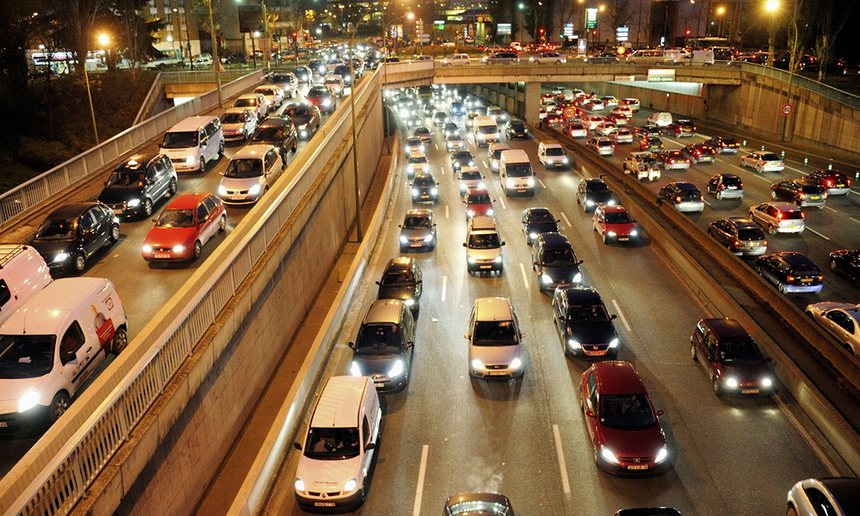
Périphérique: Ring-Road around Paris: Separating the Central and Outer Suburbs such as the Banlieues
It's very interesting reading the above blogger's thoughts on this "Modernist" architecture retold at the above link:-
"City of Towers is a two hour documentary made by Christopher Booker for the BBC, first broadcast in 1979 and a master class in the history of Modernism that covers its birth from ideas first put forward by Antonio Sant’Elia, Auguste Perret and Le Corbusier in the early part of the Twentieth Century...
. . . to its fall from grace in the latter part of the same century when its supposed beneficiaries, the people who had to live in the concrete blocks that followed the Modernist model, rebelled, and it came to be seen for what it truly was, a failed philosophy."

Bande De Filles ("Girl Gang") or English working title: "Girlhood"
The above film Bande De Filles / Girlhood is a story that takes place in the Paris Banlieues beyond the Périphérique. I enjoyed the movie and would recommend it highly. I also spent some time living in Paris and got to know some of the areas of this city, though to see a portrayal, even fictional of different areas is therefore rewarding: Who lives in different areas and how does their community and people see themselves? Well you can't help feel as if there's an impact on the architecture: Living in Montmartre on the hill is a idyllic area in this respect concerning the small community feeling it engenders and beautifully captured on film in another French film the magical realism fable Amélie. Ultimately the story in "Girlhood" is part coming of age story and part social observation of how the people living in some of these areas particularly perhaps these banlieues:-
Do Parisians buy property outside of Paris' Périphérique?
"In the U.S., the inner cities suffered while the suburbs became havens for the wealthy…just the opposite of what happened in Europe. Here in France, the central parts of the cities have continued to increase in value, while living in the suburbs became a less-expensive answer for families needing more space on a tighter budget. This is not true for all suburbs, but outside Paris in particular, the government built public housing in the banlieues (suburbs), to house hundreds of thousands of individuals from North Africa."Frames their perception of themselves and their place in society? This is explored in Dirty boulevard: why Paris's ring road is a major block on the city's grand plans by Justinien Tribillon. For a lot of people, the community of the present, the ideas of the past have been codified into structures or even strictures that dictate how they live their lives. The driving force in "Bande De Filles" is the determination to live one's own life, to free oneself, better oneself but also to learn to live and overcome such obstacles, to find an "ecstasy of experience" in friendship, and, in finding a way in life or indeed a way out of oneself, one's own limitations: To live one's own life, not one dictated by others, environment or events. To find one's own identity and freedom in that.
I was a few months ago looking after some friend's children and took them into London to see the Natural History Museum. There was inevitably a Tube strike so we had to take a bus, which on a hot day and for young children merely added to what was going to become a gruellingly long day on their much lower staminas! Fortunately the bus we took instead of being one of those "bendy-buses" was:-

New Routemaster Bus: A more convivial and communal form of transport?
I could not help feel these buses had a "human dimension" to them that the previous flawed models did not apart from the technical specifications no doubt of "micro-pollutants", crunching the effect on traffic with hop-on-off they're primarily designed to handle. They seem more comfortable and friendly in their design of seating and passenger interaction, to me. I don't remember this being the main reason or reasons for their reintroduction but it struck me as quite important if it is multiplied invisibly and unquantified across the entire central London?
In those tower-blocks the vision of the intellectuals in coding and planning for people seems to have been pre-loaded or declared instead of a more iterative way forward, an organic growth of communities; which the older buildings despite their poor specifications at least seemed to engender a human dimension in. I'm for this reason not overly fond of over-regulation of how people decide to live. But if you look at Paris this is a battle that appears more exacerbated for them.

It was Boris Johnson who relaunched the Routemaster. But unfortunately we have to suffer the Personality Politics dominating the Referendum of our SW1 masters, and their plans for us: Pete North notices this too: Bugger off Boris, and by Dr. RAE North: EU Referendum: not on our side, and Mr. Brexit expanding to the wider Tory Party itself that is dominating Remain and Leave turning the Referendum into the Tory Party Self-Promotion and Leadership Staging Event, Just whose side are the Tory eurosceptics really on? The latest fear-mongering (FUD) from Cameron: Cameron's latest fear mongering on farming, Mark Carney's curiously similar contribution and even some mutterings of Barak Obama down the pipeline, too: Banking is global and so is regulation; the industry will continue to thrive in the UK.

A certain kind of political snobbery: Keeping others "out"
The Sceptic Isle writes: The EU is moving towards its final destination, it’s time for us to depart and choose a different track.
What I want to do with this blog is simply to reflect not on this end destination but to reframe the same message but in a different form: The real form, of ideas of people from the past and how their ideas shape the present world of present people.
The question is: Is it still practical and applicable? If not: Why are we living the dreams of people long-gone and possible the coherence of those ideas, their philosophy proving to be "a broken philosophy"? I can't help consider that a certain form of "rent-seeking" "Political Class" rules Europe, and they keep other peoples' ideas out while they cleave to centralization of power and part of their pay-off is to treat with contempt anyone below themselves while supporting that which they themselves are underneath. Thus at the top: The old ideas of a few.
High Rise - teaser trailer 18.03.16
Coming back to Dr. RAE North's blog on EU Referendum: the genesis of obsolescence:-
"It is significant, therefore, that the Battle of Verdun started on 21 February 1916, almost exactly 100 years ago, and is still cited as the reason why we should surrender our democracy (what's left of it) to a supranational construct based in Brussels."
Related Note: Christopher Booker's recent article: How Britain connived in the end of the Kalahari Bushmen
As the Botswana government persecutes this people and drives them towards extinction, the UK and EU stand by and do nothing


