Red Cliffs Of Dawlish

Red Cliffs Of Dawlish
Showing posts with label The Great Deception. Show all posts

Monday, 29 August 2016

Politics & Power: The Power Of "Will Power".

Dance music is one choice, but listening to these speeches before an exercise session might just be another choice to give the old adrenaline a booster?


I listen and read and think about the current "currents" in the legacy news-media and beyond, in other deeper sources of information on the current triangle between the EU, Brexit and the Referendum Campaign. The former two are indeed scholastic or intellectual. I think the Referendum Campaign was nationally hyper-emotional, and it's no surprise there have been reports of mass hysteria. Interestingly, I was watching some of the World At War Series as well as some of the series on World War I. These events that imbued the EU with so much of it's spiritual "guidance" as a matter of fact: Booker: the EU dies where it was born. I may have not mentioned it before but I am a great admiring of Booker's "book":  The Seven Basic Plots. Moving on: I think am right in saying get the feeling that during the 1930's Germany went through the various stages described so well by Booker: The Dream Stage and such deep tragedy, The Nightmare Stage subsequently. Booker has long used this tool of filtering events, and I think you can see in his latest piece it's correct application  (once again) concerning describing the leadership of the EU's reactions currently? Probably without stretching the theme too far, there's a draining away of will power about the EU... maybe.

Anyway, one of the interesting descriptions of Hitler's rise to power was his own powerbase was built on multiples of fractious groups only united behind a common cause or leadership on a very thin surface of support, perhaps a leadership with a great deal of "will power"? If you watch the clip (it seems slightly doctored to enhance the effect of his "hypnotic speeches" and the religious fervour they worked up in crowds of people) I think it's fairly evident that this is the effective message and promise Hitler offered Germany at this time? And the preceding details that created such an environment I think are easy to understand just how conducive they were to transforming the emotional state of Germany towards such a leadership outcome? It was all building all along.

As said, I listen, watch and read and think about the current situation and it's infernally complex and chaotic. There was a very interesting example of some of the emotions tumbling around about Brexit and the EU linked at EUReferendum.com in the comments:-


I'm not entirely sure how much of the above is a combination of emotional processing, pedestal pitching of emotions and other incontinent reactions. But there's some useful insights into how people are genuinely feeling and reacting to the dissonance of a result that is going to be difficult for them to apprehend given the build up of anticipation, expectation and the subsequent dissipation and negatively in this case. There's plenty of this sort of material all over the place. It also incidentally has it's corollary in the Leave supporters. What's tell-tale and this is repeated a lot:-
  • WHO?
  • HATE
  • FASCIST
Apart from the hilarious, unintentional joke about "I thought that would be America..." (!!). Most people are basing their reactions on the other side. For them the symbol of this other side (from the Remain perspective) is Haters which when given a political colour scheme becomes "Fascists!". We come full circle back to Hitler. And I think the myth begins here. The myth has taken over the reality (see: The Many Not The Few for a another (very different but still "Myth supplanting"). It's become a story about symbolizing "hate" taking control.

I think it's not this actually. It's much more accurate to consider it as a case of a beaten people in difficult conditions with all the usual fractious divides amongst so many people at such numbers, finding a political structure which pooled them together under the aegis of "Will Power".

If looking at the subject of the EU, there is The Great Deception. On Brexit there is FLEXCIT. But when it comes down to the Referendum Campaign there is none of this intellectual dimension. There's emotion and vying for groups and the politicians promising that "Will Power" will resolve all problems if only it is "lent" to them in sufficient number. And likewise, post-Brexit The Leave groups are all pomp and fanfare and prestige and crowing that Will Power is all that is needed for a successful Brexit. Coincidentally I believe this integrates into what Dr. North has suggested supplants careful reasoning: Brexit: the failure of feedback. When people are swept up in the tide of emotions outpouring from so many different groups, then the solution is will-power and any problems are grossly de-emphasized.

It's not just the UK, but the EU uses Solidarity which incidentally the Nazis also used of course. It's not that either political entity is "hateful" it's that they're both under the same pressures and stresses pulling in different directions in multiple ways, it seems to me. Inevitably the solution is always:-

"More solidarity/sovereignty, more EU/UK (or folk-strength), more will power!!!"

Could almost be a Hitler speech, eh?

I really want to get back to reading about Agriculture, Fisheries and the Environment, I've been collecting various bits of information. Considering all the above, there's so many different ways of talking about it, it ends up being the case that simply remaining silent is the best reaction, because it captures all the above without neglecting too much of it by zealously selecting only a small drop of this ocean of outpourings.

If there were more people more silently listening and considering more and then asking sensible questions about ordinary things some more, maybe the actual process of Brexit in light of understanding the EU (and it's deep origins back in history) might become a bit more apparent and a bit more of a priority, first?

Sunday, 31 July 2016

Explanations, Reactions, Decisions and Chain-Reactions

A mere snap-shot attempting to illustrate a merest modicum of complexity, but at least fun to watch!

I think one of the biggest single explanations that captures a lot of, if not all of, the reasons that we finally see arguments made now that could or should have been made during the Referendum Campaign, is the way and worry of how politics really works. Any clearly stated course of action to be motioned for decision-making upon, creates a reaction and hence a chain of reactions forms and counter-reacts then reforms and so on.

What is left? A shadow-play of words; a calculation on intended but veiled effect; most particularly on manipulating relationships and groups of relationships: What is generally taken for granted as "Politics". Thus because we have finally had a decision, that has the weight of finality about it (despite the whinging), suddenly a lot of talking heads are coming onto the issues that were SO CLEARLY LAID OUT in FLEXCIT a few years ago. This itself is worth observing: The information may be available and highly accessible, but the emotional state of people seems to predominate in their behaviour, effectively blinding them to it. If ever there's a need for a mass anthropolitical (hehe!) study... Indeed if you believe in following those that govern the people because "they know best" and act "in everyone's best interests" just read this: Brexit: the darkest of games.

And so, to point out in EUReferendum.com 's recent postings:-

The WTO Option:-
It is complex! In fact to save you attempting to master the details, just think of it in terms of a chain-reaction of complexity as the above video at least indicates though not on a scale or degree of dimensional complexity that is needed. The point is made, one false move and the whole bloody thing:-
  1. Sets off in an uncontrolled manner.
  2. Grinds to a halt in a manner unintended.
  3. Loss of the stored potential to leverage the present working state. 
The other issue that seems to be burning away still apparently unresolvable but actually operating in the above description of "chain-reactions" and managing these things is "Freedom of Movement"; again using EUReferendum 's research to summarize:-
As has been noted, the "hollowing out" of the UK's national decision-making organs or institutions for the running of the UK, means that the politicians in Westminster serve only one useful function, these days: Enacting their role of "shadow play words" over everything for public and media consumption: Namely to use the chain-reaction motif, managing reactions, not it seems actually using information to make decisions: Perhaps Whitehall is doing that... using the one Brexit plan that actually defines the parameters then applies those conditions to any solution.

If you want an explanation for what "goes as argument" in 99% of the Legacy News-Media, then I would posit "this is as good as it gets!" Hence to be clear: The false narrative that thrives at present between The Single Market continued membership vs Freedom of Movement is merely a management of factions and their own infernal recursion of meanings: Complete gibberish fuelling the emotional reactions and managing them.

What's this all about then? There's an interesting discussion on the BBC iPlayer at the moment, you may care to watch and it contains some useful information: Britain's Vote In The EU Referendum
 
I took some notes while watching it and again using the idea of a chain-reaction to contain the relevant information and interpret it:-

Geoff Evans made some very interesting comments on the legacy of New Labour and Tony Blair and the interaction of this on Old Labour, The Working Class Vote, Immigration and Referendums/Referenda. It's worth watching.

However his information may be quite applicable and probably quite accurate, it did occur to me that his explanation was a bit like looking at the end of a chain reaction and saying "Here's the really important bit!" I think again to reference, a fuller understanding is the reward for reading The Great Deception history and reference and research on the EU, itself! Some of his language is good: "Liberal Intelligensia" or "UKIP Curious".

Next up Jane Green, it seemed to me was waffling off her feet and I could not understand her speech, only see her mouth moving. I think it was all pointed to saying "Remain was against the Status Quo of British people who were fairly pessimistic about the "so-called good" of the EU as described by the "Liberal Intelligensia". Again common sense vs a dangerously deluded over-thinking it bunch of pricks telling other people what to think.

Vernon Bogdanor, was of course very interesting on the so-called UK Constitution using an array of quotes on the subject that were both entertaining and insightful and hence useful for interpreting events against. In particular the "delegation of power" from people to Parliament and the limits that such power could or should be further bartered onwards away from and indeed how Referendums consequentially at least in the upper-echelons of the political elite became a crisis of their own identity and making.

The next speaker was Sarah Hageman, and here we really reach the business of this blog: She described "Contagion" or what I've then called "Chain-Reaction" in general application. Here specifically:-

  1. Brexit Result from UK Referendum=>
  2. N/Fr/D/Sw-EXIT Referendums in other EU nations? =>
  3. Maybe not, but domestic political repercussions =>
  4. Rate of Change aka uncertainty triggering ITA/SPA Banks in the Eurozone! =>
  5. The effects of all this looping back onto "what kind of deal will the EU give the UK"?
Here we return to the drivel about Freedom of Movement vs The Single Market!! Hello!

But there is a really important principle here: The complexity is REAL: From both perspectives of the Remain EU'ers or the Brexiteers and hence absolutely Brexit must be a very measured and controlled plan: Indeed FLEXCIT's staged or iterative withdrawal principle is exactly what this means given the complexity at stake (just think of those dominoes). It hence suggests the EU cannot "give in" on Freedom of Movement if the UK is sustain Single Market access, which would go a long way to calming market flux; ie the EFTA/EEA option purely for political reasons is very rational. Indeed looking at the EU, they really need to resolve the 4th issue above and speed on with their new Eurozone Treaty. Finally as per the blogs by Dr. RAE North above on Freedom of Movement, it's iteratively improving in the EFTA/EEA set-up secondly in any case - as planned.

The opposite of this? Shit communication, the likes of which are in torrents in the Legacy News-Media and politicians of Westminster. In fact, as per the previous blog a negative spiral against correct and healthy democratic processes.

Interestingly the final speaker, Cathyrn Costello, backs this up with her talk of "Regulated Labour Markets" and circular flows and the inadequacy of regulatory measures on these economically driven flows. She even usefully makes the point that it only took One Day before all the talk of "control" or "sovereignty" was discarded and EEA becomes the main candidate. Remember after all those years and years of lies on aka "The Norway Option": The Columbo Method: Norway.

As to the meeting and "experts" the observation I made was that these people apart from Geoff Evans and Vernon Bogdanor looked like they had "panic stricken faces" on. Namely they failed to communicate as experts or in their role as experts. For example, Cathyrn Costello showed her shallow understanding or deep ignorance chirping about "No say on internal market regulation" and a somewhat righteous tone of "betrayal of polish friends" mixed with "the EU has done everything to accommodate the peculiarities of the UK". These value-laden judgements are what was discussed previously: The emotional soup washing over people.

This is the work of the politician. The work of the expert is more neutral in tone and much more measured in stating what is known or at least thought to be known compared to what most certainly is not known, for example describing the complexity of these potential chain-reactions is I think very very useful for helping people make sense of where we are at and hence how we perhaps might prefer to proceed concerning Brexit and as Mrs. May our new Prime Minister says: "Making a Success of It!"

I think it is easy to see politics feels so alien to so many people. Does it have to be this way? Probably: With change comes winners and losers. My view is however, that the change has been in motion since the history of the EU and today globalization is accelerating this rate of change which also as a subject is seeing this emotionally hot battle of winners and losers (the narrative that Brexiteers are losers is amusing! in this regard if it were perhaps not so serious at the same time).


However, I think if the UK is able to take a bigger picture, or macroscope of things, it may help: In fact FLEXCIT starts off with the "least worst option" but confronts the challenges in order that in the future overall most dividends will it is hoped lead to maximizing "winners" and minimizing "losers": There is always going to be people who feel politics has afflicted them as opposed to served them: But how we manage our reactions to that and how we inform ourselves will help our reactions: And who knows, perhaps that itself will finally change politics, positively?

Sunday, 3 July 2016

FLEXCIT: A Glow In The Dark

A Glow-Worm: Spotted on 2nd July, 2016 (in the dark at 23:00!)

Fairly ecstatic, finally spotted a glow-worm in the countryside of the UK. Of course in the picture above, I've taken a flash-light of the creature hanging onto a stem with it's abdomen curled up to show off it's green fluorescent light. I spotted it, because the only thing I could see in the dark was a small green "LED" glowing light shiny out towards me in an otherwise dark walk home.

To be frank, it's been very nice away from politics, though it is still interesting to follow "developments" through a filter of knowledge built up over a few years. Knowledge that I hope will be developed into applications that can be used to "shine more light in the dark" in the future ahead.

Otherwise some interesting "potpourris" on the Referendum and how the next step of the process is being (or not) processed:-


This is quite useful giving perspective to market volatility. In fact responsible campaigning should have "secured access to the Single Market" reassurance if people had been able to cope with a baseline of honesty in politics...


One of the consequences of making the question more and more about "WHO?" than my proposition about "WHAT?" is the sort of above result and counter-results to accusing people of "cheating other people" of "something". It's illustrative of a very immature and ego-driven communication.


As with the above, this was grabbed off twitter, too. Norway has received far far more attention and consideration than before the Referendum and indeed the horrible horrible misinformation and legacy news-media aided exercise in this: To look at "Norway" or the EFTA/EEA option post-referendum it is undeniable in a like-for-like comparison that there are benefits to it even considering the above and very useful to use against "Storytime With..." such as Mary Dejevsky:-
"There were flickers of an idea, in the immediate aftershock of the Brexit vote, that a second referendum might soften, or even reverse, the separation of the UK from the European Union. It should now be clear, both from the response of EU leaders and from the statements of intention by all five candidates for the Conservative Party leadership, that there is no going back. At least not in the near future, and not on the same privileged terms as the UK currently enjoys.
Even the compromise models of semi-detachment – Norway and Switzerland – that would leave the UK as a member of the European Economic Area (EEA), but not the EU, have been effectively rejected because they presuppose “free movement”.  It would be to fly in the face of the vote to accept essentially the same terms the UK has now, but without a seat at the decision-making table.
More to the point, there is no sign whatsoever that an EEA deal minus free movement would be on offer from the EU, both because of the risk of “contagion” – other countries seeking referendums on membership and special deals – and because the UK was already, to an extent, semi-detached in not being a member of either the Schengen zone or the euro. This special status is one reason why the immediate impact of the UK’s departure on the European Union may be less, as seen from Brussels, than from London. The UK was never a full member of the club, either for economic or security purposes."
She should really be using basic fact boxes instead of writing such twisted junk.


I think this argument is quite interesting in the apparent "perception" people hold of the EU. It's a resistance to a political idea of the so-called "European Elites in Politics" despite the fact the UK is not very democratic in it's politics:-


Indeed the way the governments of the EU, of Greece or Spain or the UK all work is historically all of them very very suspect of quality (lack of it). Hence any vote against them if given directly would seem to be with good reason (common sense)?


In the above I have 2 retweets from completely opposite positions of support of Remain or Leave. The top one is visible and you can see that the Remain advocates are stewing about the lies of Vote Leave. For them they've made the fatal error without realizing it of a "WHO?" not a "WHAT?" problem to solve and indeed so to do too many on the Leave side...


Too many people fail to consider that both our Legacy News-Media and our Politicians make supporting statements or commentaries not on establishing "truth" (in so far as building a carefully researched argument using evidence) but on mixed motives that are not directly applicable to what is apparently being talked about. Corbyn is no exception in the above "mish-mash".


There was a very simple answer to these questions which is quite obvious given the use of lies and U-turns must exhaust "the credit of goodwill of the public" eventually:-

Adams (twitter attribution) manages to perfectly capture the necessary consequences and of course the political priorities of the politicians in the Tory party to the Referendum and indeed the overly "self-involved" institutions of Westminster/SW1.


There is of course the necessity to understand the arguments as per the reactions of many different actors in the Brexit question conclusion, even if such actors in their own campaigning failed to understand this for themselves before becoming politically active (and hugely irresponsible also).


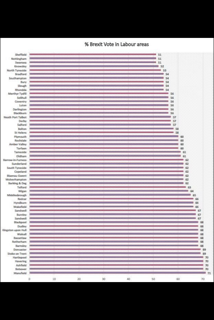
The above are major Labour Constituencies and the % of LEAVE votes: It's overwhelmingly obvious (if the picture is less blurry) that the voters who live in these usual Labour areas don't agree with the pig-headed leadership of the Labour leaders nor with the Establishment or government or other so-called VIP's who run the UK.

The odd thing is the obsession with those in charge with the identity of people and hence how they voted.

And such little regard for understanding the argument WHAT?

Let's start doing this again as a refresher:-
  1. Thousands at 'March for Europe' Brexit protest 
  2. Tony Blair: UK should keep Brexit options open
A lot of people walking and acting and it makes them all feel a lot better to get as big a group doing likewise. But if we look at Tony Blair who was giving a fairly long speech and is someone who should know what he is talking about given his 10yrs as a PM, we can change some conclusions implicit in these protests which are:-
  • The bigger the group does not necessarily mean "more right"
  • The more officious or important the person in political eminence does not necessarily mean "more right", either.
So we can't rely on two obvious things: More people means more right nor more important politicians eg PM choosing what is the right thing to do either.

So those concerned with the result of the referendum may wonder why does merely a few percentage points dictate Brexit to the rest of the 48%? It is indeed a flawed system, but it's also a direct vote not in isolation of the present time of EU Membership but of >40 years of this membership and we can use this information to feed into our decision-making using such as the politicians to illustrate for us:-

We're travelling back in time briefly to 1996 and 1997... the question is: "Does it all sound so familiar?"


The first thing to point out: "We had this Referendum and it's seed was planted in 1997 and it was delayed from happening for the EURO, EU Constitution, Lisbon Treaty and until finally 2016 on grounds that were more favourable to a Remain result via Cameron's timing and propaganda in power play.

Secondly we see the same arguments then as now.

Thirdly, we see that if the UK had really been at the heart of the EU as per Blair he had the mandate to achieve this with his huge support even if he eventually misused such support and the results are the wreakage of the Labour Party today under Corbyn's split with the Blairites.

This is evidenced in the reaction of the then EU leaders to the Labour victory.

We see what happened to the Tory splits after Maastricht now playing some couple of decades in delay in the Labour party due to the EU in part and in part the failure to address solvable problems to progress people - not political union.

I urge any readers to stop listening to the politicians games and the legacy news-media's entertainment industry output and to go and buy a copy of The Great Deception and understand "WHAT?" is the EU? Secondly concerning finding out where "things can be seen and understood" amidst this darkness in our politics:-

We have entered EU purgatory. Exit might mean heaven - or hell


Glow-worm glow in the dark

Saturday, 25 June 2016

Structured Information (Arguments) vs Visible Disintegration (EU Politics)


Network Effect: Graph Theory describing System Risk or Failure: Source/Attribution: http://www.turingfinance.com/computational-model-of-systemic-risk-for-the-banking-industry/


Well the Result did not match the Performance of the campaign and my prediction of a close Remain victory was wrong! What occurred was the choice by many millions that the Referendum provided a great opportunity to vote AGAINST our entire political establishment's own position.

Now I have to say, this inference by so many people shows good common sense. If the deductive arguments are so horribly polluted, then a proxy argument against people who time and time again distort and deceive, is a very fair way of discerning a choice to be made with low information.

Unfortunately, I don't feel that our politics has an underlying positive change from such a result. The Referendum was a "one-off" and little will visibly change after the Leave vote as predicted in FLEXCIT: The Market Solution.

My intention was to pack in the blogging for a time and move on with other things, but it's worth one more post to point out the observation of how people have reacted to the Referendum result.

Let me say that according to my own perception of Performance matching Results, I've been very pacific about either result: Some part of me wants the opportunity to campaign and educate in another Referendum more people more successfully. But another part of me is delighted to see so many people who used such horrible manipulation of communication (were they self-deluded?) to confuse so many people, and for me to see their works of deception destroyed in a big way. Pete North notices this also, particularly the malign effects of "Identity Politics" which have taken pride of place in the BBC's coverage of the past 24HRS+:-


I try to find ways of visualizing ideas, arguments, concepts and the like. If I were to paint a picture on a canvas between what appears so according to the Left/BBC and their "Identity Politics" I would paint a surrealism picture which is showing a lot of imagery in an incoherent but strangely captivating and slightly disturbing form: You can google such pictures if you like. When I look at these, they are powerfully engaging my emotional brain but I don't like them, they don't seem to have any greater ideas behind them (perhaps there's the odd exception I am unaware of?) that connects "function and form" holistically.

And so we see so much wailing and rending of clothes post-Referendum with so much inchoate nonsense spoken. There's two really good examples I watched and show of this:-


 The above presenter in Brussels conflates emotional reaction (you can decode it in her tone of voice change when asked the relevant question) with statements of facts and logical sequence of assertions and their degree of certitude or indeed that abused word in the media "Uncertainty". Secondly and a great example by Richard Starkey of the below:-


"Negative conflation, which is used mainly in attack propaganda, is employing a negative presentation idea to deliver a desirable payload idea. For instance, Stephen Lewandowsky used a negative presentation idea in a subsequently retracted paper, which was that climate skeptics had been scientifically classified as conspiratorial, reactionary and psychologically disturbed individuals. Reconstructing the shattered propaganda syllogism and expressing it explicitly; skeptics are deranged, you’re a skeptic, therefore you’re deranged. The implicit and unexpressed payload idea is of course that the last thing you’d want to be known as is a skeptic."
"Attack propaganda, as its name suggests, is nothing more than aggression against opponents but it also serves the useful purpose of scaring any of your own fellow travellers, who may be having doubts, to stay on side.
When used skilfully, explicit conflation very often goes unnoticed by those on whom it is being practised, but even when they do happen to have vague doubts about the payload idea, it does tend to mute objections, if not suppress them entirely. It takes a strong personality not to hesitate expressing reservations with a subtly conflated idea, which everyone else around you appears to think is obviously a good idea."


We see in the Newsnight debate with Paris Lees an attempt at "negative conflation" but fortunately we have Richard Starkey who is indeed a "strong personality" and he points out problems he has with this "group psychology" form of identity politics above and around the fallacy of arguments on display, veiled by so much hyper-emotional conflation and confusion (and likely as Pointman suggests Conditioning). It ends with Paris Lees attacking Richard Starkey for being "white, male" and apparently "privileged" just after he's pointed out perhaps the major reason why "unprivileged" people voted for Leave: And thus imo successfully answered the question why people in a democracy voted Leave. Thus understanding the situtation, is the first step to helping resolve problems for people! But no, for those conditioned by "Identity Politics" the stimulus of hyper-emtional signals is too big a reward or too big a personal cost to leg go of...

Now coming away from the first picture which is visible, when I trained as an undergraduate scientist, one of the core lessons was to "DEFINE: WHAT?" before working forwards with explanatory value of theories and hypothesis. Indeed the eventual result of the EU I think is fairly certain from extrapolating it's trajectory once this definition is zero-in'd on:-


To me what this allows is a network of arguments around the entire subject to form the visual image I have in my mind of the EU Referendum and Brexit subjects as per the blog's opening .gif image of graph theory showing system risk and failure in banks, to illustrate. This mental imagery is for me infinitely more structured and pleasing than the surreal images of emotion and incongruous confusion that issues forth like a tidal wave from the BBC and politicians. It's why I said before that the "Performance" vs "Results" once skillfully arrived at give a sense of pacific emotion towards the outcomes which are understandable and not confusing at all, but the rational analysis of the performance is where success and failure and detail is found.

Instead what we're witnessing is a lot of emotional people worried on a scale of millions of millions and guess what? This surrealism is manifest in the markets and volatility of currencies! It's self-made with the blame on "a dangerous referendum" and the like being bandied around.

If you look at things, the EU/EZ is in much more severe existential and concrete risk of failure and disintegration of it's over-elaborate political networks and the repercussions these have on the other areas such as economy and hence much further on people's lives. All you had to do was read the 615 pages of The Great Deception to consider that this "network of 28 nations" is at serious risk of failure.

They now expect the UK to trigger Article 50 due to this, but the UK has it's own problems to attend to and the should not trigger Article 50 until the problem has been examined and worked on in anticipation of the EU's own silly 2 year limit on Article 50!


See FLEXCIT: The Market Solution: 3.0 The Negotiating Framework

"Assuming a referendum has been held, culminating  in a victory  for the "leave" campaign, there will be a number of preliminaries that the UK government will have  to  address  before  the  parties  can  even sit  down  at  a  table.  These  are  not incidental to the process, but will define and shape the negotiations and strongly affect their outcome."
And, to compare the "Visible Disintegration" with the above FLEXCIT structured arguments (sanity):-

 The patience of a Saint compared to the madness of the Crowd.


"While they're sweeping up all those chicken heads, we have Flexcit for you: it's all worked out here. Just follow the instructions and you won't go far wrong. Written by hundreds, read by thousands (currently over 80,000), this is the definitive exit plan, as noted by The Register.

There is also the video which helps explain some of the issues, and the short version here.

Over the next hours, weeks and months we are going to be assailed by ill-informed comment in super-tanker quantities, much of it from the BBC whose David Dimbleby referred to Article 50 as "Chapter 50" - reflecting the degree of knowledge and insight in the institution.

In this and other media organisations - and in government itself - there is terrifyingly little knowledge of the workings of the EU, and next to none about how we should extract ourselves from it. Listening to some of the offerings is painful."

Be careful who you allow yourself to listen to!

Finally, Farewell: I hope this blog despite it's many deficiencies has been useful!


Sunday, 12 June 2016

RELATIONSHIP: The Central Point Argument of the EU


Why did the EU SUPRANATIONAL RELATIONSHIP Form?

There's a good summary here from EUReferendum.com: EU Referendum: remember Verdun. In The Great Deception we learn the names of the core, original architects of this idea for "the subordination" of nation states in Europe under a "United States of Europe" Supranational government:-
  • Arthur Salter
  • Jean Monnet
Subordination:
"When these two men first conceived their dream of a "United States of Europe", absolutely central to it was the prospect of setting up an entirely new form of government: One which was "Supra-National", beyond ["above"] the control of national governments , politicians and electorates. Nation states, governments and parliaments could be left in place: But only so that they could gradually become subordinated to a new supranational government which was above them all."
  • Altiero Spinelli
Deception:
"Altiero Spinelli realized that to bring his vision  about, it would be necessary to conceal from the peoples of Europe just what was being done in their name until the process was so advanced that it had become irreversible."
  • Paul Henri-Spaak

Engrenage:
"the most effective way to disguise the project's political purpose was to conceal it behind a pretence that it was concerned only with economic co-operation."
What I'd like to highlight: The reasons as per Verdun were "good intentions" to avoid bad relationships leading to millions of deaths in wars. However the means to achieve this objective, the forms decided upon:-
  • Subordination will lead to an abuse of power.
  • Deception will lead to broken communication between "elites and people".
  • Engrenage priority will lead to putting this Relationship over Reasoned Argument in Policy (for example see Fishing Discards below).
What we can see is the intention is good but the exectuion is negative and it's because of the relationship that was at the heart of the design which itself had to work through negative methods and hence it has become a negative or destructive relationship structure.

The evidence of this Relationship (As IT Relates TO and is Being Related FROM) in action vs the Technical  argument (IT Itself) being subjugated is exemplified in Fisheries evidence:-

Fish, Fisheries = IT ; UK's relationship with the EU and the EU's relationship with the UK = (it) RELATES TO/FROM

To Summarize from Owen Paterson's Fisheries Speech:-

Re-establishing Local and National control of fishing policy will revive our fishing communities and restore our marine environment. 
If anything it has got worse. 

"Eleven years ago I produced an Opposition Green Paper on fishing in which I stated that ‘The Common Fisheries Policy is a biological, environmental, economic and social disaster; it is beyond reform. It is a system that forces fishermen to throw back more fish dead into the sea than they land, it has caused substantial degradation of the marine environment, it has destroyed much of the fishing industry, with compulsory scrapping of modern vessels and has devastated fishing communities’. Despite determined efforts to reform the CFP by the UK Coalition Government, not much has changed. If anything it has got worse. 

The statistics are eye-watering

In 1995, 9,200 British fishing vessels landed 912,000 tons of fish; by 2002 there were 7,003 vessels landing 686,000 tons. That is a 25 per cent decline in just seven years, and meant the loss of on average one fishing vessel per day. A whole crew losing their livelihood each day.In that period landings dropped from over 900,000 to just 627,000 tonnes annually, with a value of only £770 million.  But the real contrast has come with imports. By 2012, by which time there were just 6,406 British fishing vessels at work, UK imports reached 638,410 tonnes, valued at £2.6bn, of which just under a third came from our EU neighbours. To make matters a great deal worse, many of them were caught in British waters."


How did this happen?
 

How did this happen? Politics. Access to fishing grounds has been dominated by political considerations, on the basis of ‘equal access’ to what Brussels called a ‘common resource’. When we joined, fishing fleets from other EU member states were given proportionately a greater share of the fish allocation in UK waters than the British fleet.  This ‘Total Allowable Catch’ was determined annually during a seedy bargaining session in Brussels.  We can’t say we weren’t warned. 

When Britain, Ireland, Norway and Denmark were negotiating to join the Common Market it was realised that 80 per cent of the EEC fish stock would now be in the internationally recognised ‘Exclusive Economic Zones’ of these four new member states. The Norwegian fisheries minister resigned rather than accept the deal, and when given the vote on whether to join, his countrymen sensibly said ‘nei’.

Effect on environment 

Considering this devastating effect on the industry, it’s almost an achievement that the Common Fisheries Policy has also managed to be an absolute ecological failure, too.
To Visualize the different arguments and the effect of this "new" Relationship on Fisheries Policy:-


Why overfishing?

Contrary to there being ‘too many fishermen chasing too few fish’, as the European Commission concluded after studying its own failures, the problem is caused by management in allowing overfishing for political reasons.

In the previous blog, Intermission: How To Argue About European Union Membership Effectively, it was looked at how to argue effectively to a general audience this message about the Central Point of the Argument about the EU as per Roland Smith's EU Referendum: Read The Question! and it needs to be reformulated in simple language that is undeniable: It is a question of Relationship Status of the UK with the EU and the merits of this status compared to a new relationship status such as:-

Explosive poll shows that the public back leaving the EU and remaining in the Single Market ~ Ben Kelly (The Sceptic Isle)


Far from in fact "selling the EEA" for it's "wonderful properties" which the Remain supporters are so desperate to contradict and step over the line into:-
  • Lying
  • Black-Naming & denigrating
  • Manipulating via Authority and Prestige sources
  • Not answering the question ie Mischaracterizing
ERM & Maastricht (Eurozone) "Economic Uncertainty" unleashed by John Major; Iraq War and Mass Immigration "Political Terror" unleashed by Tony Blair. Whether or not you like Nigel Farage the demagogue, he's the creation of both of these former Prime Ministers and their deep deep deceptions over the British people. The Deception is bigger than all the personalities and their declining prestige.

One of the worst mischaracterizations is from David Cameron's Immigration broken promise of <99,999 p.a. promise after his "Cast-Iron Guarantee Referendum" broken promise and then manipulation of the Referendum via his "Special Status" Dominance-Subordination discussions with the EU as Pete North notices: A matter of trusting David Cameron...


There's a simple truth here: The EEA is not about it's "Pros" in the first case and hence it's not about Immigration (The EU Question) either in the first case:-

The EFTA/EEA Transitional Brexit solution is effectively answering the FIRST Question of Political EU Union Membership and removing that FIRST!!!! as perahps both Lost Leonardo A Step Into The Light and The Brexit Door Transition (EEA) Unites Voters, appreciate.

The Three Body Problem of the UK's EU Relationship


Failure of uptake of The Great Deception seems to come about because of a lack of democracy. But only a rise of democracy seems possible to lead to an uptake of The Great Deception and hence determination to trigger the need for The Market Solution.

As much as my colleagues are positive about the recent reactions to the EEA, underneath I think there's this "3 Body Problem" (to nick from science: N > 2, the N-body problem is chaotic).

I think what needs to happen is to create more means and methods for Direct Democracy that by-pass a lot of the current news-media (see Scribblings From Seaham: The ‘pot-mess’ in which the UK now finds itself) and political bubble of SW1/Westminster politics (see ME Synon: How Cameron and the Commons will overturn a Leave vote) with more public <-> public (Mr. Brexit) debate and discussion generation.

This Referendum is a real result of this, any potential outcome Remain or Leave I think will be due more to "chaotic" factors!


"Booker – like many observers - is getting increasingly fed up of what he calls "this claustrophobic referendum campaign". He is by no means alone.

Lord Ashcroft's focus groups are reporting increasing frustration, where many people's perplexity over the decision at hand is turning not into enlightenment but exasperation. Among the many words people used to describe the contest so far ("unreliable", "unrealistic", "uninformative", "not that interesting", "unnecessary", "a quagmire", "a lot of bullsh*t"), by far the most common was "confusing"."

Booker rightly observes that a "1-Body Problem" is very very very simple to answer for people (UK Unleashed) as opposed to this "3-Body Complexity" issue due to a lack of Direct Democracy operating in our politics. And that is the Central Point of the Argument: EU Political Relationship. The seeming obvious fact that all the most praised Remain positives of this Relationship are the UK's current "Opt-Outs" is or should be a minor epiphany of the poor logic of this relationship.

Thursday, 9 June 2016

Intermission: How To Argue About European Union Membership Effectively

Planet of The Apes: An exemplar of a time and place shift in the meaning behind the story from the audiences' expectations and understanding until this final frame.

In this blog I've deployed a couple of devices frequently:-
  • Uses sets of 3's (people generally manage up to this number)
  • Using an alternative subject to lead into the political subject of the blog
  • Frequently using a non-linear association of themes and topics; effectively providing information in a form for curiosity building (attempt at).
  • The title above refers to "effectively", which is just how such titles are written and hence expected...
I don't have the discipline nor knowledge depth on a lot of the subjects to produce the high quality of other bloggers. But I think it is possible to be able to use "Thinking Tools" to help people consider the subjects more effectively and that's what I've mostly attempted to do, most of the time.

This blog, is going to carry on this "method" about "arguing about the EU with people effectively". But it will also build on the previous sequence of blogs I've been building recently:-
  1. Decription
  2. Explanation
  3. Argument
  4. Perception
  5. Which Argument? Relationships (subjective orders of intentionality) or Technical (The plethora of regulations and standards that can be objectively studied)
  6. Using effective argument via story structure to a general audience.
  7. Using an exemplar of 5. (next blog after this intermission).
Ok, the above is a final scene from The Planet Of The Apes, and it is a bit more dismal than intended, but it's also very iconic as well as an optimal fit to explaining 6. above:-

A very different time, a very different place and a very different reflection of people - than previously believed.

In the story of The Planet Of The Apes, some spacemen blast off into space and something wrong happens. They then find themselves crash landing on a mysterious alien planet, ruled by Apes who are developing their own civilization. Anyway after some adventures, in which the main protagonist believes the apes are still very savage animals despite their apparent mockery in emulating humans such as riding horses and wearing clothes; he stumbles across the above beach and a realization overwhelms him: The alien planet is in fact Earth and what has happened is that the spacemen have travelled in space and arrived back in the future many many years later. What the Statue of Liberty represents is that humans obviously suffered a thermo-nuclear war or holocaust and set back their civilization by millenia in which time apes had evolved separately and started to assume the civilized role on the planet with humans reverting to the more "savage and primitive species" after their fall from grace.

Now that's a fascinating bit of sci-fi, but the structure of the story that witholds this crucial information while subjectively we believe the "good" protagonist, Charlton Heston's character is right about the Apes: They're the cruel savages, not the poor humans! And then "Bam!" that story is turned upside down.

So it is with describing the EU then explaining it then arguing about it BEFORE you've even got to the stage concerning Brexit.

Instead most people are stuck in the mindset of the character of Charlton Heston, they can ONLY go on their own standards and what they see and hear all the while befuddled by the politicians and news-media's output. And hence if you are familiar with the two different versions of the EU story, the "External" out in the Open one and the "Internal" underground one you can tell which story is being told by people: The mirage vs the one based on research and factual historic findings ie the real reality.

For example some of the "savage things the Apes talk about":-
  • German Cars!
  • The EU will kick out Ex-Pats if we leave!
  • 350m£ cost of EU!
  • Immigration is the only real reason to leave!

 A good place to start: Knowledge of the beginning of the story is needed to make sense of the middle of the story then the end of the story.

So, here's my recommendation: All this is the stage where people are attempting to arguing about Brexit (remain or leave) and little do they realize that it's like they have been given some frames of a few seconds from a film/story that is well over 4 hours in length and those frames are perhaps in the middle of the film jumbled up!

You're going to "fill in the gaps" in the story relying only on what you already think you've seen and heard and hence accorded with what you'd prefer to think the story ends like (most likely according to your own personal temperament!)!

What people really need is a beginning and then a middle and then an end to the story and then give that overview to them, then let them talk about their "memes" above and insert those frames in the right portion of the story and hence add the relevant context which then changes those memes meanings and may then finally help people perceive things more clearly...

In fact I've been doing this and people struggle but they are mightily curious like solving a puzzle or working out more and more of this increasingly interesting story. They'll still put up resistance to the "Charlton Heston Moment" however!!! ie changing their minds!!! But that takes a lot more time: It's emotionally impactful arrival.

But what I've found incredibly useful is to position beginning at the beginning with the story and most if not all of that knowledge I've found in The Great Deception. Often if a listener asks a question, it's necessary to "rewind" to somewhere within The Great Deception "His-Story" point out the genesis, invariably a political motivation concealed (hence deception in the title) and then "fastforward" to the present "meme" frame and re-explain how it fits into the story, bearing in mind the listener little realizes they're still on the side of the humans (the propaganda version of events) and think the apes are savages (the actual context). For example people who say the UK is too overcrowded and immigration must come down or be stopped, it's very tricky to tell people how Migration fits into the story in it's correct connected and coherent place, first some backtracking then some explanation of the middle of the story which means that in fact the solution is to "park" Freedom of Movement as it's only a component of the full composite of Migration! But you can start improving that by voting Leave at least.


Finally for a decision that is supposed to shape the next 10yrs of our political lives, very little thought and commentary has been given to the "ending" of our story namely Globalization. And if you can manage to talk about the Middle (FLEXCIT) and steer people towards reframing from EU (Political Relationship error) towards Globalization (the technical revolution above the EU) and then I think it is possible to provide people with a puzzle where they can start to work it out more and more for themselves and feel satisfaction at doing so instead of the confusion of butting heads with those that disagree with them over those memes (stuck in the middle arguments).

The 3 components of Knowledge to bread it down (or in story form: Beginning-Middle-End):-
  • The Great Deception
  • FLEXCIT: The Market Solution
  • Globalization of Technical Regulations and Standards (we don't seem to have a fancy name for this yet!!)
If you are going to be able to argue effectively and recreate the story for people to learn from you have to possess the knowledge from these. You'll find great interest in the history The Great Deception, you'll find a lot of resistance in FLEXCIT (the present because people don't realize they're merely actors within a larger film itself measured by variable time frames (eg General Elections 5yrs, EU Treaties 9.x Years av., generational change in decades) and then you'll find a huge amount of bafflement about the "ending" but providing people with this alternative and "what might happen in the next bit of the film"... it is helpful to resolving being stuck in the middle part of the film (this referendum).

I'm very convinced this is the useful way to argue, for a number of reasons:-

  1. I've successfully used it and observed the reception and reactions of people using these materials (mainly from EUReferendum.com , The Leave Alliance, The Blogger's Army (see side-bar)). Hence I can report on whether or not it works and in what way it does work and gauge some measure of that all important "Emotional Digestion" in people.
  2. I compare it to what is churned out on TV and in Books and otherwise, for example:-
 Challenging To Use: Mostly Unstructured and Semi-Structured Information

 Disconnected and extremely variable quality of information mixing in high proportions of misinformation


 Tim Martin (Wetherspoons EU Referendum Special Magazine): Sources Politicians rhetorical arguments with low structure of information and often poor research of details. Martin's is usefully around The Central Point Argument of the EU Membership Question but could be much more powerful structured as I've suggested above.

Once you have this "full story structure" from research in place, you can see that the means and methods and mediums of information of politics delivery to people in the UK is incredibly "primitive" (Planet of the Apes reference!) for the purpose it's set out to produce: Informing and educating and enhancing national democratic debate and argument to reach national decision-making on the past 40+ yrs with a view to at least the next 10yrs for the UK's Membership of the EU or it's alternative in an increasingly globalized and changing world.

Pete North is worried about where democracy will go if we vote Remain: What scares me most if we vote remain.

It's merely a symptom of the poor ways in which the UK carries out it's so-called systems of democracy and hence the poor results that are more likely to follow or by chance sometimes not! Correcting how we go about doing democracy may help. Assuming the same old channels of communication work or are adequate may be a barrier to more political progress that itself may open up more progress in other areas?

 A Map Argument (or decision-tree flow argument): One of my previous attempts to structured information. "Story Structure" in this blog is another attempt for use in verbal arguments to coordinate WHERE/WHEN/WHY which need to precede HOW in peoples' understanding of the story and that leads to eveeeeerybodies' favourite in politics as evidenced on tv and radio talking-heads: WHO (the least important perhaps?)

I have not checked, but The Great Deception is ripe for Radio Serialization with a story structure and mild editing to ensure it's read at a brisk pace, which matches modern audiences' current "More Salt!!!" taste buds in how they prefer their information to taste!!

Why so so many so-called "experts" on this subject fail to mention it and begin the story at the beginning... or even appreciate the full range of Brexit papers categorization in the middle let alone that "Globalization" future. For 40+ years the public has listened to their attempts at politics on the EU and it's been mostly a complete waste of the UK's potential capacities for collective action and energy.

Perhaps one of the biggest arguments against political elites in charge of large decision-making exclusive of people: The history of the UK's Membership of the EU.
 

Wednesday, 11 May 2016

EU History: Destructive Emotions & Creative Thinking

Fire and Ice ~ By Robert Frost

"Some say the world will end in fire,

Some say in ice.

From what I’ve tasted of desire

I hold with those who favour fire.

But if it had to perish twice,

I think I know enough of hate

To say that for destruction ice

Is also great

And would suffice." 

The above poem is not only a nice poem but as with good poems it condenses the core elements of the content as much as possible, in this case the musings on "destructive emotions that shape the consequential external destruction invoked". In this spirit, it's also referred to by George R.R. Martin in his series of fantasy epic: A Song Of Fire And Ice and acts as the complete canvas to all the micro and macro dramas in that "tapestry"; involving multiple warring factions which itself is loosely based in historic events of The War Of The Roses (and other such conflicts fictional or historic):-

Attribution: By Richard Burchett (1815–75)[1] - File:Richard Burchett - Sanctuary (1867).jpg, Public Domain, https://commons.wikimedia.org/w/index.php?curid=12626198

"The Wars of the Roses was a series of wars for control of the throne of England. They were fought between supporters of two rival branches of the royal House of Plantagenet, the Houses of Lancaster and York. They were fought in several sporadic episodes between 1455 and 1487, although there was related fighting before and after this period. The conflict resulted from social and financial troubles that followed the Hundred Years' War, combined with the mental infirmity and weak rule of Henry VI, which revived interest in Richard, Duke of York's claim to the throne."

Here was a war for control of the Throne of England. Subsequently power itself was fought over in The English Civil War:-

Attribution: By Unknown - Encyclopædia Britannica online, Public Domain, https://commons.wikimedia.org/w/index.php?curid=8631860
"The English Civil War (1642–1651) was a series of armed conflicts and political machinations between Parliamentarians ("Roundheads") and Royalists ("Cavaliers") over, principally, the manner of its government. The first (1642–46) and second (1648–49) wars pitted the supporters of King Charles I against the supporters of the Long Parliament, while the third (1649–51) saw fighting between supporters of King Charles II and supporters of the Rump Parliament. The war ended with the Parliamentarian victory at the Battle of Worcester on 3 September 1651."
Here was a conflict between two factions: The Throne and the emerging power of Parliament itself.

Before moving onto the third and final "conflict" in this series on "Conflicts of Power by Internal Forces" centred on Political Power in our history, we need to take a view of another history neighbouring, a "Conflict of Power Amongst External Forces": Two relatively recent blog posts on this subject by Dr. RAE North at EUReferendum.com and in connection with the recent Introduction by Christopher Booker to FLEXCIT: The Movie:-


They are, how to express how essential these two summaries from The Great Deception, essential to understanding the genesis of forces acting on the Remain side of the question in the upcoming EU Referendum Question and as I asserted in the previous blog, any derivative motivations and intentions of the modern descendants or inheritors of this strand of feeling and thinking in how to "manage power":-
"What was especially interesting, though, is that Juncker and Cameron are pictured visiting a First World War cemetery on the Somme, despite the official hagiography of the EU firmly rooting its genesis in the post-WWII period.

In fact, the First World War was far more important to the intellectual genesis of the EU than the Second, something that Booker and I observed in The Great Deception (see p.14 et seq).

So vital is it that we start Chapter One with an account of how, on 22 September 1984, two portly middle-aged men stood holding hands in front of the largest pile of human bones in Europe. One was the President of France, François Mitterrand; the other the Chancellor of Germany, Helmut Kohl.

The reason why the two most powerful political leaders in western Europe were staging an act of reconciliation before tens of thousands of graves was that the site of this ceremony was the ossuary at Douaumont, just outside Verdun in eastern France.

And if there was one historical event which more than any other inspired what was eventually to become the European Union, it was the battle which had raged around Verdun the First World War. For the British the defining battle of that war was the Somme in the summer of 1916."
The Great Deception (2nd Edition Link)


And again in the subsequent blog but with a view not to the past (World War I) but to the future (World War III):-

"With Mr Cameron claiming on this of all days, "Europe Day", that leaving the EU would bring us closer to war, all he is actually doing is repeating the most insidious myth of them all in relation to the European Union - that this monstrous construct has helped keep the peace.

The myth finds is purest form in the EU hagiography, where the European Commission's asserts that "probably very few people in Europe know that on 9 May 1950 the first move was made towards the creation of what is now known as the European Union".

Crucially, it would have us believe that this was an attempt at preventing a Third World War, but completely omits to tell us that the intellectual genesis lies not in the post-WWII period but in the 1920s, devised is response to the problems arising out of the First World War.

For the myth-makers, though, the origin of the EU was Paris on 9 May 1950. Against the background of the threat of a Third World War engulfing the whole of Europe, the then French Foreign Minister Robert Schuman (pictured above, right, with Jean Monnet) read to the international press a declaration calling France, Germany and other European countries to pool their coal and steel production as "the first concrete foundation of a European federation". 
This was what was on offer was the creation of a supranational European Institution, charged with the management of the coal and steel industry, the very sector which was, at that time, the basis of all military power. The countries which Schuman called upon had almost destroyed each other "in a dreadful conflict which had left after it a sense of material and moral desolation". Thus, concludes the European Commission in its own history, "Everything... began that day".

Needless to say, the reality is very different. Far from the heroic Schuman standing at the centre of the "project", he turns out to be little more than an unwitting stooge, manipulated by one man who had made its his life's work to set up a "government for Europe"."
That man was Jean Monnet.

FLEXCIT THE MOVIE Intro by Christopher Booker. ~ Linking both sides of the argument and pointing out the difference between quality arguments and "destructive low quality emotions" that dominate the Referendum today.

What we see is that the widely held belief about the EU is itself a Myth taking the form of a "Creation Story" and that story is not factually/historically accurate, even if it's hyper-emotional. Far from seeing the genesis of obsolescence alone, we see the seeds of destructive emotion where perhaps "we least expect it" and indeed the European Union does not appear to have developed as perhaps so many in power set the peoples' expectations for it towards, only 10 or 15 years ago?

The "Creation Story" is very important, to forging an "origin of legitimacy for political union and power". Ultimately (that means eventually on this preset course!) however this requires a formation of an established "Demos" of some form as acknowledged perhaps under International Law? Indeed much of this is the thinking behind those who still support the further Political Union of the EU:-


So you see, the assertion in the previous blog for both sides of the argument, despite my personal support of one over the other, I think is still highly applicable, irrespective of my own opinions, the arguments themselves must be asserted.

And here is indeed where and why I part ways with the EU Remain side: Those destructive emotions we see in our histories and in our stories ultimately find their most potent form when the consolidate and centralized around power instead of dispersing or controlling that power or "kratos" as per The Harrogate Agenda:-


To be clear I'm not pitting the forces of "Good" on one side vs the forces of "Evil" on the other side. For some European Nations the EU may indeed under The Fundamental Law above be a very necessary next step for many possible reasons.

However, coming back to the UK, and those historic "Internal Conflicts" over the source and control of political power:-
  • The War Of The Roses (Throne vs Throne)
  • The English Civil War (Throne vs Parliament)
  • EU Referendum (Parliament vs People)
In my view, the modern equivalent of those previous power conflicts is fortunately not a battle involving either guns or steel but ideas as is possible when democracy establishes itself in a nation and the idea of war recedes as a destructive way to resolve problems rather than the creative solutions people can generate through argumentation and analysis and communication tools:-

If we take another model of understanding and apply it to this posited idea:-


What we see is that the basic necessities of life are much to are "First World Problems" chagrin catered for and we run up against another layer of problems. In fact "Safety" is a basic expectation of our own government and social contract with the state. But it is a basic "need" and one that I'm sure the UK is predominantly in control of. Yet the government failing at delivering "higher needs" inevitably overplay's it's hand concerning how valuable it is and indeed how valuable the EU is, doubly so given it's own "Creation Story" in this area. And so so much of the debate is bogged down via lower quality arguments and lower order needs without a positive argument that reaches towards more productive and creative and growth generating solutions:-
What we see from FLEXCIT is those higher order forms of actualization and self-expression by people:-


I'd finish this overview of history and the "Remain" side of the question, by suggesting for the UK, clinging to "security and safety" is the least or minimum of our aspirations for progress. And driving that "expectation setting" is our own Parliament and politicians who in my opinion more than anyone appear to be holding back the UK's ability at creative thinking to solve our modern and very global problems.