A tree in May: Life, light and colour: So much to see and so much to do outside.
I think perhaps for those that live in the UK Islands, this time of year, May, is a time of natural exuberance and one that our modern life schedules fails it seems to fully factor into with the change of the season. I remember one of my previous office jobs and watching some tree-surgeons tree-climbing and chopping back the branches of the trees away from the office buildings, outside. At this time of year I really enjoy being outside and indeed I've been doing just this for the past week: Working on renovating a property and it's land and working in the evenings managing a Summer sport. I've also managed to enjoy so much of the natural world from plants such as bluebells and somuch more to insects to myriad and highly visible and audible birds and finally to foxes and their cubs.
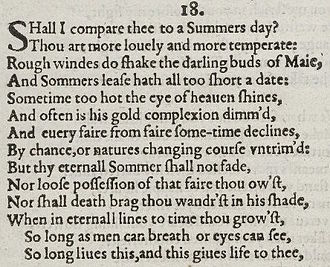
William Shakespeare's Sonnet 18 in particular the phrase:-
"The Darling Buds Of May"(darling or "to darl" either is as good as the other!)
By William Shakespeare - http://luna.folger.edu/luna/servlet/s/by2g21, CC BY-SA 4.0, https://commons.wikimedia.org/w/index.php?curid=47881412
Captures much of what I've barely tried to describe in observation above but with more mood and fewer words! In fact at this time of year I feel my behaviour is in need of significant alterations:-
Two Jackdaws collecting horse hair to use to line their nest with.
I'll definitely put out some collected horse hair next year along with any bird food, realizing the value to these animals of such a material at this time of year. As such, the EU Referendum subject has felt more remote than it has been for me for a long time. That said, given the huge efforts made for The Leave Alliance Launch and FLEXCIT - The Movie filming, the ideas and content discussed at these meetings are very vivid and fresh in my mind while I'm about other things. In fact so much so, what amounts to "news" in the Legacy News-Media feels like an anthropological documentary of some kind where the strange and bizarre customs of the natives is observed in bafflement but nonetheless recorded for science... It's mainly the ever more perverse behaviour of our politicians as they go about their roles in the same way as if the Referendum were no different to any general election and they can come out with their lies and low quality arguments and hence low value to our society. There's plently of discussion on this and observation and description of it by "The Blogger's Army" in support of The Leave Alliance:-
I still manage when not able to blog and develop ideas on the EU Referendum to read most if not all of the above sources. In fact, looking at the fact there's a small but steadily emerging movement, despite the risible politics of the UK made even more visible in this EU Referendum:-
The burnt remains of the Establishment controlling both "Remain" and "Leave" sides of the EU Referendum
In the previous blogs, Expectation Setting: The Key To Winning The Referendum we've looked at a critical measure of Brexit arguments right from their genesis and where they fall on the "Uncertainty Spectrum" regarding their possibility for implementation. This applies to both sides of the argument as per Our Once And Future Sovereignty. It should be noted that arguments now are shaped by probability later and where this is taken advantage of is by our ruling class of politicians on both sides of the argument: Große Lüge - The Big Lie of Magic Money.
The Key Criteria to Positive Expectation Setting and Good Communication
This sets our expectations, The Leave Alliance: A Choice With A Plan, the journey our nation agrees to travel along and the destination set. And this depends on everyone having a clear idea of what the rules are, Our Once And Future Sovereignty, and hence what agreements are possible and what the consequences will be and by whom, Our Once And Future Sovereignty, and where those agreements either way will lead to; again this applies as much to Remain as Leave as per EU: From Common Market To EU Constitution. Which if we accept the rules of our present relationship with the EU, as commandeered by our politicians, which is evident in analysing their type of communication with us, Decrypting: What is Babel-17? and which also allows us to probe for what they don't want to communicate to us as per The Columbo Method: Norway; remember Nip a hidden act that damages the community. Then we have to decide: Why? Living Someone Else's Dream or do the hard work and choose our own.
Watching the amusing Little Britain clip above reminds me of the last few decades of the Leave Campaigns dominated by the "eurosceptic aristocracy": Too self-important, too comfortable, too lazy, too well-off to really care about more than the appearance of wanting to forge a future vision, The Leave Alliance: Our Vision: I've had the opportunity to consider the arguments and done the necessary "home-work". With that there's a temptation to become arrogant when you look at just how low in quality the prevailing substitution arguments are; the more prestigious such as John Major or David Cameron, the more the emotion of "disgust" bubbles up. For the general public, struggling to navigate and help themselves understand the arguments, it looks like as previously: Argumentum Ad Infinitum:-
Ant Mills: Infinite loop: Going nowhere
Capturing some of these arguments and this behaviour can be done using online commenting systems such as Reddit uses, which is much more useful than most commentating systems to visibly follow a trail of arguments. Given the latest fashion on Canada FTA as per The Lady In Mouve! from Vote Leave and Boris Johnson, here's a Argument Ant Mill in Action:-
Promisingly Vote Leave's Canada FTA is being seen for what it is: A title and an ending and nothing in between. Amazingly when described as such so simply that so many in the media and politics take it so serious: "The Lady In Mouve! ... The End!" is about as substantial as it gets. But then the people who talk about it such as Boris Johnson get a free pass in the media according to their Prestige:-
Power is being able to talk and be listened to
What is damaging however is where this provides opportunity for smothering productive communication:-
Which Criteria is most effective for people to use to aid their decision-making?
It comes back to the basic proposition, that if the UK were not a member, how many would actually vote to join it? See Norway. Coming to Iceland:-
Sir: In his Notes on 5
March, Charles Moore tells the story of a visit by Sir Winston
Churchill to the Icelandic Parliament, Althingi. Mr Moore says:
Churchill
famously irritated its members by the first half of his sentence and
gratified them with the second half: ‘I come from the mother of
parliaments [pause] to the grandmother of parliaments.'
A
good line, but one that was delivered not by Churchill but by Lord
Newton, who was sent to help the Althingi celebrate its 1,000-year
anniversary in 1930.
Incidentally, our first laws
were spoken rather than written, so the presiding officer had to recite
them when parliament met. This is the origin of the phrase ‘Mr Speaker'.
Björn Bjarnason Kvoslaekur, Iceland
The Althingi is one of the oldest extant parliamentary institutions in the world.Its establishment, as an outdoor assembly or thing held on the plains of Þingvellir ("Thing Fields") from about the year 930 AD,laid the foundation for an independent national existence in Iceland. To begin with, the Althing was a general assembly of the Icelandic Commonwealth, where the country’s most powerful Leaders (goðar) met to decide on legislation and dispense justice.
Then, all free men could attend the assemblies, which were usually the
main social event of the year and drew large crowds of farmers and their
families, parties involved in legal disputes, traders, craftsmen,
storytellers and travellers. Those attending the assembly dwelt in
temporary camps (búðir) during the session. The centre of the gathering was the Lögberg, or Law Rock, a rocky outcrop on which the Lawspeaker (lögsögumaður)
took his seat as the presiding official of the assembly. His
responsibilities included reciting aloud the laws in effect at the time.
It was his duty to proclaim the procedural law of Althing to those
attending the assembly each year.
The basis of the Norwegian society is democracy. Norway has come to
learn how self-governance is the wise foundation of our decentralized,
elongated and scarcely populated country. As a sovereign nation, Norway
can cooperate and trade with other nations.
The Norwegian population has twice voted no to membership of The European Union. Referendums where held both in 1972 and in 1994
. No to the EU
strives to ensure a truly influential democracy, where important decisions are made with an effective democratic control.
No to the EU aims at being a widespread and diverse people’s movement. No to the EU has its own youth organization
(
Ungdom mot EU
)
and student organization
(Studenter mot EU)
.
Policy of the
Nei til EU
:
No to the EU
wants to ensure democracy and Norwegian sovereignty.
No to the EU
wants to ensure a continued Norwegian independence in international politics.
No to the EU
strives for fairness and equality in international trade and
cooperationllaboration, and urges Norway to play an active role on the
global arena in obtaining and ensuring such qualities.
No to the EU
strives for Norwegian natural resources to be administrated by Norwegian authorities and institutions.
No to the EU
promotes a broad international cooperationllaboration, not restricted by the boarders of Europe.
No to the EU
is engaged in women politics and information tasks promoting gender equality.
The parliament in its present form was first constituted at Eidsvoll in 1814, although its origins can be traced back as early as the 9th century to the allting, a type of thing, or common assembly of free men in Germanic societies that would gather at a place called a thingstead and were presided by lawspeakers. The alltings were where legal and political matters were discussed.
Switzerland
Direct (Real) Democracy in Switzerland
In Switzerland, Direct Democracy has a long tradition:
The origins of Direct Democracy can be traced back to the late
the middle ages: archaic forms (assemblies of the electorate discussing
and deciding major political issues) have been practised
in part of the country since the founding of the
Old Swiss Confederacy
in 1291.
The origins of Switzerland's modern system of Direct Democracy
with formalized opinion polls and frequent
referendums
lie in the experimental phase of democracy in the 19th century
when Switzerland was surrounded by monarchies on the European continent
that showed little to none enthusiasm for democracy.
"The
premise on which our movement is based is that democracy means "people
power". The word democracy stems from the Greek word, dēmokratía, comprising two parts: dêmos "people" and kratos "power". Without a demos, there is no democracy. But people without power is not democracy either.
Our current system of government is known as "representative democracy".
That phrase is a misuse of the word democracy. People do not hold
power: that system cannot by definition be a democracy. We seek to
return power to the people. We are concerned with power – who holds it
and under what circumstances and controls, and how to get more of it.
Above all else, we hold to the core principle that in a true democracy
the people must hold the power.
Our objective is to recover power. Our focus is on the acquisition of
power. And once we ourselves, the people, hold the power, we can then
attend to the many problems and injustices that plague modern society.
But without power, there is only protest – and we achieve nothing of any
lasting value. To help us acquire power, we are adopting the original
strategy of the Chartists. Like them, we felt it was vital to frame a
very limited number of achievable demands – six in number. These are
listed below"
Politicians use maechavellian phrases: "Save The Children!" and then over-spend on other areas and not Education Policy... This is the legacy of their communication to people
We do have the BBC: Reality Check: The EU referendum and they're evidently trying to provide lots of information. But it's unstructured, lists that quickly fatigue the brain even if via high-sharing it's connecting "consumers" at high volume: It's still "low-sense-making". A more productive way to make sense and communicate knowledge more effectively:-
BBC: High-Sharing, Low Sense-Making
Looking at the above Nations: Iceland, Norway and Switzerland, it's interesting to consider their own political histories and modes of communication to effect a community and hence to derive decisions and learn from the consequences of those decisions:-
Most people have heard Clay Shirky’s
quote that, “It’s not information overload, it’s filter failure.” The
professor and author has coined terms such as ‘cognitive surplus’ to
explain that we have the mental capacity to do a lot more with our
collective intelligence, but too often, societal barriers inhibit us. We
are too busy with the day-to-day commute, usually in a deluge of noise
from radios, billboards, and news sources, to reflect and consider
bigger issues. Getting paid every two weeks focuses employee attention
on the short term, as do quarterly reports for executives. Filter failure is only part of our challenge to make sense of our
world. Even with good information filters in place, we remain passive
consumers of information. We can share our filtered information, which
many do on social media or over a coffee, but what value are we adding
to it? It takes more time and effort to take our filtered information
and make sense of it. Shirky, once again, says that “Curation solves the
problem of filter failure”. I would say that curation adds a layer of
value, but is still not enough.