Red Cliffs Of Dawlish

Red Cliffs Of Dawlish
Showing posts with label Dilbert. Show all posts

Monday, 21 March 2016

Expectation Setting: The Key To Winning The Referendum

What is the key to opening that D.O.R (Debunk, Offer, Reassure)?

The winning condition for the referendum is a >51% of the vote verdict for either Remain or Leave.

 The most visible argument against firstly holding a referendum as well as against the Leave choice has been determined as "Uncertainty". When this term is employed we should appreciate it's meaning more specifically:-


High Uncertainty = High number of uncontrolled outcomes leads to a decision to avoid increased risks occurring

  • Probably = A High Chance of an event happening.
  • Improbable = A Low Chance of an event happening.
  • Increasing the number of possible outcomes = Increase Uncertainty concerning the specific or intended or desired event
  • Decreasing the number of possible outcomes = Decreasing Uncertainty concerning the specific or intended or desired event.
Uncertainty has a lot of derivatives:-
  • X "Could" Happen where X is usually considered unplanned and/or unwanted.
  • "A Leap Into The Dark"
  • The EU has problems but it's not worth the risk.
  • No one knows what Brexit/Leave would look like.
  • Econometric/economic modelling outputs "Bad for the economy" results
  • Lack of focus on the rules of withdrawal (Article 50) lead to multiples of "order of intentionality" involving retribution or moral blackmail
And the list goes on and on.

If we use this simple principle of reducing and minimizing uncertainty and removing economic issues from political issues then any Brexit plan which does not meet this condition is a non-starter from two perspectives:-

  1. Ad Hoc: Perception of High Uncertainty = Very low probability = Bad Decision
  2. Post Hoc: Practical Proof that such a decision would be highly risky and highly damaging to the economy is a risk not worth taking
  3. Together the decision is very clear: Hence all of WTO, FTA, Customs Deal, Bi-Laterals as Brexit categories are unworkable on EU Withdrawal.
Whereas minimizing the number of outcomes towards:-

BREXIT (British Exit) = "Withdrawal from EU Treaties (via Article 50) - only."

Here the definition of LEAVE is a political status transition only which minimizes outcomes from the day before to the day after the Referendum. This is the genesis for the iterative method of withdrawal that The Market Solution adopts:-


The Market Solution is making the actual alternative much clearer. Aligned with reducing uncertainty through the increase in probability of possible implementation by reducing the number of outcomes from withdrawing from EU Treaties in the short-term.

Here with high certainty interesting repercussions on perception occur:-
  • Ad Hoc: People are more confident of what Leave looks like and it tackles the question and problem of Political Union directly focused; reassuring many variable voices of specific interest over their own particular area of outcome interest.
  • Post Hoc: It is bona fide do-able because Norway and other EFTA/EEA nations already do it including Lichtenstein and Iceland. There is no argument that it is not possible: It is Possible and Probable.

At EU Referendum: Leave Alliance launch, one of the speakers, the director of the Futurus think tank Anthony Scolefield made a very interesting comment; and background to the subject of this blog at Will It Be A Fudged Referendum? :-

"I have pointed out repeatedly reference the Scottish referendum that even if that referendum had won a majority ,that would not mean that Scotland would become independent and certainly not on the Nationalist prospectus."
 

"We also; Blair nearly had a referendum on the EURO where Robert Worcester of MORI and Ken Clarke advised Blair to go for an enabling referendum as a detailed referendum question would be hard to win."
 

Now Michael Portillo said last week that:-

''by the way a majority for Leave (which is what he expects) does not mean the UK leaves'.

He expects Johnson to come in and say he is 'the most brilliant negotiator and try to renegotiate things.'

In the above link we see that when Switzerland held it's own Referendum on whether or not to join the EEA, the government was very responsible to its people and provided a lot of facts and set out the categorical problems comprehensively allowing the people a free hand in how they chose to vote; which contrasts with the above so demonstrably in quality or lack of it from our own UK Government for decades.

What we can compare between the two is:-

EXPECTATION SETTING:-

If we have a very very clear Brexit plan chosen by the Leave side, effectively The Market Solution, we have a very clear basis for expectation setting for our own government's actions should the result in a fair and informative Referendum declare a Leave result >51% of the vote. It would be clear that with such a well-thought out plan that reduces number of outcomes from a singular Referendum decision as much as possible and focuses on a Political transition of status from:-
  • EU/EEA or EZ/EEA = Remain.
  • EFTA/EEA = Leave.
Where the EU has been by it's won rules, set our membership expectations of "Ever Closer Union" from the EU to the EZ (see above) compared to our expectations not to follow this route but to build a genuine single market via EFTA, then we give our clear expectation of what we want our government to achieve for us: The People manage their own government instead of the reverse which has become the norm:-

"Managing your manager": The Key To Setting S.M.A.R.T.E.R. Expectations!

The argument to put to the Leave supporters is simple: You support the Brexit plan that sets the most confident Expectation Setting which is The Market Solution (see probability scale diagram above).

The alternatives are also quite simple to define, effectively. For Leave Voters who want to "Control Our Borders" above all else:-

GO/UKIP/Leave.EU: Delayed Gratification: You have one marshmallow now or two if you can wait a few minutes.

Except in this Referendum, The Market Solution: Stage Two - Free movement, immigration and asylum, you won't even get "1" marshmallow if you cannot "delay gratification". I sympathise, but above all I believe that Migration Policy should have a very strong democratic input into it to arbitrate management of this policy closer to the people's choices. It's about democracy for me and that means withdrawing from EU Treaties first! Then implementing the effects of that decision over time.

As for the "EU Reform" position of Vote Leave: We've already seen that unless we set clear expectations, The Market Solution: Stage 1 - Leaving the EU for how we demand our government acts and does not break it's "oaths of office" then we leave room for them to deceive us for them to make election pledges that they never had any intention of keeping, as per:-


 Vote Leave: Same old politicians, same old con-artists

The Key is intellligent and honest EXPECTATION SETTING if we are to demand more democracy and open that DOR (more choice) we must ensure it is SMARTER and then it become a simple choice of trusting the people over the politicians in how we self-govern the UK towards stronger decision-making and indeed such political foundations reduce/remove "uncertainty" most effectively:-



Friday, 12 February 2016

The Root Of All Uncertainty

The Uncertainty Precept: Start with the right question(s).

Quoting Wikipedia once again on the "Uncertainty Principle" (must donate!):-
In quantum mechanics, the uncertainty principle, also known as Heisenberg's uncertainty principle, is any of a variety of mathematical inequalities asserting a fundamental limit to the precision with which certain pairs of physical properties of a particle, known as complementary variables, such as position x and momentum p, can be known simultaneously.
So "uncertainty" is in-built it seems into the very nature of the realistic universe! Or to adapt it for a more "relate-able" misuse:-


And this is indeed a hilarious transposition of "uncertainty" when we also find the same "joke"as noted by Mr. Brexit:-


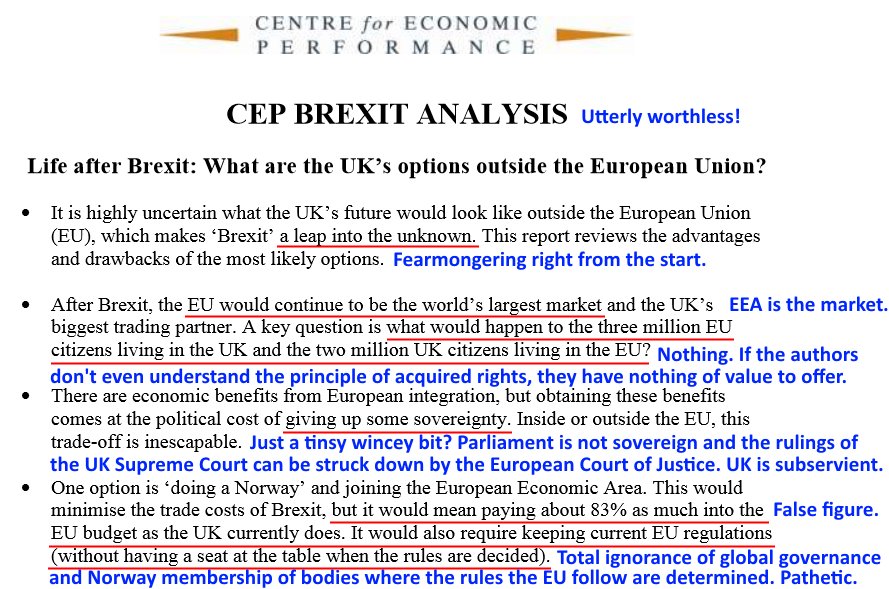
CEP: "You Just Made That Up."

Interestingly enough we can actually take what Dilbert says above and apply it to the CEP "analysis" above:

"If you understand a project you won't know it's cost, and vica versa." ~ Dilbert


Effectively to para-phrase: "because we don't understand the project (Brexit)" we therefore DO understand it's costs: They're "ginormous"!! The Project Uncertainty Principle, in action.

This is attributed to "uncertainty". So how do we reduce/remove uncertainty?


What does "uncertainty" look like = Bad Decision-Making ; What is at the root of uncertainty = Not asking the right questions aka 1. DEFINE THE PROBLEM

Once we use such a framework it should be noted, CEP above launches into Stage 3. [See Above: "What are the UK's options outside the European Union?"] suggesting there is uncertainty over 3 million jobs and The Single Market and the EU are all blurred into one amorphous and undefined entity to which all manner of uncertainty properties can be attributed.

But the dual fallacies are both launching into Stage 4. AND not starting at Stage 1.

I think this simple process explains probably 95% of all the work we see published by various think tanks on the EU Referendum and on Brexit as per Dr. RAE North at EUReferendum.com.  It's staggered that our National Decision-Making apparatus and institutions is so primitive in it's observable out-put.

Progress? Nope. Uncertainty? Yup.

The enormous disregard for The History of the European Union as described and defined in The Great Deception has been a key contributor to failure of progression of the argument.

If anyone is interested in Brexit, they must know what the defined problem is as per Lost Leonardo: For The Avoidance of Doubt. But this also allows an insight into the workings of the "eurosceptic aristocracy" who are taking over the Leave Campaign forming their own "Policy Ponzi" scheme as per Leave HQ: What's Wrong With the WTO Option?. Why? Why do they do this? What we see by the process of obscuring the definition of the problem ie ignoring The Great Deception is that it means the "Consideration Set" is kept broad and undefined. Here is the space with which the politicians can peddle their "Policy Ponzis" as per The Brexit Bullshit Sandwich to a bewildered public. By going through the entire cycle of Decision-Making we can connect the original problem itself to a form that is "fitted" to democratic decision-making on a mass scale for voters to be an executive part of the full decision-making cycle. But it relies on HIGH QUALITY!


It's funny you don't need the likes of LSE or CER who are paid so much by such powerful entities with such jealously guarded vested interests, a simple tabulation tells the story as effectively and more clearly. And as pointed out they deliberately go about:-

Finding The Right Answer(s) to The Wrong Questions.

There seems to be a lot of money and prestige sloshing around in those think tanks as per The Political Food Web of Prestige and possibly far too much geopolitical power projection invested in the EU to allow us plebs to decision on the right question: EU Reform: Asking The Wrong Question.

Is economics in the core defined problem? No. So remove it.

We can see that CER and Open Europe are determined to also ask the wrong questions and get the right questions on economic projections. This is why FLEXCIT removes this area from the original question and from the practical implementation of Brexit too. No other Brexit plan do we see this simple high quality thinking.

And this itself can be used to reinforce our Problem Definition:-

Just look at all these useless reports that fail to Define The Problem and Ask The Right Questions.

Our Membership of the Supranational EU is itself a deterioration of democratic decision-making processes as a nation!!


"If it sounds too good to be true": Elliott, Lea, Campbell-Bannerman, Redwood, Cash, Hannan, Carswell, Cummings,

Why don't the above avowed "Leave Campaigners" seek to solve this problem via higher quality decision-making and hence avoid uncertainty? It's their trade as "eurosceptic aristocrats" in SW1 as part of the political class: Farage on that front is certainly right!

It's up to voters to force such people either out of the way as part of the problem preventing problem definition or make them part of the solution:-


Importance of sovereignty

"Many voters had sovereignty at the top of their list for their reasons to say ‘no’, both in 1972 and 1994.

Norway gained independence from 90 years of Swedish rule in 1905, and was prior to that a part of the Danish Kingdom for more than four centuries. Skinner writes that this history of foreign rule has made Norwegians reluctant to give up independence to a supranational union such as the EU.

“For many Norwegians, the distance to Oslo is long,” says the researcher. “But the distance to Brussels is even longer.”

She says Norwegians are content with their political system, characterised by a short socioeconomic distance between the government and the governed, and are put off by the decision-making process in the EU.
Marianne Sundlisæter Skinner.

This attitude was found both in the seventies and nineties."
I guess the Norwegians had their heads screwed on tightly both:-
  • Defining the Problem.
  • Defining the Challenge: Not trusting or being led by THEIR lying politicians who did want to join! 
However one important difference to sharp-eyed observers, this was about Sovereignty to them in the 70's and 90's.

Today, in the 10's the problem is still Supranationalism but the challenge is Intergovernmentalism. The problem with Supranationalism?

Bad Decision-Making = ... (you guessed it!).

Wednesday, 7 October 2015

Our Government: "Ifs, Buts, Maybes"

Referendum Party: 1997 election video
It's interesting to look back and consider what the people interested in the question of EU membership and in 1997, in particular EURO membership, thought about both the UK, the transition from the EEC (Common Market) into the EU (Political Union) and of course EURO membership. Also how they considered the past from that position in time, the present then, the past now.

What stands out in my opinion is just how static a lot of the general arguments have remained. They've been differentiated from our British Politics of the day or otherwise bogged down in details. In the video above:-
"The politicians are putting up a smokescreen to deceive us, this time in the shape of a referendum on the Single Currency. But whether or not we join it it will make little difference."


Looking at the BBC's various Timeline Summaries of the idea of the EU: A timeline of the EU it loses a lot of the critical arguments found in The Great Deception.

  • 1948 - Plans for a peaceful Europe
  • 1950 - The Schuman Declaration
For example the above, the formation of the idea well before 1948. Jean Monnet's important role and the engineering of "engrenage" behind the scenes as per Jean Monnet's "Engrenage": Destination unknown?.
 "No erosion of essential sovereignty."
But above all, the nature of the EU as a Supranational organization and the essential difference of this compared to Intergovernmental Cooperation as per Dr. RAE North: EU Referendum: an immensely complex operation. It makes clear how long these debates have been endlessly being dragged out:
Making interesting reading is an extract from a Cabinet Office document entitled: "Legal and Constitutional Implications of United Kingdom Membership of the European Community - Memorandum by the Law Officers" (C(67) 62) dated 25th April 1967 – and secret at the time.

The key bit comes at the end, and reads as follows:

"The requirements under the Treaties would restrict our independence of action in future international dealings, and would, broadly speaking, have the effect of transferring to Community institutions our power of concluding treaties on tariff and commercial matters …

As a matter of international law, we would have no right to withdraw from the Treaties unless there was a fundamental change in circumstance s (e.g. if one of the member States were over-run by a foreign power). We regard this as somewhat academic; if for any reason, the United Kingdom decided to withdraw, and an Act of Parliament were passed for this purpose, we find it difficult to imagine that our Courts would not give effect to it. Withdrawal from the Treaties would certainly be an immensely complex operation."
As per the 1997 election video:-
"These fear I need hardly say are completely unjustified." ~ Mr. Edward Heath
 In the above video,  "Now in 1997 we can look back...". Now we look back from 2015 back to 1975 and again from Of Democracy and Time Dilation  from "The 1975 Referendum":

Politicians and people knew, as important as it was, it remained an exercise to "to be got out of the way."
This seems quite similar to recent articles and attitudes today, to take one up to date example at random: Business group urges David Cameron to call European Union referendum earlier . This reflects Business For Britain's arrogance (see Business for Elliott's Friends by The Boiling Frog) in that Business's voice is one of the loudest but actually represents few of the actual people who will vote in the Referendum. Yet their coverage is disproportionate in the News-Media. In the piece the argument goes:-

"There's a real possibility that a 2017 referendum would be a short-term judgement on the government:  A chance to whack the poltiical elite."
This fear was echoed, as recorded in The 1975 Referendum book but atst we see recordings of Parliament holding

"Mammoth Five-Day Debate."


There were various issues in the 1970's from the post-war years and more. However comparing 1975 to 2015 we have a track-record to access and hence to use to decide if Parliament, David Cameron and their usual "tricks" repeat. In the above Dogbert cartoon, the "consultant" uses the trick of first creating anxiety in the customer, then providing a "service" to remove it if the customer is happy to pay for their services. Here's another one from The Far Side:


 The performance of our government seems more preoccupied with maintaining it's position in the face of not progressing the EU argument. Their performance is made clear in their communication: Manipulative, Evasive resorting to "Ifs, Buts, Maybes" in as much of their talk of "EU Reform" as possible which as per David Cameron's false renegotiations are deliberately ill-defined:
 "Believe me, I have no romantic attachment to the European Union and its institutions. I'm only interested in two things: Britain's prosperity and Britain's influence. That's why I'm going to fight so hard in this renegotiation, so we can get a better deal and the best of both worlds."
Lost Lenardo makes this point Language Matters on the poor quality of reporting on Article 50 TEU Lisbon Treaty and the deliberate omission of it also in the conflated Reform, Renegotiation, Referendum debate:-


Like the above "Anxiety Inducements" they'll be on hand to alleviate the "pain" from the public just before we vote in the Referendum with some "spectacular deal" without as per repeated historic examples solving the actual problem. Here Pete North provides elaboration on what is missing from Mr. Cameron's speech: The EU is really about the elimination of democracy

The delay, procrastination and gold plating that occurs inside the EU is not necessary and adds no value to the process. The conclusion of Trans-Pacific Partnership, if ratified, demonstrates that independent nations are perfectly capable of of creating alliances without the artificial edifice of the EU. Alliances are always better than bloc treaties in that they allow nations to change allegiances according to the industry they are regulating so that the best deals can be made without unfavourable compromises.

The reason it survives is because it bribes special interest groups with our own money, farming out rights and entitlements as though there were no unintended consequences, and the result is slower growth, fewer opportunities and less secure contracts as Europe struggles to compete. But you won't find an academic in a cosy sinecure who's opposed to receiving EU funds, nor activists in EU funded NGOs and influential think tanks. That is how they control the message and that is how they dominate media opinion.

The bottom line is the EU is the fabrication of a fictional demos to impose on a people who wouldn't want it if they were told the truth about what it is and why it exists. Had it never existed, as things stand today, nobody would bother to invent it, unless of course they wanted what the EU wants - the elimination of democracy and the end of the nation state.  

"Ifs, Buts, Maybes..."