Red Cliffs Of Dawlish

Red Cliffs Of Dawlish
Showing posts with label Intergovernmentalism. Show all posts

Thursday, 3 March 2016

David Cameron: Dominance Hierarchy Displays

Body-language often provides signalling of dominance hierarchies, especially homo sapiens; as does proximity positions in hierarchies!

Another day, and another dominance hierarchy display by David Cameron (ab)using his office of Prime Minister for all it's worth in conveying his Argument From Authority for the Remain side of the Referendum vote. Previously Cameron performed the same trick on his #DavesDodgyDeal:-

 
To Be Seen... and "Seen With"

What is interesting is that the Deal was as per Dr. RAE North EU Referendum: beginning to make sense

"And indeed, there is much to hide – not least, as we pointed out at the time the document was published, that the Counsel was confirming that Mr Cameron's treaty was an intergovernmental agreement, subject to the Vienna Convention."
EU Referendum: debunking the deal:-
Technically, the instrument may be a "treaty" in terms of its construction. It may be irreversible in that the text cannot be changed, but the elements identified invalidate it. It may be a treaty, but that does not make it a valid treaty. As such, those elements cannot be legally binding.

As such, therefore, this matter has neither been properly addressed nor resolved by the many commentators who have discussed it. Not even a note by Arnold Ridout Counsel for European Legislation, acting for the EU Scrutiny Committee, has been of much help.

Asserting as it does: "This international law agreement does not purport to change the Treaties, only clarify or supplement them", it is plainly wrong. The phrasing in the agreement, stating: "The substance of this Section will be incorporated into the Treaties at the time of their next revision …" is clear evidence of it purporting to change the treaties.

Ridout, however, does say that the areas of future Treaty change "are … conditional, as they must be, on the approval/ratification of the Member States". He then adds: "This makes any future Treaty change vulnerable to a change in government or an adverse referendum result in another Member State".

On that basis alone, the commitment to the treaty change cannot possibly be binding, as falling within Article 61 of the Vienna Convention.
 

 Hugs All Around: Reaffirming social bonds and alliances

If we note also that the subject in question with the French leader President Hollande then looking at White Wednesday's Brexit and the Calais problem:-
The “Calais arrangements” mostly refer to the Le Touquet Treaty of 2003 (coming into force in 2004) which was signed by the then Home Secretary David Blunkett and his French counterpart Nicholas Sarkozy. It allowed British immigration officials and therefore passport checks on French soil and the reverse arrangement on British soil. A migrant seeking to claim asylum under the Geneva Convention of 1951 therefore becomes unable to even set foot on British territory in order to claim asylum under the convention. Thus we hear about makeshift camps in Calais where migrants get stuck.

But the important point about the Le Touquet Treaty is that it is an intergovernmental treaty between France and the UK. It has nothing to do with the EU. The fact the two states are EU members is incidental — the two states also happen to be members of NATO and other international organisations.

The point is that these issues/complaints are nothing to do with Britain’s membership (or not) of the EU — they are practical implementation issues calling for a British response. Basically more money.
And to spell it out, if the complaints are not related to EU membership then EU membership can’t be the cause of them.
 You can interpret David Cameron's behaviour as attempting to suggest that Brexit is risky and will lead to FUD. But I think as important you can given both of these "conspicuous shows" are outside relative to the EU (the irony of Cameron's deal...) that in fact they are purely an attempt to assert dominance of authority derived purely from his Office of Prime Minister over the quality of arguments to be had.

 Leading Primatologis Frans De Waal on his excellent book: "Chimpanzee Politics"

His "Snap Referendum" appears to further back up this possibility in combination with the lack of substance combined with high social visibility performances. If you really want to extend this way of describing behaviour, our politics in the highest capacity appears to be run by a naked ape conducting chimpanzee politics.

There is of course a more sophisticated and civilized alternative: FLEXCIT: The Market Solution


Wednesday, 2 March 2016

FLEXCIT Application: 3. Fisheries Outcomes


Primary Source Material (the DNA):-


  1. The Common Fisheries Policy – Part 1
  2. The Common Fisheries Policy – Part 2
  3. The Common Fisheries Policy – Part 3
  4. The Common Fisheries Policy – Part 4
  5. The Common Fisheries Policy Part 5: Spanish Accession
  6. The Common Fisheries Policy part 6: The public swallowed the propaganda
  7. The Common Fisheries Policy part 7: FleXcit: Our fisheries’ future.
  8. The Common Fisheries Policy Part 8: Can we believe anything?
  9. Cameron’s deceit over sovereignty
To recap we have correctly described the problem and it's correct context. We've then looked a the solution that draws away FROM the problem and now look at where/what we are transitioning TO: The Outcomes.

How do we come to outcomes? Quoting the Fisheries Green paper by Owen Paterson above:-

"To produce it, we have built on an earlier visit to the Falklands, visiting numerous British fishing ports and successful fisheries in Norway, the Faeroes, Iceland, Canada and the USA."

We have a true competition of ideas, the use of scientific method and the coherent integration of all dependent parties. This is the effective outcome that is better than the problem from which we desire to remove if we find the means to make it possible.

You can see that by looking at some of the best cases of Fisheries Management Systems from around the world, lessons can be learnt and applied, successfully. However they can only do this if the UK has Fisheries Policy Control restored to it's government in service of it's people and their ownership of their own resources: Themselves and their nation!

For example using the summary of the above paper on such policy proposals:-
"From that experience, backed by extensive discussions with scientists, experts, fishermen and environmentalists, we have devised a policy framework tailored to suit the specific requirements of the UK 
It is based on the following principles":
  • Effort control based on “days at sea” instead of fixed quotas
  • A ban on discarding commercial species
  • Permanent closed areas for conservation
  • Provision for temporary closures of fisheries
  • Promotion of selective gear and technical controls
  • Rigorous definition of minimum commercial sizes
  • A ban on industrial fishing
  • A prohibition of production subsidies
  • Zoning of fisheries
  • Registration of fishing vessels, skippers and senior crew members
  • Measures to promote profitability rather than volume
  • Effective and fair enforcement

 It's clear to see from this map that the UK Fisheries Zones are enormously important Policy Competence for the UK to manage and govern responsibly and productively

The objective of this blog is to summarize and not "rehearse" nor "rehash" argument without attempting to provide more perspectives and alternative ways of combining and organizing information. So more of the above can be read via the particular paper quoted.

Here there's something worth pointing out: We need Policy Control returned to our government. But that government also needs to be Self-Governing. What does that mean? Most arguments take this to mean:-

Sovereignty = Self-Governing + Policy Control

In short-hand I would argue. Here we then see that this headline container of "Sovereignty" vs Supranationalism shapes so much of the arguments. Our Prime Minister David Cameron on this subject:-

David Cameron: "You have an illusion of sovereignty but you don't have power"

A Great Deception or An Illusion of Sovereignty?

 ~~ Thought Exercise Intermission ~~

This is one of the almost classic examples of when you know someone is either lying or deceiving (Tony Blair) but you can't necessarily explain how. To suggest that the UK must give up Sovereignty to have power is actually telling us how Mr. Cameron views the world and it's that the UK/"you" means those in charge of the people of the UK - not the people themselves. Now this minor intermission, is worth a pause: Repeat that phrase to yourself several times by rereading it and apply it as sort of "interpretation filter" the next numerous occasions you happen to be listening to a politician involved in a senior capacity in our own Westminster Parliament and note if this is the filter their own mental models tend to hint at: How they really see themselves: As masters or as servants of the British people?
Fortunately we can rely again on John Ashworth to clear up this question of Sovereignty and define our REAL PREDICAMENT and hence allow us to depart from Babel-17 - finally after 4 detailed blogs.


There is a massive difference between loss of sovereignty, and what has actually happened. Our Westminster Parliament has “lent” sovereignty to the European Union. We start with the classic definition of sovereignty given by A. V. Dicey in his “Introduction to the Study of the Law of the Constitution”:
  • “The principle, therefore, of parliamentary sovereignty means neither more nor less than this, namely that ‘Parliament’ has ‘the right to make or unmake any law whatever”.
This means that Parliament exercised its sovereignty in passing the European Communities Act 1972. By doing so, Parliament — not the EU, not the European Court of Justice, but Parliament — decided to accept the obligations of EU membership for the UK. Parliament has continued to exercise its sovereignty in passing the legislation necessary to implement every EU amending treaty since the Single European Act 1986.

Therefore the UK Parliament is and remains sovereign. That is not affected one millimetre or one inch by the Lisbon treaty. As our own courts have ruled, by Lord Justice Laws:-
  • “The fundamental legal basis of the UK’s relationship with the EU rests with the domestic not the European legal powers.”
John Ashworth makes the product of understanding our Sovereignty very clear: "We cannot change European Law."
This, however, is exactly what Prime Minister David Cameron is trying to do and explains why on becoming party leader he dumped the policy of returning fisheries to national control and why before this, he had been so opposed to Michael Howard’s letter outlining the course of using the supremacy of parliament to obtain national control of fisheries, because he has no intention of using the British legal order.

To quote David Howarth again: it is of our own doing that we are in this club. (The EU) While we are in the club, we are bound by its rules. If we object to the rules, we can leave the club, but we cannot ourselves, by ourselves, change those rules—they can be changed only according to the rules of that club.

"To get back up to the shining world from there; My guide and I went into that hidden tunnel; . . .Where we came forth, and once more saw the stars." ~ Dante Alighieri: The Divine Comedy - Inferno Canto XXXIV:70-139 The Poets leave The Nine Circles of Hell

What is so interesting is that here with Fisheries we have the echo of the greater argument with which not only the details of a specific policy are in harmony with but also the entire philosophical principles and derivations from such principles or axioms of argument themselves when we now return to the present and see for ourselves The Great Deception in full operation via our own Prime Minister:-

Politicians: Ahead of the Law (for now...)

Dr. RAE North has suggested that what is needed is a Positive Vision, an offer that is worth travelling through that dark tunnel or across that bridge: What lies beyond? It is very easy to get bogged down by the deceptions and lose the vision. But if we have not lost our Sovereignty what are we to gain from leaving?


So hopefully we've concluded that via the European Communities Act 1972 we have "lent" our Fisheries Policy competence and hence self-governance to the EU as per the above applicable to the UK. We've decided that for this policy there is a problem and we have identified the solution to remove that problem: So what does the Outcome look like? In detail looking at the summaries provided we want to separate the Political Agenda of the EU (Supranationalism) from the Technical and Scientific Frameworks in accordance with good Self-Governance.

Maritime Affairs and Fisheries

  • Directive 2014/89/EU of the European Parliament and of the Council of 23 July 2014 establishing a framework for maritime spatial planning. 
  • an Integrated Maritime Policy for the European Union [COM(2007) 575 
  • Towards the integration of maritime surveillance: A common information sharing environment for the EU maritime domain [COM(2009) 538
  • Developing the international dimension of the Integrated Maritime Policy of the European Union [COM(2009) 536
  • Towards an Integrated Maritime Policy for better governance in the Mediterranean [COM(2009) 466
  • “Guidelines for an Integrated Approach to Maritime Policy: Towards best practice in integrated maritime governance and stakeholder consultation” [COM(2008) 395
  • Recommendation 2002/413/EC - Integrated Coastal Zone Management in Europe

Some of the integration measures here will help with cooperation practically so they are positive, but where they are political they are perhaps negative as we have seen. Effectively leaving the EU is removing the "Ever Closer Union" political attribution but keeping the cooperative trading and conservation agendas. Let's think about these as the source of an alternative positive oucome or vision:-


 We've decided we can do a much better job ourselves under our own policy control!

And here is the problem as John Ashworth has remarked: We have to swallow the entire EU acquis including Fisheries and the rules therein and this is why this policy has not improved because of our own government.

If we look at the EU's Management of Fisheries we can do a better job ourselves, but secondly if we look further at the Sustainability, Biodiversity and Conservation of Marine Ecosystems, which John Ashworth comments on very succinctly in how they essentially work, we see the EU is taking it's lead from:-

Target 6: addressing the global biodiversity crisis

The EU must step up its contribution to averting global biodiversity loss by meeting the commitments made at the 10th Conference of Parties (COP10) to the 
United Nations Convention on Biological Diversity, which took place in Nagoya in 2010. During this conference, the EU committed to:


achieving the goals set by the Global Strategic Plan for Biodiversity 2011-2020;

implementing the Nagoya Protocol on Access to Genetic Resources and the Fair and Equitable Sharing of Benefits Arising from their Utilization to the Convention on Biological Diversity (ABS Protocol); and

mobilising additional resources to finance the challenge of protecting biodiversity world-wide.
Secondly it seems the specific functions that are mutually beneficial perhaps between the EU and European Nations not in the in this policy area:-
Then the UK would still contribute and collaborate fully with anyway. Other bodies such as:-
"OSPAR is the mechanism by which 15 Governments & the EU cooperate to protect the marine environment of the North-East Atlantic."
"KIMO is your local government voice on marine pollution. KIMO engages with the most serious environmental threats using practical, diplomatic and research based approaches."

Outside the EU would equally be involved with the UK.

The picture is a merging of the Global bodies and specialisms with the local bodies and specialism, effectively and removing the excesses and inefficiencies of centralized government where this is negative in this area. In another EU document on this subject:

"In particular, with regard to the regional conventions, their long track record of scientific and technical competence and ability to act as a bridge with non-EU countries will make them invaluable partners in delivering the EU Strategy. With regard to the existing institutional and legal arrangements at an international/global level (e.g. IMO, UNCLOS) EU policy will be developed within the context of the Green Paper on Maritime Policy."
In particular:

"Community participation in Regional Fisheries Organisations (RFOs)"


Given the size of the UK's Fisheries more direct specialism and expertise and collaboration in this sphere would seem very productive as per Owen Paterson's Fisheries paper we already mentioned:-

"To produce it, we have built on an earlier visit to the Falklands, visiting numerous British fishing ports and successful fisheries in Norway, the Faeroes, Iceland, Canada and the USA."

As per the link above on RFO's they in turn are influenced by other global bodies such as FAO: Food and Agriculture Organization of the United Nations; and UNCLOS: United Nations Convention on the Law of the Sea.

Then looking at Deep-sea Fish Stocks there is collaboration between an international organization and an EU one:-

 When David Cameron says there's an "illusion of Sovereignty" vs Power (for business in the example he gave) if we compare with Fisheries it's quite clear that the UK gains far more local and global power outside the EU! We remove the problem and additionally have a positive vision of an outcome in collaborating and sharing expertise with global bodies removed of political pollution.

Moving away from the management of Fisheries and into the Commercial Trade Industry for Fisheries, taking Norway as an example outside the EU on Fisheries influence, and now using Dr. RAE North's FLEXCIT: The Market Solution and compare this with the EU's: EU market for fishery and aquaculture products:-


 In FLEXCIT: The Market Solution - 9.1 Replacement and removal of existing law Dr. RAE North provides a summary of the law the UK operates under via domestic and EU sources:-


 What we're seeing therefore is the entire argument about "power" as David Cameron calls it is about the RULES we impose on ourselves and how these are developed and by whom and how we agree to accept them or otherwise. In Fisheries Outcomes we've already seen that this EU Law has some major components:-
  • Some is not specific to the UK
  • Some of it is engendered with the principles of the EU: "Ever Closer Union"
  • Some of it is from global sources who are the specialist in making it.
  • Community Law takes precedence over Domestic Law which applies to all members and limits members equally according to "Community Rules" applied equally or equivalently.
With respect to the above market for Fisheries there is a mismatch between the regulatory requirements for example with food products (Horsemeat) and criminal activity which is based on National enforcement of standards. Secondly there is a "Two-Tier Regulation" System argument that fails to acknowledge that standards are increasingly being set at global levels for convergence eg WTO. Dr. RAE North remarks in FLEXCIT: The Market Solution: 10.1: The EU Role In Global Governance:-
"Nevertheless,  despite  the activity  of  the EU  at  global  level,  there  is  a perverse effect  arising  from  globalisation.  As  more  and  more  issues  are addressed  at global  level,  the  EU  is  losing control  over  its  own regulatory  agenda."
"More than 80 percent of the EEA acquis (and therefore the EU's Single Market legislation) falls  within  the ambit  of existing international  organisations and  is thus potentially amenable to global regulation. In   terms   of   detail,   over   33   percent   of   the acquis comprises "technical regulations,  standards,  testing  and  certification".  Much  of  this  is  implemented through standards bodies which will eventually emerge as ISO standards."
Further reference with direct respect to Norway: Norway has no influence? Let's now take a look at Fisheries in this respect to Norway now the wider picture scene is set:-


 So according to Mr. Bjorn Knudtsen he and his nation Norway are ALREADY in the situation we've decided might be hypothetically desirable for the UK in this particular case for Fisheries Policy. We do not need to deliberate, we can decide DECIDEDLY as per international rules on food "Codex was the "top table" and evidently the source of expertise of technical considerations.

This highlighted section is the argument we've been trying to elucidate all this time for the effect that separating EU Supranational Politics from UK Politics (Self-Governance) and hence UK Policy Control (Competence).


We see that Norway has been "from inception to the final formulation of rules" been involved "at every step of the process".

Here encapsulated into Fisheries Policy we have our Positive Outcome!

Norway has no influence?

"Much of modern law is made at an international level, along with trading rules. They are made by UNECE, Codex Alimentarius, WTO, ILO, IMO, UNEP and a whole host of bodies few have ever heard of, where the EU takes our seat and negotiates on our behalf. Norway is fully engaged in the process before it gets anywhere near the EU. They are at the top tables with full rights of veto.

 Abstraction of Outcomes:-

  1. Specific Policy requirements for the UK Fisheries are needed at Local level.
  2. These cannot be "reformed" inside the EU due to the nature of the working of the Supranational nature of it's rules system in service to Supranational political destination.
  3. This is especially adverse for the UK which has extensive Fisheries national resource and has the knowledge via comparing globally to produce the best outcomes for policy superior to the EU.
  4. The argument concerning Supranationalism for Sovereignty is a false dilemma. It's exchanging Supranationalism for Intergovernmentalism and Sovereignty is better served by this outcome or paradigm shift!
  5. The "emergence" of this results also indicates a by-product advantage: We can cut down on the enormity of deception enacted without checks and balances to their egregious behaviour of our politicians and leadership against the Sovereignty of the British People: Public Enemy Number One: David Cameron can be removed and the source of so much confusion; it's head chopped off.
  6. When we break down the EU Legal instruments we see that global bodies are just as influential and increasingly so on Fisheries Management and Conservation as well as Products and Marketing standards of Fish produce eg Codex.
  7. Secondly in areas where it makes regional sense the UK can still form positive partnerships with the EU which is complementary to the UK regaining seats at the real "top tables" of global standards and regulations setting and making bodies.
  8. We see that removing the EU specific political legal instruments will likely lead to stronger scientific input into our policies in the case of Fisheries used to exemplify here.
  9. This trend is quantifiable given 80-90% of EEA acquis has it's origins in such global bodies. Again the EEA acquis split with the Single Market shows that these are predominantly of a "technical nature" as opposed to forming a hidden "political agenda" eg "Community Waters/Fleet" etc.
  10. Through Dr. RAE North's research on regulations great challenges are found to realigning here and reforming conditions so that world trade can be boosted.
  11. This evidence is already extant with Norway being an exemplar bona fide case study for direct comparison.
  12. Much of modern law is made at an international level, along with trading rules. They are made by UNECE, Codex Alimentarius, WTO, ILO, IMO, UNEP and a whole host of bodies indicates that Fisheries is far from being alone or exceptional example but rather a very clear example of the general trend.


s


Sunday, 21 February 2016

FLEXCIT Application: 2. Fisheries Solutions

 Understanding the Solutions means understanding their context too: Under Supranationalism or Under Intergovernmentalism

Primary Source Material (the DNA):-

  1. The Common Fisheries Policy – Part 1
  2. The Common Fisheries Policy – Part 2
  3. The Common Fisheries Policy – Part 3
  4. The Common Fisheries Policy – Part 4
  5. The Common Fisheries Policy Part 5: Spanish Accession
  6. The Common Fisheries Policy part 6: The public swallowed the propaganda
  7. The Common Fisheries Policy part 7: FleXcit: Our fisheries’ future.
  8. The Common Fisheries Policy Part 8: Can we believe anything?
  9. Cameron’s deceit over sovereignty

1. The Solution Defined:-


Before looking at the potential Solutions if we agree that there are indeed problems:
"The Common Fisheries Policy is a biological, environmental, economic and social disaster; it is beyond reform.  It is a system that forces fishermen to throw back more fish dead into the sea
than they land, it has caused substantial degradation of the marine environment, it has destroyed much of the fishing industry, with compulsory scrapping of modern vessels and has devastated
fishing communities."

"Fisheries cannot be managed successfully on a continental scale; they need local control." ~
Consultation on a  National Policy on Fisheries Management in UK Waters ~ Owen Paterson January, 2005

Then we must establish the exact nature of those Problems, to which John Ashworth The Common Fisheries Policy – Part 1 provides the exact description of the rules of the EU, how it works:-

"When a Regulation is created, at the top it states the articles within the Treaty the regulation takes its authority from, and as soon as a Regulation comes into force, it in turn becomes what is known as the acquis communautaire:-
  • "The Court of Justice has ruled that the EU acquis takes precedence over national law if there is a conflict, and that the acquis may have direct effect in the Member States."


In understanding the workings of the then EEC, now European Union, the above paragraph is probably one of the most important aspects to have to learn.
Firstly – what is this acquis communautaire. -. It is all EEC/EU treaties, EU legislation -(regulation), international agreements, standards, court verdicts, fundamental rights provisions and horizontal principles in the treaties such as equality and non-discrimination. In short, all EU-law.


When Britain joined in January 1973, the acquis communautaire amounted to around 5,000 pages; today it is estimated to be 170,000 pages and growing. When a nation joins, what is now the EU, it has to accept, and comply, with the acquis communautaire in full, without exception, other than with transitional derogations. In addition the existing members have to all agree, to the applying Nation joining under those terms, which in effect the existing members, by Treaty, are endorsing their allegiance/compliance to the acquis communautaire."
 The UK joined the EEC in 1972 and has been a member of the EU for 44 years and a part of the acquis system above. Dr. RAE North in FLEXCIT: The Market Solution - 9.0 Regulatory issues provides a summary of the full weight of membership to this system for the UK:-
"In  this  event, the UK will be obliged to keep all Single Market  regulation in place. This  is an extensive body of law. From May 1992,  when the EEA Agreement encompassed 1,849  legal acts, by  December 2013 it had grown  o 5,758  legislative  acts, out  of  the 20,868  EU  acts  currently  in  orce (Table 3). By the end of October 2015, there were 4,957 acts remaining in force, with EU laws in  force recorded at  23,076. As a percentage of that number, the EEA acquis stood at 22 percent."

2. The Two-Step Solution Applied (I):-


"Since there would be no obligation to retain the remainder of the acquis, theoretically, leaving  the EU could  give relief from around 15,000 acts (although  by no  means all are  applicable to the UK). Amongst  others,  high profile policies such as the CFP and the CAP, would be amendable to abolition if there was the political will to do so, and the nation was prepared to accept the consequences."
 Of which, Table 3: European Union Legislation in force Fisheries Acts = 1,170.


Solution = transition or "bridge" between Problem and Outcome

If we look at our FLEXCIT model we remind ourselves what is the "problem" we are trying to actually solve. Is it economics? No It's political. We saw in FLEXCIT Application: 1. Fisheries Problems of Supranational membership. This is why "keeping all the Single Market regulations" in place is undertaken on withdrawing from Political Union.

The solution is as per Dr. RAE North in FLEXCIT:-
"To  allow time  to revise  our  law  books,  a  holding  process  will  be  needed.  The best option is to repatriate the entire body of EU law, converting it en bloc into British law (by a device similar to the ECA)"
 Hence the solution is to again quote John Ashworth The Common Fisheries Policy part 7: FleXcit: Our fisheries’ future.:-

"As far as the UK is concerned, the fundamental principle on which a policy should rest is that the fish and other sea creatures within the UK’s fishing zone of 200 mile/median line are the property of the nation as a whole. Custody of that resource lies with the central and devolved governments."

"The first priority, therefore, is that control/competence is returned back to Britain."
Here we have the solution, repatriation of the acquis does mean full "control/competence is returned back to Britain."

3. The Two-Step Solution Applied (II):-

This comes back to the quote above concerning removing Supranationalism to quote Owen Paterson Consultation on a  National Policy on Fisheries Management in UK Waters:-
"Since its inception, it has been dominated by political considerations that have had little to do with good fisheries management, so the decline and impending collapse of British fisheries has to be laid squarely at the door of the CFP."

"There is now increasing evidence that the reason for the failure is that the core regime applied by the CFP is irredeemably flawed, not least in terms of its appreciation of fish biology, the quality and interpretation of data, as well as the treatment of fishermen"
To come back to John Ashworth:-
"However, as far as fisheries are concerned, it is no good scrapping one régime in order to establish another equally bad system. Withdrawal presents us with a once-in-a-lifetime opportunity, to show what can be achieved in an area that contains one of the finest marine resources in the world."
John Ashworth: The Common Fisheries Policy part 7: FleXcit: Our fisheries’ future.
"But the distinction has been made, once we regain Sovereignty of a national resource, the full British Fisheries Industry scope is set according to International Law that allows Sovereignty to be clearly defined and not obfuscated under Supranationalism (which we see persistent examples of):-
An inshore industry could be built around the 0 -12 mile limit, which would have a beneficial effect on coastal communities through tourism, recreational fishing, employment and other ancillary industries. All could be administered locally."

"The offshore Industry would be based on the 12 to 200 mile/median line, and then you have the straddling stocks and reciprocal arrangements, which brings genuine friendship between fishermen of different nations. When other nation’s vessels fish in our waters they would do so under our rules."
What we see is that there is no "leap in the dark" there is a orderly two-step withdrawal that regains Sovereignty and removes Supranationalism. Remember that the Solution is not the Outcome, it's a bridge FROM Supranationalism TO Intergovernmentalism:-


 This simple distinction is not made by so much of the political commentary on this subject not just say on Fisheries but on Immigration or any other "Policy Outcome Aspirations". The process of transition itself.

What this solutions does not provide (Outcome) it does provide in terms of relief as per Owen Paterson above, relief from Bad Politics interfering with good fisheries management. It also will help provide a stronger scientific and technical basis for Fisheries Conservation, Sustainability and Recovery and hence a thriving industry administered locally by people who have a vested interest in it's welfare and their own. For example John Ashworth again summarizes:-

Two essential features are needed for a viable fisheries policy:-
  1. The first is the ability to be able rapidly to close areas down where juvenile fish are abundant. This has to be done within hours, even if the closure period may only last for a day or two. This ability to react quickly will never happen while our waters are under the control of Brussels control.
  2. The other important feature of any contemporary fisheries management is the use of selective gear, As a fishing gear designer I need to emphasise that the gear you design for one area is not the same for another area. Even if you are catching the same species, you need to make slight alterations to the gear. This level of adaption is impossible under the policy imposed by Brussels where one set of rules must fit the whole of a large area.
"You must have fishermen on side to make this work, but again, under the North/Paterson proposals, this is far more likely than under the current EU- controlled regime. The attitude it has engendered is that if I don’t catch it, some other foreigner, even though it is another EU citizen, will get it, so I will get in first."

"Personally, I am strongly in favour of the model used by the Faeroe Islanders which operates in a diametrically opposite way to the EU system of setting for each species a total allowable catch on an annual basis, often based on dubious research. In my view it is no good working from the top of the pyramid downwards. Research should be directed at the base of the pyramid upwards; starting with the food source. Once you know the availability here, you can calculate what can be sustained at the top. If for example you have a collapse of the base, you have to fish the top hard, the very opposite to what would happen now."

And on the problems in-built into the "DNA" of the Political "Ever Closer Union" Supranational EU:

"Ranged against us are those who don’t want the Nation State, and those reformists who either don’t understand the workings of the EU, or else who have a hidden agenda. If they really believed in reform, they would want to get rid of the principle of equal access to a common resource without discrimination. However, such reform is impossible because of the thinking behind the EU Common fisheries policy, which is incapable of beneficial reform along the lines suggested here as it violates the very principles of integration enshrined in the EU treaties which it was designed to promote. Unfortunately, so-called reformists never acknowledge this harsh reality."

"Leaving the EU per se is no solution in itself. It is only the beginning." ~ John Ashworth The Common Fisheries Policy part 7: FleXcit: Our fisheries’ future.
.

Abstraction of Solutions:-

 
  1. Member states must take up the full acquis communautaire under the terms of the EU Treaties.
  2. With respect to Fisheries this takes precedence over our own law as per the ECJ and with respect to the derogation of Fisheries we lose Sovereign Control of our Waters under "1982 Law of the Sea Convention".
  3. As we are removing Supranationalism, we retain Single Market acquis to trade with the EU via EFTA/EEA in the ideal settlement. This leaves possible scope for revision of the CFP acquis which is not part of the EEA agreement; ie Policy Control is returned. It also means the return of our Sovereign Waters.
  4. In the process of withdrawal we would repatriate the entire acquis simply to make the withdrawal and renegotiation expedient and avoid disruption to all economic activities.
  5. This would in the longer term however provide potential relief from EU legislation not part of the EEA acquis and secondly reform of various sections of the acquis itself such as the CFP.
  6. This itself is full Policy Control returned to Britain as well as relief from the maladaptive political interference of the EU under it's principles of "greater integration".
  7. It would also provide relief from the false arguments of EU Reform which by the nature of the rules are restricted in scope.
  8. This sets the greater scope for scientific and technical considerations in the management of Fisheries over "capricious Supranational politics".
  9. Clarification of Fisheries under International Law is a positive boon for our politics and how that influences the Fisheries success of management proposals.
  10. We can remove wasteful years of excessive "political maneuvering" by our politicians and EU officials to be replaced by practical and positive policy implementation that is measurable and accountable and comparative to good practices and the spread of high quality expertise and application over "political horse-trading".

Sunday, 14 February 2016

FLEXCIT: A Paradigm Shift


What is Brexit? A Bridge. What is Flexcit? A Paradigm Shift.

Brexit is misconceptualized in almost all communication and particularly by the majority of "Leave" supporters.
  • Brexit = A Bridge or "A Process". It is not the same as "The Outcome".

THE LEAVE ALLIANCE

Flexcit - The Market Solution to leaving the EU

Dr Richard A E North with Robert Oulds of the Bruges Group and the assistance of readers of EUReferendum.com

Friday, 12 February 2016

The Root Of All Uncertainty

The Uncertainty Precept: Start with the right question(s).

Quoting Wikipedia once again on the "Uncertainty Principle" (must donate!):-
In quantum mechanics, the uncertainty principle, also known as Heisenberg's uncertainty principle, is any of a variety of mathematical inequalities asserting a fundamental limit to the precision with which certain pairs of physical properties of a particle, known as complementary variables, such as position x and momentum p, can be known simultaneously.
So "uncertainty" is in-built it seems into the very nature of the realistic universe! Or to adapt it for a more "relate-able" misuse:-


And this is indeed a hilarious transposition of "uncertainty" when we also find the same "joke"as noted by Mr. Brexit:-


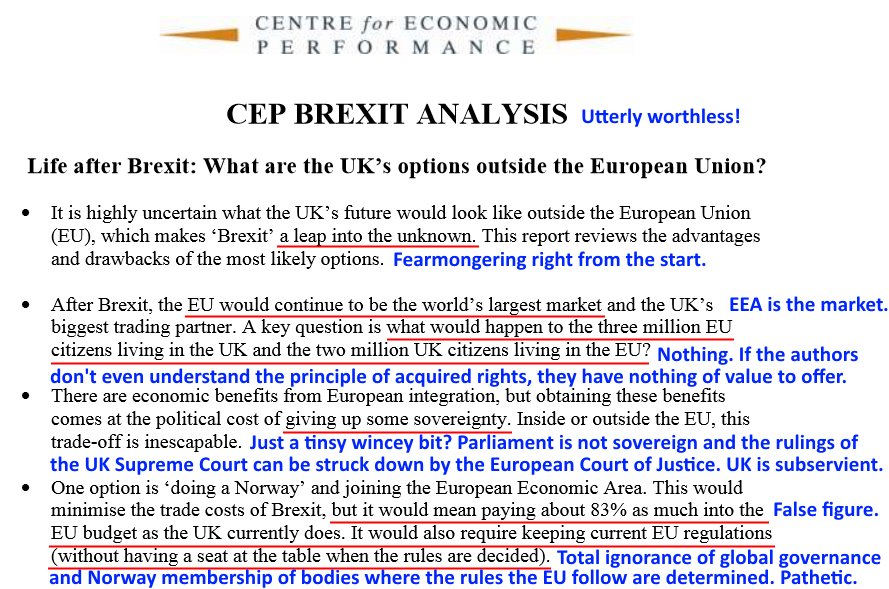
CEP: "You Just Made That Up."

Interestingly enough we can actually take what Dilbert says above and apply it to the CEP "analysis" above:

"If you understand a project you won't know it's cost, and vica versa." ~ Dilbert


Effectively to para-phrase: "because we don't understand the project (Brexit)" we therefore DO understand it's costs: They're "ginormous"!! The Project Uncertainty Principle, in action.

This is attributed to "uncertainty". So how do we reduce/remove uncertainty?


What does "uncertainty" look like = Bad Decision-Making ; What is at the root of uncertainty = Not asking the right questions aka 1. DEFINE THE PROBLEM

Once we use such a framework it should be noted, CEP above launches into Stage 3. [See Above: "What are the UK's options outside the European Union?"] suggesting there is uncertainty over 3 million jobs and The Single Market and the EU are all blurred into one amorphous and undefined entity to which all manner of uncertainty properties can be attributed.

But the dual fallacies are both launching into Stage 4. AND not starting at Stage 1.

I think this simple process explains probably 95% of all the work we see published by various think tanks on the EU Referendum and on Brexit as per Dr. RAE North at EUReferendum.com.  It's staggered that our National Decision-Making apparatus and institutions is so primitive in it's observable out-put.

Progress? Nope. Uncertainty? Yup.

The enormous disregard for The History of the European Union as described and defined in The Great Deception has been a key contributor to failure of progression of the argument.

If anyone is interested in Brexit, they must know what the defined problem is as per Lost Leonardo: For The Avoidance of Doubt. But this also allows an insight into the workings of the "eurosceptic aristocracy" who are taking over the Leave Campaign forming their own "Policy Ponzi" scheme as per Leave HQ: What's Wrong With the WTO Option?. Why? Why do they do this? What we see by the process of obscuring the definition of the problem ie ignoring The Great Deception is that it means the "Consideration Set" is kept broad and undefined. Here is the space with which the politicians can peddle their "Policy Ponzis" as per The Brexit Bullshit Sandwich to a bewildered public. By going through the entire cycle of Decision-Making we can connect the original problem itself to a form that is "fitted" to democratic decision-making on a mass scale for voters to be an executive part of the full decision-making cycle. But it relies on HIGH QUALITY!


It's funny you don't need the likes of LSE or CER who are paid so much by such powerful entities with such jealously guarded vested interests, a simple tabulation tells the story as effectively and more clearly. And as pointed out they deliberately go about:-

Finding The Right Answer(s) to The Wrong Questions.

There seems to be a lot of money and prestige sloshing around in those think tanks as per The Political Food Web of Prestige and possibly far too much geopolitical power projection invested in the EU to allow us plebs to decision on the right question: EU Reform: Asking The Wrong Question.

Is economics in the core defined problem? No. So remove it.

We can see that CER and Open Europe are determined to also ask the wrong questions and get the right questions on economic projections. This is why FLEXCIT removes this area from the original question and from the practical implementation of Brexit too. No other Brexit plan do we see this simple high quality thinking.

And this itself can be used to reinforce our Problem Definition:-

Just look at all these useless reports that fail to Define The Problem and Ask The Right Questions.

Our Membership of the Supranational EU is itself a deterioration of democratic decision-making processes as a nation!!


"If it sounds too good to be true": Elliott, Lea, Campbell-Bannerman, Redwood, Cash, Hannan, Carswell, Cummings,

Why don't the above avowed "Leave Campaigners" seek to solve this problem via higher quality decision-making and hence avoid uncertainty? It's their trade as "eurosceptic aristocrats" in SW1 as part of the political class: Farage on that front is certainly right!

It's up to voters to force such people either out of the way as part of the problem preventing problem definition or make them part of the solution:-


Importance of sovereignty

"Many voters had sovereignty at the top of their list for their reasons to say ‘no’, both in 1972 and 1994.

Norway gained independence from 90 years of Swedish rule in 1905, and was prior to that a part of the Danish Kingdom for more than four centuries. Skinner writes that this history of foreign rule has made Norwegians reluctant to give up independence to a supranational union such as the EU.

“For many Norwegians, the distance to Oslo is long,” says the researcher. “But the distance to Brussels is even longer.”

She says Norwegians are content with their political system, characterised by a short socioeconomic distance between the government and the governed, and are put off by the decision-making process in the EU.
Marianne Sundlisæter Skinner.

This attitude was found both in the seventies and nineties."
I guess the Norwegians had their heads screwed on tightly both:-
  • Defining the Problem.
  • Defining the Challenge: Not trusting or being led by THEIR lying politicians who did want to join! 
However one important difference to sharp-eyed observers, this was about Sovereignty to them in the 70's and 90's.

Today, in the 10's the problem is still Supranationalism but the challenge is Intergovernmentalism. The problem with Supranationalism?

Bad Decision-Making = ... (you guessed it!).

Thursday, 28 January 2016

Britain, Supranationalism & Globalization

Is this what Pro-EU advocates believe the UK's position in the EU actually looks like?

In the previous blog post Arguments: In The Deadly Grip of Confabulation. We looked at examples of empty concepts or containers that dominate the EU Referendum arguments in place of i(e due to a lack of) a cooperatively shared and developed and disseminated "intellectual architecture" to advance our arguments quality with. Dr. RAE North provided a description of this previously in EU Referendum: back to basics, using the metaphor of building the foundations of a building before the actual useful components of the building that are functional for people to use can be developed; and indeed people who use these spaces are often unaware of what they are "literally" built upon.


 EU Parliament percentage of MEP's representing each national member

If we compare the above: What is yet another confabulation of our membership of the EU to the actual foundations, or "details" using merely one example that's more than illustrative and fairly representative: We see that in effect our leaders our telling the people that:-

"All Animals Are Equal But Some Animals Are More Equal Than Others." ~ Animal Farm, George Orwell
 If we look further at the effect of the Supranational EU:-


 Supranationalism: Effectively all UK MEP's could vote "no" but be overruled Supranationally in the EU Parliament (political institution)

 FLEXCIT: 5.5 "Influence" in perspective, p.97 _ Dr. RAE North:-
"As to Britain's voting power within the EU, most often agreements are reached by consensus. Where a vote is called, qualified majority  voting (QMV) applies to  the  Council  of  the  European  Union  (formerly  the  Council  of  Ministers). There, Britain  has  29  out  of  352 votes,  representing  eight  percent  of  the  vote. A qualified majority is 252 votes (73.9 percent).

In the European Parliament,  the  situation  is  little  better.  There  are  73  UK  MEPs,  and  these represent  a  mere  9.7  percent  of  the  751  elected  MEPs  (post-2014  election). Given the party splits,  this level of representation is notional. UK MEPs rarely vote together as a single bloc. Even if they did, they could never muster the 376 votes needed for a majority.

Furthermore,  the  powers  of  the  Parliament  and  the  Council  are  limited  in important  but  poorly  recognised  ways."
Worse the smaller nations have even fewer votes than the "major" nations such as Germany and the UK as dint of their population sizes. Even worse this is the proverbial "tip of the ice-berg" due to how the various streams of legislations are filtered down to the EU Parliament or either by-pass it completely or are already in their final form and require a "box-ticking" symbolic vote on them to be passed on Nationally (read on from p.97 in FLEXCIT above for more).

And here's the problem with this system:-


Europe's inherent diversity and complexity of network of actors and interests

Europe can be divided into distinct regions with distinct cultural, historic and geographic and political attributes that are VARIABLE per region and indeed per member nation! The above suggests the barest representation of this reality.

Now combining all this variation into one QMV system is simply suffocating this variation under a system that merges and mixes "political" and "technical" issues. This is of course the deliberate function of the EU as a Supranational Construct: To erode National Sovereignty and merge National Institutions under one EU Supranational Institution.

This is indeed seen in the way the EU Parliament actually works via groups:-


As you can see these groups work as "clusters" of alliances of MEP's. Predominantly the groups that are Pro-EU the institutions "club" together. So far from the UK "having a seat at the top table as a big player on the world stage in the EU club playing by the clubs rules", the UK is split up between these groups and it's national interest further diluted down. In fact these are politicians and their privilege and priority is to the EU and their careers. The amalgamation of different regional and national concerns of politics along with technical legislation is perhaps not a happy recipe?

An alternative model:-


FLEXCIT: 11.2 Potential regional structures, p.222 ~ Dr. RAE North:-

"Working within the aegis of the WTO's TBT Agreement, UNECE could thus be equipped  to  coordinate  the  production  of  single  market  instruments  for  the whole of continental Europe,  then administering the functioning of the market. It  would  replace the EU  as  the dominant  body,  thereby  involving  all  European countries in the decision-making process, not just EU Member States.

This is perhaps an improvement on that offered by Lord Leach of Fairford, who has advocated attempting "to redefine the EU as the Single Market" rather than as  "a  vague  aspiration  to  political  union". Such  a  scenario would  conform with  the  Foreign  Affairs  Committee's  idea  of  "radical  institutional  change"  to give  decision-making  rights  in  the  Single  Market  to  all  its  participating  states, on  an  equal  footing. By  this  means,  the  EU-centric "Europe  of  concentric circles" would  be  avoided,  and  with  it  any  idea  of  first  class  and  second  class members. Each body, such as EFTA and the EU, has equal standing, creating a community of equals."

ASEAN and the European Union: Lessons in Integration


With this caveat, there are three main lessons worth considering for regional integration experiences in ASEAN and the EU.

1. Integration processes are not really comparable, though their fundamentals are similar
"Many like benchmarking ASEAN’s progress to that of the EU’s. There is a tendency to project the EU as a model for ASEAN and to propose the European way of integration as applicable to ASEAN as well.  The EU’s commitment to pooling sovereignty for common gains has been cited as key to an integrated communityOn the other hand, ASEAN pursues integration without yielding individual sovereignty of member states.  This has created the impression that the EU is a supra-national body in a way that ASEAN cannot or does not aspire to be. The principles of inter-state relations enshrined in the ASEAN Charter reiterate respect for sovereignty, territorial integrity and national identity.  Yet, the two organisations are more similar in their decision-making processes than is generally acknowledged.

The EU depends on unanimity – not just consensus – for its major decisions. The image of the EU’s supra-national authority has also been recently shattered as the Eurozone crisis evolves. Individual members have made their (national) preferences prevail at the regional table.  Regional consensus cannot be forged without taking into consideration the national interests of individual members." 
2. Institutions (and mechanisms) do not always work
"Recent experiences in both ASEAN and the EU have shown that institutions notwithstanding, no regional organisation can accomplish its goals of regional peace and security nor economic integration without national commitment to regional priorities. Regional institutions can certainly play a role in community-building. However, if regional decisions are not supported – and implemented – at national levels, the institutions by themselves cannot do much, even with well-meaning attempts to fine-tune or reform them."
3. Regional disparities can hamper integration
"While the EU faced less of a problem of regional disparities in pursuing economic and monetary integration (with “strong” political will carrying the day) in the past, the EU today is confronting  the problem of relatively weak and unstable economies. The financial crisis has exposed the vulnerabilities of the EU economies, especially those in its periphery. Greece’s budget deficits have considerably weakened the EU’s economic position and standing, as have those of Portugal, Ireland, Italy and Spain."

What we're seeing is that political integration is introducing it's own set of stresses. What is needed for the EUROZONE is increase in Global Trade to increase it's chances of recovery. Effectively in conjunction with the wider global processes happening (see below) there's fundamental need in the EU Political Project for boosts to prosperity to "salvage" it's future. ASEAN shows that "Supranationalism" is not the only nor necessarily the best option for regional cooperation.

This is very important part of the Globalization of Regulations to which a full blog of links and references will be needed to cover the full details. As we can see above it's in the UK's ultimate interests to split the Single Market from Political Union. It might be argued from the opposite position, if argued honestly, that the Political Union needs to be split from the Single Market also for those goals and objectives; namely the future of the EUROZONE which we've already looked at referencing the top EU thinkers and their plans for this Political Union.

Pete North has written some excellent blogs on this globalization process. Which will be listed in another blog. But to try to show a summary of the concept (perhaps failing and falling far short, in the attempt):-

Metcalfe's Law: Two computers can make only one connection, five can make 10 connections, and twelve can make 66 connections.

Metcalfe's law states that the value of a telecommunications network is proportional to the square of the number of connected users of the system (n2).

Metcalfe's Law is related to the fact that the number of unique connections in a network of a number of nodes (n) can be expressed mathematically as the triangular number n(n − 1)/2.
The law has often been illustrated using the example of fax machines: a single fax machine is useless, but the value of every fax machine increases with the total number of fax machines in the network, because the total number of people with whom each user may send and receive documents increases. Likewise, in social networks, the greater number of users with the service, the more valuable the service becomes to the community."
The irony of raising fax machines into the discussion...

Above Eg: 16(16-1)/2=120 ; EEA-31: 31(31-1)/2=465 ; UNECE-56: 56(56-1)/2=1540

As said the full globalization process is staggeringly complicated. But the above at least gives an illustration of the virtue of a larger network at GLOBAL - REGIONAL - NATIONAL connectivity level and as Dr. RAE North points out in:-

FLEXCIT: 19.0 Trading with the rest of the world p.350 ~ Dr. RAE North
"The  global  economy  is  being  re-shaped at  breakneck  speed.  In  the  past decades,  political  systems  have  changed,  new  players  have  emerged  on  the markets,  as  well  as  new  materials,  new  technologies  and  workers  who  are better skilled  than ever. To compete  in  this fast-changing economy requires regulation that promotes growth, better access to markets and the availability of new sources of energy. Cut EU Red Tape: Report from the Business Taskforce February 2014

By  this  penultimate  stage  of  our  six-stage  programme,  all  the  structural  issues have been addressed, leaving the way clear to look at Britain as a global trader. As  we  have  seen  earlier,  organising  trade  in  continental  Europe,  adopting formal   structures   around   UNECE,   would   not   replicate   European   Union arrangements,  in  that  there  would  be  no  external  trade  policy.  Britain  would thus  be  free  to  act  on  its  own  account  in  relations  with  the  rest  of  the  world. Alternatively,  it could act with EFTA, or take collective action through ad hoc alliances."

FLEXCIT: 21.4 Conclusion, p.402 ~ Dr. RAE North
"But it is this idea of a six-stage plan, integrating disparate points, which makes The Market solution what it is. We start with stage one – the process of leaving the EU.  We then move on  to  stage two – sorting  out  immigration  and asylum. Stage  three  has  us  launching  a  genuine  European  single  market,  breaking  free from the EU-centricity of Brussels and building a European village where every "house" is  equal.    In  stage four,  we address  the  task  of  rebuilding  independent policies, and stage five has us reinvigorating global trade, with the adoption and implementation of an eight-point programme."

Conclusions:

When we started this blog post we had this horrible confabulation of "Leading in EUrope!" that means nothing except false and broken promises to people and the abrogation of democracy itself.

I've tried to summary a vastness and of course failed in the attempt. But at least a glimpse may have been provided for the rational, the "intellectual framework", the foundations that are invisible and underpin the First Stage Of The Market Solution:-


The Sceptic Isle has a full summary here:-

Coming back to the objective of this blog, to dispell the starting premise of confabulation from our Pro-EU Politicians; the rot starting at the top, I hope Leave Campaigners will not fall for such arguments as "Leading in EUrope", but choose an eminently wiser and more pragmatic and maturer political outlook:-