Red Cliffs Of Dawlish

Red Cliffs Of Dawlish
Showing posts with label Decision-Making. Show all posts

Tuesday, 26 July 2016

Before Decision-Making: Explosive Cocktails of Emotion


In one of the previous blog posts I noted how the news-stories wash over us incessantly bathing people in the emotional-narrative driven soup of the major broadcasters and tabloids. Evidently this serves a function which people feel a need for: The connection to the community and world within which they coexist and share and shape their expectations for life.

Legacy News-Media: No responsibility for sensationalism vs accuracy and training people to accept an unreality as the "norm".

For the concept of democracy to work, it hinges on the assumption that each voting adult who has made the successful transition from childhood as an independent decision-maker with a single vote to represent that, that such people are emotionally mature and rational. But if we compare the diet or environment within which voters exist, the above sensationalist news-media and the preference for people to seek pleasurable emotional stimulation even if it's "angry"; we can already see where this is going to lead to communication being impaired and reducing to people emotionally "venting": Sometimes nastily but invariably distracting away from building foundations of decision-making ie informing first.

Not only are people going to be less rational in their political discourse, they're equally reducing the complexity of understanding they are able to tolerate without feeling deprived of hyper-emotional presentation. The capacity to tolerate complex information itself is reduced. Just try reading some of the reports and papers that are primary source...

This may sound overly theoretical at the moment, but one look across "the pond" towards the United States of America and with the benefit of "outsiders' eyes" I think it seems very obvious how degraded their processes of democracy must be if we consider the communication of information to voters to aid their decision-making, even delusional on a mass scale, might appear by comparison to our standards? Now envision how the Chinese looking at the United Kingdom and wondering how poorly and chaotically do they run their political planning and policy to be able to effectively "run an entire nation"?! It may give pause for reconsideration of how we actually as opposed to apparently make decisions at a national level? There's so much grandstanding on "self-expression" (from Mill) and a "free press" and such little thought to extending BEYOND this beginning of democratic processes!! As if the beginning IS the process alone.

To bring the subject towards the focus of this blog: Brexit: Since we have had the decision, what is obvious is the ongoing attempt to emotionally digest it; from all corners and speakers

And I think this is perhaps of observation at a mass scale, in the confusion of the leadership or lack of it, in fact, of our political leaders concerning the permanent set of crisis operating across Europe concerning the EU, the EURO, Migration and Terrorism and how to politically deal with these things without a chain reaction due to the uncertainty vs confidence of our market economies.

Such explosive cocktails of emotion were deemed too dangerous at a national level by the original thinkers of the EU Supranational solution (Jean Monnet) almost one hundred years ago towards the ending of World War One. I notice our present analysts of the Referendum such as Matthew Goodwin has taken time to use the voting data to describe the obvious: "Britain is divided" along his preferential measures of Education, Age, Income Bracket, Metropolitican vs Rural for example.

From such studies many commentators come out with rationalizations: "People voted for Brexit because...".

Of fascination however, is this quote from Dr. RAE North at EUReferendum.com:-


"The thing is, when we are dealing with something as important as a complete revolution in the way we are governed, with the health and wealth of the entire nation dependent on it, that is the sort of detail we should be looking at. To have a amateurs casually interviewing a few high prestige witnesses, simply to confirm the prejudices of the questioners, is a complete waste of time and effort.

Of course, we are so good at having prolonged inquiries after the event – the BSE inquiry, the Bloody Sunday inquiry, Leveson and, more recently, the Chilcot inquiry. At a cost of hundreds of millions, it seems no expense is spared in our attempts to find out why things went wrong. Why then should we not invest a little of that money up-front, in attempt to make sure that we do things right?

And, if Parliament can't hack it, it should move over and cede the ground to people who can do the job. We used quite frequently to have Royal Commissions to examine issues of substance, and their weighty reports used to fuel debates for years thereafter. If ever there was an example of a need for such a Commission, the post-exit reconstruction of Britain is one.

As it is, one cannot escape the impression that officials are flying blind and, outrageously to mix metaphors, are totally out of their depth." 
The former in red is symptom of the investment in distractions due to the failure of using knowledge to promote decision-making capacity in place of "forceful personality" (see Blair-mania and the promotion of celebrity of our leaders: "The first lady or coloured candidate emotional-pleading narratives) and hence subsequently the loss of capacity in decision-making in light of new or alternative evidence.

Is it little wonder that Parliament emulates this "explosive cocktail of emotions" within the population when they bray like donkeys at each other? It's a show, a distraction which itself feeds most of the legacy news-media which in turn feeds itself based off the emotional needs of the population. The "house of workshop" (where decision-making is deliberated via structured and organized activity and rules for such (Parliament)) itself has become a fossil not fit for the work of policy and intelligence driven decision-making at a national and democratic level.

The latter in blue suggests that investment in decision-making behaviours themselves that demonstrate an encapsulation of "intelligence" will likely help the UK avoid the excesses (in red): But it takes a very conscious and very committed and finally very community-driven initiative to set such higher expectations for the entire UK. Pete North makes this point:  The revolution that never was:-
"Much of what is said by European leaders is for the time being merely political signals to their own electorates now that Hollande and Merkel are facing re-election. There is always a gulf between what politicians say and what is technically feasible.

[...]
In that regard, I will not be watching PMQs or even paying that much attention to the words of the EU commission. It will be in the back rooms and select committees where Britain’s fate is decided. That is where I will be watching. What I have seen thus far is not encouraging."

 After a failure of decision-making we end up with the euphemisms of failure: "Mistakes Were Made". In fact no real communication produces such analysis of results as Matthew Goodwin above desperately attempts, like a blind man in the dark, to grasp the meaning of but never quite getting there: Only rearranging the data into interesting patterns. He's not alone, I listened recently to almost the entire Lords Debate on the Referendum on the BBC Parliament channel and not once did I hear the authority of attempting to first understand the EU, via using a history of it "The Great Deception" before attempting to use such a common ground to then promote discussion of Brexit from. You could hear a thousand different reasons, all as plausible and personal as the next and never come away with a deeper understanding. Not beginning correctly, and hence attempting to begin at the end and ending up with more emotional cocktails exploding... entropy of politics and the fear of the ruling order of "too much democracy" such as "Referendums are a scourge on democracy"!

But if we look at this argument, then I think it supports the idea for Brexit to ensure as much political decision-making concerning Article 50 is "automated" or "off-the-shelf" as is possible to MOVE BEYOND THIS EMOTIONAL BEGINNING and get away from it as successfully as possible via FLEXCIT: Stage 1. Failure to do so is very obvious presently in the discussions:-


People like Nicola Sturgeon and Lord Lawson, it may be rationale to understand what role they are play-acting in their absurd demands and declarations from Brexit, but if you take the "model" of "emotion" before decision-making: This is indeed what they are playing at: They are playing and captivating and conditioning peoples' emotions to shape-decision-making political power. They are "beneath contempt" as per Dr. RAE North:-
"Handled properly, the benefits of Brexit for the UK could be huge, but there should be no illusions about the effects of a botched exit, based on this sort of insanity. We thus need people to stop playing fantasy Brexit and to focus on reality. We really cannot afford these games."
 It's much less that democracy is a danger, for good democracy promotes good communication and hence good argument and hence good decision-making practice and indeed the experience of improving at this with more practice. It's our leaders who are the cause of and consequence of failure "we cannot afford these games" quite numerically and literally!


Sunday, 27 March 2016

How To Vote: A Simple Guide to Decision-Making


Confusion of arguments predominantly involves the 'mixing up of' these 3 Decision Levels (simplified)


One of the 'most crude' and stupid arguments I've come across does not come from the Remain advocates but from the Leave advocates. It's so staggeringly stupid that stupidity on such a scale becomes "invincible ignorance". There is no argument against such a position because it is so devoid of thought that it is sub-thought, emotional-conviction and hence to argue against it is misdiagnosing the problem of the people who believe in the position, not appreciating that a position must be built from an argued case. I think I've managed to identify the problem in their thinking, their confusion: It's above, mixing the levels of decision-making in combination with not holding the requisite knowledge to understand the argument themselves.

Now it's not my preference to direct the description of someone's intelligence to "stupid" without good reason: Afterall, mistakes and errors are in the majority and all different types of mistakes and errors make them very reasonable to make by anyone!! The real trick is not calling someone stupid, but in UNDERSTANDING HOW they have made their mistake: This is incredibly useful way to learn for oneself. And I've benefited from it a lot and I too make mistakes and errors.

An intellectual foundation and attention to detail are essential in the #Brexit campaign ~ The Sceptic Isle / Ben Kelly


So why call this mistake stupid? It's an absence of thought, that is what I would argue is stupid, the opposite of intelligent, an application of thought/thinking. People assume if enough people hold enough conviction then the vote "will go their way". An example, "events" will dictate the vote such as:-
  • Immigration (leave)
  • Terrorism (leave)
  • Uncertainty (remain)
  • No Alternative (remain)
Now these types of arguments all fall within the same category: Stupid! So stupid in fact, that looking at how the nation and how the political leaders actually arrive at decisions, makes for viewing a world that full of madness. I don't think it's unexpected that when things don't turn out how we anticipated them to for our benefit, we see so much "pulling at heart-strings" and "why is the world/politicians/people such a terrible place?!". Stupidity is the singular answer.
:-


Stupidity is a lack of intelligence, understanding, reason, wit or sense. Stupidity may be innate, assumed or reactive – a defence against grief or trauma.

The root word stupid, which can serve as an adjective or noun, comes from the Latin verb stupere, for being numb or astonished, and is related to stupor. In Roman culture, the stupidus was the professional fall-guy in the theatrical mimes.
According to the online Merriam-Webster dictionary, the words "stupid" and "stupidity" entered the English language in 1541. Since then, stupidity has taken place along with "fool," "idiot," "dumb," "moron," and related concepts as a pejorative appellation for human misdeeds, whether purposeful or accidental, due to absence of mental capacity.

We'll come back to this later. First what is this stupid mistake?

Ben Kelly The Sceptic Isle: An intellectual foundation and attention to detail are essential in the #Brexit campaign, manages to provide a very useful argument to correct it:-
"We are told by some that having a plan is not necessary or helpful and that we are wrong to worry about “unnecessary detail”. Obviously, we couldn’t disagree more. The purpose of a plan is not so that the whole public should read it, but so that it gives our campaign and our arguments an intellectual foundation. It is absolutely necessary to know the details so that when people raise questions, as they inevitably will, we have the answers. Brexit is complex and people are worried about the details, therefore to refuse to worry about details or offer any kind of plan when proposing what amounts to the biggest political change in 50 years and a huge geopolitical event is an abdication of responsibility."
I've tried to illustrate this visually previously:-

What A PLAN looks like: The Big Triangle that's a complete plan? That's called FLEXCIT: The Market Solution - from which all derivative details derive from.

The first thing to assert as Ben Kelly does is:
  1. We have a highly credible plan
  2. We have an alternative to the Status Quo (or Null vs Alternative Hypothesis in scientific testing language)
From this "credible" (believable) plan we move onto the merits which are data-driven or research driven. We've removed FUD and moved onto Intelligence-driven arguments which are positive in nature: Innovative-seeking to find solutions and happy outcomes.

1. Plan: A detailed "how to" achieve/do something from NOW/HERE to THEN/THERE:-


However, I think the problem can be highlighted if we relearn how to communicate using simple English and being precise in the words we use:-

  1. Plan = "a detailed proposal for doing or achieving something."
  2. Navigation = "the process or activity of accurately ascertaining one's position and planning and following a route."
  3. Negotiation = "discussion aimed at reaching an agreement."
In the case of the Leave side of the argument, the Alternative Hypothesis or question, we have to have a plan "to do something". That "something" is to "navigate and plan a route to a new position from our present position". This is done in the context of a discussion between different parties to reach a mutual agreement. This is an assertion of very simple intelligence. As Ben Kelly describes:-

2. Navigation: From-To via what is In between:-

"The questions come thick and fast in this debate: How will the economy be affected by Brexit? Will I still be able to live and work in Europe? What about our trade deals with other countries, will they need to be renegotiated? How will the negotiations work? Will the EU look to punish us for leaving?  What about agriculture subsidies after the abolition of the Common Agricultural Policy, will farmers lose out? The financial sector is vital for Britain, will leaving be detrimental? Will we get a say in its regulation? They go on and on."

3. Negotiation: UK WITH EU on Leaving realistically and mutually:-

 Reading The Market Solution Introduction we can list the key concepts of a workable plan:-

  • We must have an Exit Plan that plots the route, demonstrates an Alternative Hypothesis and hence choice to the null/default choice of Remain - except this time we have a vote for the first time as a voting public
  • Such a plan must be modest and set expectations that are fair with the EU's side of the negotiation as much as it is for the UK.
  • As such a gradual, staged, soft or iterative withdrawal is safest and most reasonable expectation setting.
  • Negotiation on compromise means that minimizing number of total outcomes increases probability of agreed settlement between both parties.
  • Thus advocating "conviction-based" "blue-sky" proposal NOW are damaging to future proposal THEN! Do not do this to win votes!
  • Removing predictive models that are based on garbage data or garbage processing is enormously aided by declaration to retain MEMBERSHIP OF The Single Market.
  • A holistic solution means that short-term TACTICAL solutions serve the larger Strategic Goal of transferring from Supranationalism to Intergovernmentalism. Any short-term deficiencies must either be reassured via Operationally repatriating the entire acquis so there is little to no actual change to derivative policies.
  • Both Trade and Migration are linked to TACTICAL reorientation from EU/EEA to EFTA/EEA as the short-term immediate solution. This allows future Strategic alterations and fits the holistic solution sense above.
  • MEMBERSHIP OF the Single Market requires the rules top be applied. Anything less unravels this holistic tactical solution and that then has negative repercussions to all operational details on policy. Thus failure to secure and retain Single Market access will lead to failure to achieve our strategic destination.
  • The conditions to all the above negotiations, the legal process to go with the securing of the Single Market is Article 50 which has limitations. Thus removing Legal and Economic questions leaves purely Political Questions which = "Withdrawing from EU Treaties" only = Successful Brexit negotiations navigated using a detailed Plan: FLEXCIT: The Market Solution.
  • The Six Staged Plan is the complete Strategic Decision-Making Level.
  • Repatriation of the acquis is the Operational decision-making.
  • The subsequent few years (EFTA/EEA) is the Tactical Decision-Making Level.
The Current confusion over the EU Referendum debate:-


 Deception via Imbalanced Perception: David Cameron's LIE depends on confusing "Operational Decision-Making" for Remain as a safe option compared with "Strategic Leap Into The Dark" disaster for Leave.

Whereas, Supranationalism is the fundamentally flawed and faulty and POLITICAL question that we want voters to consider as the Null Hypothesis vs Alternative Hypothesis or Paradigm: Intergovernmentalism.

We can only get to that question by removing Economic and Legal issues:-

  • Single Market Access (Tactical)
  • Article 50 Lisbon Treaty + Repatriation of Entire Acquis (Operational)
 This leaves A Simple Guide on How to Vote:-
  • Supranationalism or Intergovernmentalism
Given that the question on Remain should be Strategic Level decision-making given our Referendum is for x43 Years of Membership covering x9 EU Treaties towards "Ever Closer Union" once you remove the above (below) levels the decision-making for voters who do not need to know all the details because they are covered  on both sides of the question, then it looks like voting for the next 10-20,30 years outside the EU is a very very valid and viable decision to consider. It's also a very simple question too to answer given we have the EU Treaty Rules themselves with which to refer tot he Strategic Decision-Making of the EU which has led to the EUROZONE which will have new Treaty for more Sovereignty to the EU coming up before 2025.

When the Deception is on an enormous scale... the stupidity that follows

It should be discernable that David Cameron's deal is dressed up as "Strategic" when it's barely even "Operational" given it is not legally-binding. It serves to confuse voter's decision-making that the UK has "special status" which is camouflage for No EU Reform whatsoever. Our Prime Minister is a failure and worse: A Liar and a deceiver of the people.

This is the gift of Supranationalism working through him presently and previously via his predecessors in entering the UK into the EEC back in 1973 (Jan) on the pretext that Strategically it was a Market Solution.

We all make mistakes, sometimes we're stupid. That's forgivable. But what I think our Membership of the EU proves, our Null Hypothesis is that it is built on Deception at the highest level of decision-making: Strategic.

 Honest Mistakes: We can learn from. Deception however...

This deception is not stupid, it is intelligence used for hurtful and destructive outcomes; even if the intentions were presumably "good"; the intelligence is infernal and it leaves the quality of arguments and political decay in the UK as it's defining outcome which in effect is a kind of increase in stupidity; Check: EU Referendum: corruption at the heart of the media and EU Referendum: the Johnson saga continues a decrease in intelligence at the top of the UK's strategic decision-making processes and people; wouldn't you agree?


Friday, 12 February 2016

The Root Of All Uncertainty

The Uncertainty Precept: Start with the right question(s).

Quoting Wikipedia once again on the "Uncertainty Principle" (must donate!):-
In quantum mechanics, the uncertainty principle, also known as Heisenberg's uncertainty principle, is any of a variety of mathematical inequalities asserting a fundamental limit to the precision with which certain pairs of physical properties of a particle, known as complementary variables, such as position x and momentum p, can be known simultaneously.
So "uncertainty" is in-built it seems into the very nature of the realistic universe! Or to adapt it for a more "relate-able" misuse:-


And this is indeed a hilarious transposition of "uncertainty" when we also find the same "joke"as noted by Mr. Brexit:-


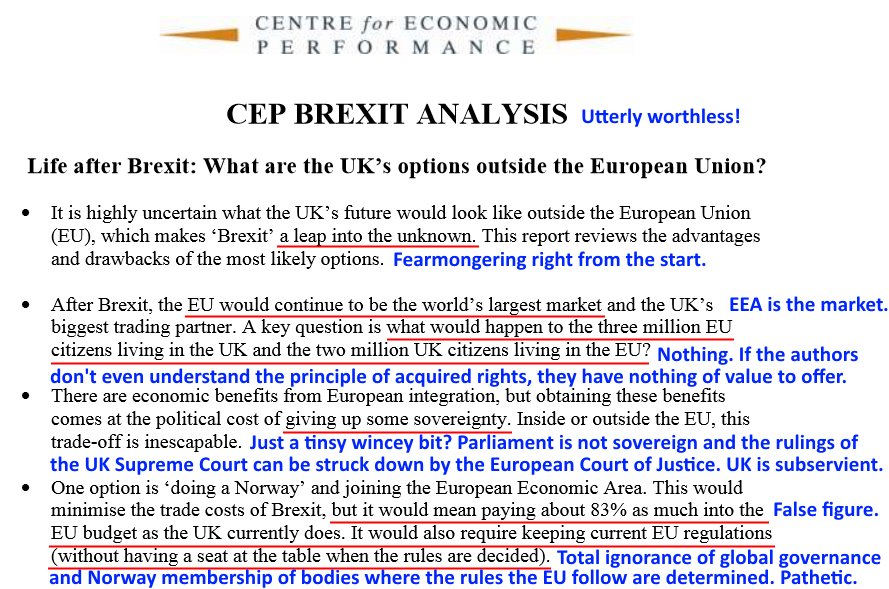
CEP: "You Just Made That Up."

Interestingly enough we can actually take what Dilbert says above and apply it to the CEP "analysis" above:

"If you understand a project you won't know it's cost, and vica versa." ~ Dilbert


Effectively to para-phrase: "because we don't understand the project (Brexit)" we therefore DO understand it's costs: They're "ginormous"!! The Project Uncertainty Principle, in action.

This is attributed to "uncertainty". So how do we reduce/remove uncertainty?


What does "uncertainty" look like = Bad Decision-Making ; What is at the root of uncertainty = Not asking the right questions aka 1. DEFINE THE PROBLEM

Once we use such a framework it should be noted, CEP above launches into Stage 3. [See Above: "What are the UK's options outside the European Union?"] suggesting there is uncertainty over 3 million jobs and The Single Market and the EU are all blurred into one amorphous and undefined entity to which all manner of uncertainty properties can be attributed.

But the dual fallacies are both launching into Stage 4. AND not starting at Stage 1.

I think this simple process explains probably 95% of all the work we see published by various think tanks on the EU Referendum and on Brexit as per Dr. RAE North at EUReferendum.com.  It's staggered that our National Decision-Making apparatus and institutions is so primitive in it's observable out-put.

Progress? Nope. Uncertainty? Yup.

The enormous disregard for The History of the European Union as described and defined in The Great Deception has been a key contributor to failure of progression of the argument.

If anyone is interested in Brexit, they must know what the defined problem is as per Lost Leonardo: For The Avoidance of Doubt. But this also allows an insight into the workings of the "eurosceptic aristocracy" who are taking over the Leave Campaign forming their own "Policy Ponzi" scheme as per Leave HQ: What's Wrong With the WTO Option?. Why? Why do they do this? What we see by the process of obscuring the definition of the problem ie ignoring The Great Deception is that it means the "Consideration Set" is kept broad and undefined. Here is the space with which the politicians can peddle their "Policy Ponzis" as per The Brexit Bullshit Sandwich to a bewildered public. By going through the entire cycle of Decision-Making we can connect the original problem itself to a form that is "fitted" to democratic decision-making on a mass scale for voters to be an executive part of the full decision-making cycle. But it relies on HIGH QUALITY!


It's funny you don't need the likes of LSE or CER who are paid so much by such powerful entities with such jealously guarded vested interests, a simple tabulation tells the story as effectively and more clearly. And as pointed out they deliberately go about:-

Finding The Right Answer(s) to The Wrong Questions.

There seems to be a lot of money and prestige sloshing around in those think tanks as per The Political Food Web of Prestige and possibly far too much geopolitical power projection invested in the EU to allow us plebs to decision on the right question: EU Reform: Asking The Wrong Question.

Is economics in the core defined problem? No. So remove it.

We can see that CER and Open Europe are determined to also ask the wrong questions and get the right questions on economic projections. This is why FLEXCIT removes this area from the original question and from the practical implementation of Brexit too. No other Brexit plan do we see this simple high quality thinking.

And this itself can be used to reinforce our Problem Definition:-

Just look at all these useless reports that fail to Define The Problem and Ask The Right Questions.

Our Membership of the Supranational EU is itself a deterioration of democratic decision-making processes as a nation!!


"If it sounds too good to be true": Elliott, Lea, Campbell-Bannerman, Redwood, Cash, Hannan, Carswell, Cummings,

Why don't the above avowed "Leave Campaigners" seek to solve this problem via higher quality decision-making and hence avoid uncertainty? It's their trade as "eurosceptic aristocrats" in SW1 as part of the political class: Farage on that front is certainly right!

It's up to voters to force such people either out of the way as part of the problem preventing problem definition or make them part of the solution:-


Importance of sovereignty

"Many voters had sovereignty at the top of their list for their reasons to say ‘no’, both in 1972 and 1994.

Norway gained independence from 90 years of Swedish rule in 1905, and was prior to that a part of the Danish Kingdom for more than four centuries. Skinner writes that this history of foreign rule has made Norwegians reluctant to give up independence to a supranational union such as the EU.

“For many Norwegians, the distance to Oslo is long,” says the researcher. “But the distance to Brussels is even longer.”

She says Norwegians are content with their political system, characterised by a short socioeconomic distance between the government and the governed, and are put off by the decision-making process in the EU.
Marianne Sundlisæter Skinner.

This attitude was found both in the seventies and nineties."
I guess the Norwegians had their heads screwed on tightly both:-
  • Defining the Problem.
  • Defining the Challenge: Not trusting or being led by THEIR lying politicians who did want to join! 
However one important difference to sharp-eyed observers, this was about Sovereignty to them in the 70's and 90's.

Today, in the 10's the problem is still Supranationalism but the challenge is Intergovernmentalism. The problem with Supranationalism?

Bad Decision-Making = ... (you guessed it!).