"Yesterday I was thinking about my first meeting
with Alan Sked in 1991 at the house of Eva Taylor, widow of A. J. P.
Taylor, our common supervisor and what came out of that. What a long way
we have come. I claim some credit."
It was The Boiling Frog blog that led me to EUReferendum.com and the variety of useful influences and help in attempting to further expand the scope and improve the quality of political discussion and debate in the UK concerning this subject. I think I came across the blog sometime in early 2013 or perhaps just before. Pete North Politics Blog: Helen Szamuely:
"Helen was a massively influential part of the early eurosceptic movement
long before Ukip became a household name. One of the original
Brexiteers. She was a hugely respected thinker on the right and a well
known voice in conservative circles."
I had not heard of this lady but it brings to mind the many many people who started this movement far beyond my reckoning(some as far back as the late 1960's in the Campaign for an Independent BritainCIB group) and contributed in the right way to it who are not well known but who need to be thanked for their early and essential actions.
On that note, this blog (finally) ends. I aim to start a new a new website and continue what others started:-
John Ashworth has produced another excellent Fisheries booklet... "Seizing The Moment: The Opportunities For UK Fisheries After Brexit" while Scribblings From Seaham has started another website for Real Democracy: Direct Democracy 4 UK "Moving Forward – A Public Consultation." and Lost Leonardo has murmings of starting blogging again...
For current Brexit Research from Dr. RAE North, don't forget to keep checking and reading (and re-reading) The Brexit Monographs at EUReferendum.com as well as the daily blogging.
"I am a finger pointing to the moon. Don't look at me; look at the moon." ~ Gautama Buddha
Often when listening to some or other politics programme on the television, in particular Daily Politcs, Newsnight and Question Time from the BBC, I am very aware of a distinction:-
When talking about Political Policy (what?)
When talking about Political Personality (who?)
I consider most of the "who?" category to be secondary and "low quality information" and yet if I were to do a proportion measure on the above programmes and calculate the time spent between the two, it might be quite interesting to see how much time is spent on this "who?" and at the cost of "what?". Why is this? Indeed, do you agree or disagree that one is primary and two is secondary?!
You can easily make the connection between the quote above and this consideration of politically productive discussion vs (not always but mostly) empty discussion (in the main).
A big hint why this happens is actually provided recently by Pete North, in serendipitous fashion:-
I remember a lot of "stick" that Pete North has taken, perhaps he's just one of these unfortunate types who the very look and sound of, is enough to piss people off and rub them up the wrong way... perhaps there's multiple other reasons that a radio talkshow could spend a good afternoon gossiping about and still not zero in on the de facto reason. It does not matter, we're not talking about Pete North, and the irony of "the look of disapproval" to "emote" this flaw... but what is worth saying is that this particular blog content is one of the most important made concerning the campaign process for this referendum.
Let's take another example however where this principle operates in polling data which is also something the pundits relish talking about as much as if not it seems more so than the actual political policy:-
Sex/Gender:-
Age:-
Ethnicity:-
Political Party:-
Socio-Economic Group:-
Education:-
Religion:-
How will all these data sets describe how people will vote in the EU Referendum? So much is made of this and yet so little is made of:-
Knowledge Self-Awareness "&" Appropriate Application "&&" Recognition in Others
The above graph is quite easy to appreciate. If you have been reading the past five blogs at EUReferendum.com then it is easy to appreciate the "green line" of "How much more I realise there is to know".
I think a lot of people rightly identify themselves as "Beginner": "I know nothing". However, they are unable to assess or fall for incorrect measures when the likes of:-
Actors/Celebrities:-
Authorative Business Leaders:-
Celebrity "Popular" Politicians:-
Prestigious Politicians:-
Foreign "powerful" dignataries:-
Intelligent Sounding Academics:-
Officious-Sounding "Impartial" Think Tanks:-
Provide their "Hazard""I'm an expert" (of what?) opinions and what I think people generally have as "good intuitions" are confused by such appearances by the above as the above "trump" such beginner opinions "I know nothing".
I personally believe this all leads to the simple outcomes of "top trumps" or "Butting heads" replacing arguments with fractured and fragmented fallacies empty memes/headline factoids (Hazard!):-
Impressive forces! But I think such polical outcomes in people leave the combatants exhausted and frustrated: "They're all as bad as each other" observation.
These are the old argument forms that are increasingly visible and condensed given the Referendum is directly on the subject of the EU and much much less on the "who?" of tribal politics. Therefore even in this error of UK Gov (Cameron/Eton) vs UK Gov (Johnson/Eton) Remain vs Leave outcome, there has been a by-product we can make future use from.
And that's more concentrated and effective methods at looking at that moon in all it's heavenly splendour:-
False Positive = Vote Leave ; False Negative = HM Government & David Cameron
With just over 6 weeks until the Referendum day on June 23rd, it's worth considering the state of the arguments and the underlying emotional energy that drives them in the absence of carefully building a factual and intellectually-driven basis for voting either Remain or Leave the EU.
Indeed the emotional histrionics and sense of urgency are all carefully created by the HM Government under David Cameron and aided by Vote Leave (see "Intellectual Quagmire" below).
In describing what we all CAN so easily observe, we may create an opportunity to avoid becoming bogged down in the quagmire that our politicians and legacy news-media have created: EU Referendum: an intellectual quagmire
"With less
than two calendar months to go before polling day, it is nothing less
than alarming to find that fundamental questions relating to Brexit are
so far from being settled by Vote Leave that we're not even past first
base.[...]
In the
first instance, Jenkin is making the same error (although perhaps
unwittingly) that Mr Cameron has made in agreeing his supposed treaty.
He has neglected the provisions of Article 61 of the Vienna Convention
on the Law of Treaties, and the dictum res inter alios acta vel iudicata, aliis nec nocet nec prodocet,
where two or more people cannot agree amongst each other to establish
an obligation for a third party who was not involved in the agreement.
What these amounts to is that the member states, even if they agreed to
carry out negotiations (which seems unlikely), would be acting
inter-governmentally (which Jenkin acknowledges), which means they could
not bind the European Union – which has its own, separate legal
identity – to the terms of any agreement.
The inescapable bottom line, therefore, is that, if there is to be an
exit settlement, the negotiations have to be with the EU. And that means
working within the constraints of Article 50. [...]
We are
actually paying good money for this extruded verbal material, to achieve
nothing but a further attestation of the capacity of our elected
representatives to waste time and money.
Whether by MPs or the official campaign, we are so badly served in this
referendum that the issues have been submerged in that self-same
quagmire. Not for nothing does Mr Brexit argue that the political game playing and personality politics of the referendum campaign is snatching the goal away from us.
When this is all done and dusted, he says, there needs to be a reckoning. We could not even begin to disagree."
The result of the above was already predicted as per Dr. RAE North, EU politics: Germany in stasis :-
"The new
movement, "Direct Democracy for Europe", Patzelt speaks about
favourably. It certainly has "a chance", he says, a man who is
demonstrably no great fan of representative democracy.
Those who want more democracy must resort to other means - referendums
initiated by citizens, regardless of elections. The problem with
representative democracy is that, after the vote, the citizen has no
voice. "The most important instrument of political influence between
elections", he says, "is the referendum".
However, not all referendums have the same value. If they are top down,
they are a tool in the hands of professional politicians. The must work
from the bottom up, with citizens deciding on the topics. He who fails
to make this distinction will miss the opportunity of making a truly
democratic system of government, Patzelt says."
The predicament this leaves those who are fully in agreement that there needs to be an intellectual foundation to arguments of such importance as national Real (direct) Democracy decision-making at such scale of human organization of people for their future (millions over decades) is the attempt "to clear the rubbish" out of the way:-
But this is "losing cause" I think. What it is doing is reducing the time possible for the dissemination of the arguments into new forms at ever greater scale and speed of distribution and multiplicity of forms while sustaining the original quality source of such derived communications to people. It's a stalling exercise, a holding up exercise due to the lack of seeing what both Vote Leave and HM Government are actually behaving according to, as opposed to making the mistake of listening to their nonsense words:
"A Free Trade Zone Across Europe" ~ Vote Leave: "Lookin' Good"
"World War III" ~ David Cameron/HM Government: "Gotta Hide!"
As we get closer to the EU Referendum Date, it becomes more necessary to be able to disseminate according to a holistic argument to produce a clearer picture with which people can contribute positively via DIRECT REPRESENTATION of themselves to their own future - independently from politicians.
The above is a play on The Vinegar Tasters. In fact only recently did I realize that the interpretation I'd read in some book or other was partly wrong. I read that for one taster the taste of the substance was bitter, another sour and yet another sweet and so how could the experience be "negative for two" yet one of the three find the experience "positive"? It was that sweet taster was putting "mind over matter" and this was how we should approach things.
Actually I think that's a superficial rendition. First we learn through experience which is tasting. That experience may be either sour and bitter (or indeed sweet) and hence partly right but subjectively so depending on us and on the conditions in which we were tasting: In my cup of tea - yuck! On my fish and chips with salt - yum! The single objective answer we can all agree on is: "What is in the large pot?" The answer is of course "Vinegar." It it - in this case - what it is.
You may like it or you may not like it, but at least KNOW WHAT IT IS = Supranationalism
I was just catching up on the BBC Question Time for this week and watching the usual scenes of people who don't know therefore they replace this lack of not knowing with "emotional intuition" which they then force to fit into particular conclusions and emotively extrapolated statements.
Trade appears not to be a singular discrete object but more of a web of various possible interactions?
"If you
care to Google "TTIP", a goodly number of reports will refer to it in
terms of the creation of "the largest free trade area in the world". And
in the simple designation of "free trade area" lies one of the most
prevalent misunderstandings, quite literally, in the world. TTIP is not a free trade area (FTA).
[...]
Above all
else, non-tariff barriers are the target, recognition of which requires
breaking away from the tired old mantras, and understanding what we are
dealing with. What we end up with is not free trade, but managed trade – and the better the management, the better the results."
There's so much to quote in the above by Dr. RAE North, that it would almost end up c&p'ing the entire article: Please read it and see that there is no special privilege to calling the EU = Supranational Political Entity than attempting to more clearly define what we mean by "A Trade Deal" by the Vote Leave lot as opposed to the Remain lot (HM Government, above):-
"This puts
the likes of Boris Johnson, Gove and, latterly David Bannerman, on the
spot. If they want to take what they insist on calling the "free trade"
route, it is their responsibility to identify the extent of the
financial penalty, and then to argue that Brexit is worth it. What they
cannot do with any validity, is argue that there is no financial
penalty. Nor can they argue that a partial CRA is equivalent to the
Single Market. It is not.
Alternatively, and more sensibly, we can adopt the Efta/EEA route, as part of an evolutionary process
of which even the Adam Smith Institute – spiritual home of "free trade"
doctrine – seems to approve. That way, we remain part of the Single
Market CRA and there is no financial penalty."
And this is about the "flavour" of the EU Referendum so far: Even the public have realized that one side says "Jump!" and the other side says "Duck!" but neither side are ready or able to explain to people why? The result is in fact that the people shouting out the commands to the people how to respond to the EU Referendum:-
"What is the point of the British legacy media? It is incapable and
where capable unwilling to report on reality. It exists only to lie to
you. Sure, for the most part, the hacks are just clueless keyboard
thumpers who know not what they do. But why should ignorance be an
excuse when these people are being paid? Everybody makes mistakes. But the extent of the deception and
self-deception which bubble journalists evince is on another level. If
these people are ill-informed, it is because they want to be. If I type
“EU referendum” into a search engine, the top site is EUReferendum.com.
So we come to the focus of this post, this
condescending and inaccurate Evening Standard article written by
Anthony Hilton. I shall not rebut the entire piece, just a few
illustrative examples."
It could be Anthony Hilton with his "cool pose" in the Evening Standard or Michael O'Leary (Ryan Air) on BBC Question Time with his apparent business sense on display... . There's too many people shouting about their own personal tastes based on ignorance and emotion and not enough on producing a coherent and consistent model of understanding of the subject to be debated and discussed BEFORE being voted on directly by people in this EU Referendum.
I think if we recollect where we are in time at present, however, looking back we may find that there was one group at least where people were sharing an understanding that people can use and make sense of by attributing to things what they really are as opposed to the reaction they might or might not induce in that person or others:-
I've mixed computer metaphors with car mechanical with political! The visual image is stronger for that of a car object but the concept is stronger for the computer architecture applied to the politics
This blog post observes two sets of useful feedback from the current compromised Referendum Process, for future information usage, which it is hoped can be accounted for and put into "political memory" for a subsequent time:-
Negative Feedback: Our Politicians and Politics on both sides of the Leave, Remain question have only become more exposed as failures and failing to serve their functions.
Positive Feedback: There is again through this Referendum process greater exposure to the early stages of useful contribution by people more actively into our political decision-making processes.
Let's look at the Negative Feedback first; because it's a real education.
The above diagram is intended to make a connection: A car without an engine cannot move. The engine is the essential feature from which the rest are in designed around. The rest of the hardware; a platform to sit the engine in, the wheels on the platform connected to the engine to power them forwards, breaks to stop the wheels by control of the driver and a fuel system to power the engine are all obviously needed. Over the top of this you have the "User Experience" the seats, driving wheel and dashboard and of course the hood or cover so that an enclosed space can have it's internal environment can have it's conditions regulated: Either heating or cooling so that the people's trip is both made and made comfortably and safely.
Without an engine, you could choose either a horse, a bicycle or other non-engine form of transport!
Interestingly Brexit campaigners have no qualms about visualizing David Cameron's "version" of a deal as a clap-trap car. But equally important, as David Cameron as a dishonest second-hand used-car salesman:-
People are much stronger making "investment based or risk analysis" decisions about buying a new car than about choosing how to vote in politics
So, in this Referendum Campaign, I think the analogy of an engine is the core requirement for the argument to be able to "move" politically forwards. How how well designed, how safely, securely and reliably does it work? Will people be convinced to buy it and make the journey using this "vehicle"? This then is in turn up to the Leave Campaigners to promote and sell to the voters. A really well run campaign will make people feel:-
Safe
Comfortable
Excited at this new model
Worth the investment
Worth the journey
Superior product to the competition
They can recommend to family and friends
What I find very peculiar from our politicians on the Leave Campaign side is that these people running the campaigns have built a chassis that they think fits what they think people think looks attractive for an automobile roof. Now I am confident I am not bullshitting here. Why? I have been observing and watching a lot of what is taken to be politics (the automobile roof) and the "plans" or policies created by the politicians to fit to that (the chassis or vehicle frame):-
"A vehicle frame, also known as its chassis, is the main supporting structure of a motor vehicle to which all other components are attached, comparable to the skeleton of an organism."
Now we have a framework for our own thinking we are all familiar with; let's implant this onto the actual subject. I was watching BBC News Night and Andrew Marr Show; two stalwarts of how we receive our political information via "rich" news-media (audio-visual and/or "live") presentation. On Newsnight Evan Davies had three ladies and they discussed the touchy-feely emotive reactions of various individuals concerned around a particular political subject. Then again on the Andrew Marr Show today, we had Grayling, Toynbee and Marr. Here driven dominantly by Toynbee the same "so-called politics" was discussed concerning the personalities and opinions and emotional reactions of the people, not the actual arguments. The same or similar when Lord Lawson is invited on, and he waffles on about a few details in his "chassis" but does not build a coherent picture.
By contrast, I have full sympathy for when empathy and emotion are called for: There were two women who expressed incredible compassion and intelligence on a particularly challenging subject (where such intrinsic empathy was required) at another time on Newsnight and I was deeply impressed with both of them and their ability to articulate such complexity and in a manner that was subtle but explanatory.
Now. My contention is this: All the designing of chassis, all the designing of automobile rooftops and accessories for the market are a complete waste of time if the core around the concept of a car, the engine is completely ignored! I can't imagine what weird non-working machines would be created imagining such a defect mechanically! Now imagine this picture politically.
But it's deliberate. And here we can move onto the second feedback, which is positive:-
A friend of mine once gave me a visual thought exercise that I find useful and enjoyable to think about and consider how to apply to various different situations. In fact it was with regard to my then current disillusionment with having completed a science degree and finding the idea of researching very deeply and very narrowly very unrewarding after spending most of my childhood thinking that I would probably become a scientist. It looks like this:-
Search Strategy: Buried in a specified area is "something wanted" = Current Information. Which is a more effective way of structuring a search for it? A or B?
What I think the above defect of our politics illustrates is that all the talking that dominates information delivery to people is a search strategy along the lines of "A". Doing the same thing expecting different results: Both the leave campaigners and our own politicians concerning the EU Membership. Instead what I've noticed which is very positive is that scouring commenting facilities online despite the huge numbers, a kind of Brute-Force Search by increasing the number of people feeding into a problem-solving exercise:-
"In computer science, brute-force search or exhaustive search, also known as generate and test,
is a very general problem-solving technique that consists of
systematically enumerating all possible candidates for the solution and
checking whether each candidate satisfies the problem's statement."
There's a vast majority of low quality comments, but the sheer number does throw up some exceptionally strong thinking and new ideas. Interestingly this theme was also noticed by Lost Leonardo in his recent blog: Leading In Europe:-
“The reasons to leave the EU are quite clear and simple.
Outside of the euro and political integration the UK has no role in the
EU. This message cannot be countered by the Remain camp”.
"So writes a commenter on my previous post. This is the kind of thing that makes writing a blog worthwhile."
In Dr. RAE North's recent blog post,EU Referendum: spurning the chance of victory , commenting on Christopher Booker's comments, I think we're all on the same wavelength noticing this analogy between designing a car back-to-front in our current politics compared to actually designing around the core function, the arguments themselves not the personalities that I've secondly tried to illustrate in the "search strategy" picture above: All the media focus is on "A". Whereas enough comments (ie "B"):-
Douglas Carter, writes a very observant comment:-
So too does Simon Stephenson:-
I notice The Daily Telegraph has ceased it's commenting function in the lead up to the Referendum. This goes some way back to when the old bloggers, Hannan, Obourne and prior to then Dellingpole all vacated the newspaper. Interesting Polly Toynbee and Chris Bryant all use the idea that the "Legacy News-Media" is at least half virulently eurosceptic and peddling lies which Remain supporters must battle against!
And yet to take these morons at face value is the biggest mistake of all. If you read Simon Stephenson, the use of the words "window-dressing" or to use my analogy the "automobile roof"; effectively this feedback loop as Dr. RAE North coined it provisionally: "Politico-Media Loop" is exactly the engineering failure of our politics I've been talking about. And to connect with Ragnarök or Referendum: The Final Battle concerning treating people as "childlike in their mentality" as above. As Douglas Carter notes, the actual argument on Remaining in the EU, Pro-EU is a defunct argument. It's replacement, the engine of Brexit is deliberately ostracized, again as Douglas Carter notes above or the commenter at Lost Leonardo's blog.
Telephone: Circa 1950 = number of components = very finite mechanical. Modern iPhone different order of complexity ie a pocket-sized computer: Who understands all this? Systems-orientated thinkers not sales/marketing and image "experts".
One of the core reasons I believe is that our politicians are not engineers, creating and running and understanding the systems of politics that as Dr. RAE North noted first of all in his FLEXCIT Presentation has become so technologically advanced in pace with our own technological revolutions over the decades aka container: "Globalization".
Again I'm confident I'm on the right tracks when reading Dr. RAE North's recent blog comment I considered just how much he must appreciate the enormous gaping gap in what "is taken as serious politics" vs what "actually is rigorous, technical understanding of the arguments that form the engine of political process".
"Fear works, and that is why it is being used by the reamins. We have
consistently warned that they would rely on FUD, and that is exactly how
it is turning out to be. The "leavers" don't like it, and it's not an
attractive form of campaigning. But, ultimately, this referendum will be
determined by people in the voting booths deciding on whether it is
safe to cast a "leave" vote.
As we went into this campaign, it was
my view that we were facing major hurdles, which were going to be
extremely difficult to surmount. Thus, the default scenario was that we
loose. Actually to win will require an inspired, well-fought campaign.
Instead, we are making every mistake in the book. Unless we
address that issue, there is no point in doing anything else. We can
wax lyrical about the joys of leaving the EU, and constantly warn people
about how terrible the EU is, but unless we can reassure people that
leaving is practical and safe, we're going nowhere.
I really don't
know how many more times I'm going to have to say this - or even how
many more times I'm even capable of writing it before my head explodes."
I've barely even started taking an interest in politics seriously and can truthfully say: It's been an education. I have barely participated so can only appreciate to a tiny degree the amount of frustration at the primitive and superstitious behaviours that still seem to dominate how a supposedly "Great" nation such as the UK/Britain runs it's serious decision-making capacities!
Francis Bacon, 1st Viscount St AlbanPCKC (/ˈbeɪkən/;
22 January 1561 – 9 April 1626) was an English philosopher, statesman,
scientist, jurist, orator, and author. He served both as Attorney General and as Lord Chancellor
of England. After his death, he remained extremely influential through
his works, especially as philosophical advocate and practitioner of the scientific method during the scientific revolution.
The central contention of the title of this blog is simple:-
How we select the people to rule or govern us the people is deeply flawed.
We can examine this from the historic perspective and developments as far back as Francis Bacon, to provide some perspective on progress vs stagnation in our endeavours and sources of these.
Our politicians and our politics and legacy news-media are rife in these defective and more and more on context of globalization, defunct modes of thinking.
To put modern words to Francis Bacon's insights: Our politicians provide complexity for the sake of complexity: Namely in their over-elaboration of "horse-trading" with each other to confuse, befuddle and hold-up their "fixations" or "idols" they've all bought into for personal gain. I think The EU has been a very strong example of this not far removed by the people who intended for it to be so: Our own politicians in Westminster.
In the previous blog, The Betrayal Of Britains Fishing - Booklet I wanted to try to provide a stronger visualization of that so-called "Engine" that is at the heart of driving Brexit forwards. I think I was partially successful. However, much work remains to be done to develop more thinking of this engine in more useful ways. I have tried to consider it again using computer concepts (an area I'm currently learning hence): There's a bit more on this here: Kernels and Shells:-
The disappointement I've felt when at FLEXCIT meetings, some people start talking about "reactions"; little realizing few people ever directly interact with the kernel: Others usefully provide all the services they need built via layers on top of it!
In FLEXCIT we have a body of knowledge that effectively contains substantial research basis into the "hardware" of politics concerning the EU, Referendum and Brexit subjects. The actual research per area connected. This summarized form then is a final living document which people can read, and of course it's complicated and few of the "end-users" will use directly. But that's the whole point. Above the kernal some "power-users" will be able to interact directly and create useful information to then feed into useful functions for other people "application layer/level" and then share these with yet more and more people. So we have 2 analogies, a car engine and a kernel. I think I've given a visual concept of the engine/kernel, "what it looks like" in the above blog post. But there's much more to do for example:-
Some years ago, I actually worked on the EU's implementation of changes to "roaming charges" at the company I then worked for. From that personal experience I can say there were two types of driver for change:-
Top-Down
Bottom-Up
Effectively with mobiles you have "roaming" and "network coverage" covering a given area so the end-users can use their devices. Mobiles have increased communications beyond anything you can imagine (billions/trillions). This is as with Internet a good thing overall, allowing the spread of information. And this is indeed reflected in boosting economical activity, hence there always was going to be a political driver from this point of view of expanding the market. However, mobile operators passing on the use of different networks for travelling customers, would include charges for the use of their different networks. This new technology led to a couple of serious end-user consequences:-
Customers would unwittingly charge themselves thousands of pounds without realization.
The costs of such for such a function were incredibly heavily skewed to the intended activity for using the mobile.
The advent of data with new technology from EDGE/GPRS to 2.5G, 3G etc massively expanded the multimedia rich usees of smart phones along with their own improvements (see iPhone).
Fraud was a big issue: Lines become hacked and customers are footed with a bill that leads to negative retention between customer and service-provider.
Due to all the various carrier networks and matrix of combinations of "roaming" charges and their relative expense the consumer and business choice of understanding the vast array of different tariff options was always going to result in either telecoms service resale companies supporting such businesses or for consumers being ripped off with ridiculous bills and pushing for consumer changes. This again was a driver for turning networks into "dumb tubes" that behaved more consistently and transparently.
Secondly as above, the advent of rich media on mobiles created it's own demand for subsequent services such as apps which are immensely profitable (eg Apple). This further was a driver for consumers to have more accessible tariffs and pricing options.
So if you look at the whole picture, telecommunications was invariably going to mature as an industry and the promotion of competition in this service an aid to uptake usage and the data/information revolution itself.
Hence it's quite a good example of the globalization process. Albeit to simply illustrate that using a particular policy area is challenging, or a problem of communication that someone reading FLEXCIT might like to develop an argument for in aid towards for example arguments that support and promote and extend the "usablity of FLEXCIT" in our political decision-making.
I think there's space here for intelligent and inventive people to politically make a difference and network around some prodigiously advanced and capable work and build off the shoulders of such progress!
The alternative is of course that "The EU wot did it?" Well I'm sure the EU probably was conducive, certainly for it's self-image, but why not? It just makes practical sense concerning Telecommunications trends. But did that require over-complexity of political idols and fixations?
As was reported recently concerning the tax issues: If you build a society around rewarding greed, sanctifying certain types as "good greed" you'll get tax avoidance results. The same with our politicians: If you build a voting system that promotes the self-serving and the over-complex manipulators of appearance over promoting a rigorous or "stoic" system of selection of candidates who can actually PROVE what they have contributed rather than fabricate it in the minds of captive audiences... that sounds a lot like what we've ended up with and more sharply in focus in this EU Referendum than ever before, in my opinion.
The above clip is the opening scene from The Truman Show movie. It's a mix of people being interviewed and providing profound beliefs for the roles they play in this "great tv project" ("of our times..."!). Everyone believes in what they say and it evidently accords with their values and inspirations of "higher things"; only all too often they habitually say their lines in front of product placements... .
It's all perhaps on the first viewing an introduction of "excitement" at
the novel idea of a live tv show. On future viewings you can't help
notice that this opening scene is terribly, terribly full of the full
portents of irony, suffused into the film all the way through towards
the final peak of "ekstasis"
- and even then irony has the final say beyond that moment, too. Once
you've watched the movie and are aware of where the film is heading, you
are sharp eyed for every slight perturbation along this theme. It's a
good story showing the resolution of a character at the same time as the
irony of an indifferent environment to the character's underlying "crisis of self-identity". As another character in another movie once said, Total Recall: "If I am not me? Then who the hell am I?"
"That's... weird..."
This is not going to be a long and patriotic speech that we are "British" and demand our "Sovereignty" or all the other identity and flag-waving emotions; although speaking to a friend after attending EU Referendum: Leave Alliance launch, they mentioned that the original notion of Sovereignty was probably something defined along the lines as "Not The French." !No, it's an "epiphany", a way to describe the surreal, bizarre, perhaps madness that is the way in which the communication of this Referendum and indeed the EU and Brexit and our politics is conveyed via the Legacy News-Media by both politicians and journalists and to which many people themselves then take their own opinions from - within this self-contained world.
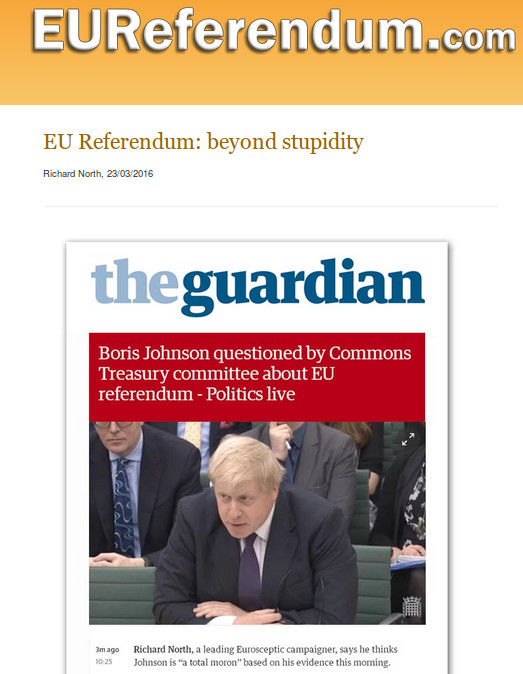
Along with David Cameron, Boris Johnson, one of the main cast of actors: But who or what is directing this (virtual) "reality show"?
One of the strangest of strange results that has been operating for at least the last 4 years as far as my own recollection enables me to have personally observed it is this:-
1st RULE of the EUROPEAN UNION:-
What are the Rules? Are we committed to follow these rules? Does the historic record confirm this is factual reality?
Generally when you buy a new appliance, you open up the "How To..." or "Instructions Manual" or if you play a sport you learn the rules of that sport. Why are our politicians not acting responsibly to the public to educate them on the rules?
The First Rule of the EU: "Ever Closer Union"
The Last Rule of the EU: "Article 50 Lisbon Treaty"
Instead we get The Referendum Show:-
The sheer banality and inanity of our journalists and politicians
But I think the biggest joke is on the people who watch this and don't take a look at the rules, at the responsibilities of those rules in both the Remain and the Leave "emotionally incoherent and biased" drives:-
The politicians don't believe the people really want or should want "something else".
As per Lost Leonardo and for the last two years, apart from "Article 50" being side-lined and "Ever Closer Union" being side-lined for the last 43 Years (!) until of course David Cameron can "magically make it all ""go-away"" ":-
There is a solution, despite the enormous, the prodigious energies expended by those in power to deter people; the one thing the politicians don't want people to do:-
Spontaneity can often be a simple and honest reaction - if unpredictable
Poor on all the doom, all the threats, all the begging, all the pleading, all the bullying, all the coercing, all the antipathy of these prestigious aggrandizing people, abusing their responsibilities by very simply not referring to the simple rules that were supposedly agreed and are if you read them so simple and so clear in meaning.
It's your life and your choice, for the first time in 41 years. A lifetime in point of fact.
In quantum mechanics, the uncertainty principle, also known as Heisenberg's uncertainty principle,
is any of a variety of mathematical inequalities asserting a
fundamental limit to the precision with which certain pairs of physical
properties of a particle, known as complementary variables, such as position x and momentum p, can be known simultaneously.
So "uncertainty" is in-built it seems into the very nature of the realistic universe! Or to adapt it for a more "relate-able" misuse:-
And this is indeed a hilarious transposition of "uncertainty" when we also find the same "joke"as noted by Mr. Brexit:-
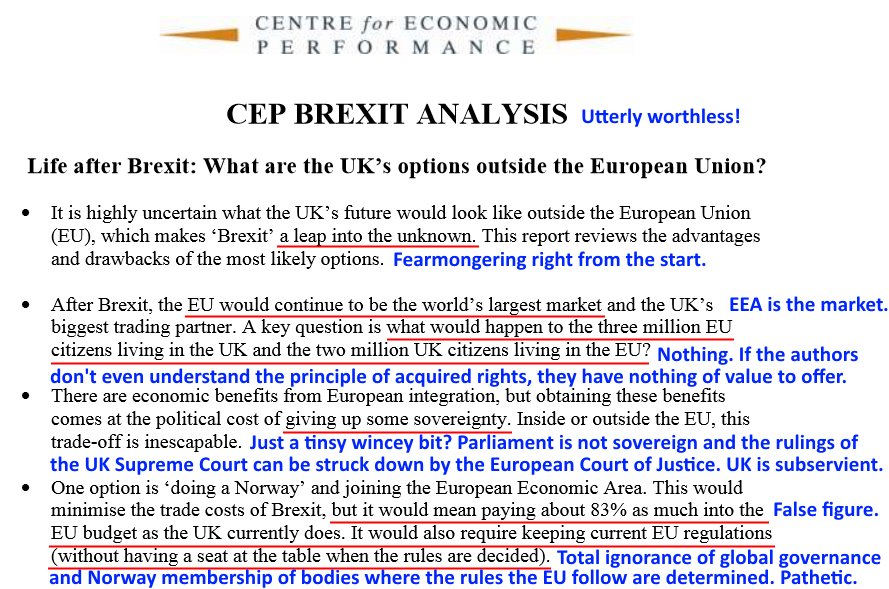
Interestingly enough we can actually take what Dilbert says above and apply it to the CEP "analysis" above:
"If you understand a project you won't know it's cost, and vica versa." ~ Dilbert
Effectively to para-phrase: "because we don't understand the project (Brexit)" we therefore DO understand it's costs: They're "ginormous"!! The Project Uncertainty Principle, in action.
This is attributed to "uncertainty". So how do we reduce/remove uncertainty?
What does "uncertainty" look like = Bad Decision-Making ; What is at the root of uncertainty = Not asking the right questions aka 1. DEFINE THE PROBLEM
Once we use such a framework it should be noted, CEP above launches into Stage 3. [See Above: "What are the UK's options outside the European Union?"] suggesting there is uncertainty over 3 million jobs and The Single Market and the EU are all blurred into one amorphous and undefined entity to which all manner of uncertainty properties can be attributed.
But the dual fallacies are both launching into Stage 4. AND not starting at Stage 1.
I think this simple process explains probably 95% of all the work we see published by various think tanks on the EU Referendum and on Brexit as per Dr. RAE North at EUReferendum.com. It's staggered that our National Decision-Making apparatus and institutions is so primitive in it's observable out-put.
Progress? Nope. Uncertainty? Yup.
The enormous disregard for The History of the European Union as described and defined in The Great Deception has been a key contributor to failure of progression of the argument.
If anyone is interested in Brexit, they must know what the defined problem is as per Lost Leonardo: For The Avoidance of Doubt. But this also allows an insight into the workings of the "eurosceptic aristocracy" who are taking over the Leave Campaign forming their own "Policy Ponzi" scheme as per Leave HQ: What's Wrong With the WTO Option?. Why? Why do they do this? What we see by the process of obscuring the definition of the problem ie ignoring The Great Deception is that it means the "Consideration Set" is kept broad and undefined. Here is the space with which the politicians can peddle their "Policy Ponzis" as per The Brexit Bullshit Sandwich to a bewildered public. By going through the entire cycle of Decision-Making we can connect the original problem itself to a form that is "fitted" to democratic decision-making on a mass scale for voters to be an executive part of the full decision-making cycle. But it relies on HIGH QUALITY!
It's funny you don't need the likes of LSE or CER who are paid so much by such powerful entities with such jealously guarded vested interests, a simple tabulation tells the story as effectively and more clearly. And as pointed out they deliberately go about:-
Finding The Right Answer(s) to The Wrong Questions.
There seems to be a lot of money and prestige sloshing around in those think tanks as per The Political Food Web of Prestige and possibly far too much geopolitical power projection invested in the EU to allow us plebs to decision on the right question: EU Reform: Asking The Wrong Question.
Is economics in the core defined problem? No. So remove it.
We can see that CER and Open Europe are determined to also ask the wrong questions and get the right questions on economic projections. This is why FLEXCIT removes this area from the original question and from the practical implementation of Brexit too. No other Brexit plan do we see this simple high quality thinking.
And this itself can be used to reinforce our Problem Definition:-
Just look at all these useless reports that fail to Define The Problem and Ask The Right Questions.
Our Membership of the Supranational EU is itself a deterioration of democratic decision-making processes as a nation!!
"If it sounds too good to be true": Elliott, Lea, Campbell-Bannerman, Redwood, Cash, Hannan, Carswell, Cummings,
Why don't the above avowed "Leave Campaigners" seek to solve this problem via higher quality decision-making and hence avoid uncertainty? It's their trade as "eurosceptic aristocrats" in SW1 as part of the political class: Farage on that front is certainly right!
It's up to voters to force such people either out of the way as part of the problem preventing problem definition or make them part of the solution:-
"Many voters had sovereignty at the top of their list for their reasons to say ‘no’, both in 1972 and 1994.
Norway gained independence from 90 years of Swedish rule in 1905, and was prior to that a part of the Danish Kingdom for more than four centuries. Skinner writes that this history of foreign rule has made Norwegians reluctant to give up independence to a supranational union such as the EU.
“For many Norwegians, the distance to Oslo is long,” says the researcher. “But the distance to Brussels is even longer.”
She says Norwegians are content with their political system, characterised by a short socioeconomic distance between the government and the governed, and are put off by the decision-making process in the EU. Marianne Sundlisæter Skinner.
This attitude was found both in the seventies and nineties."
I guess the Norwegians had their heads screwed on tightly both:-
Defining the Problem.
Defining the Challenge: Not trusting or being led by THEIR lying politicians who did want to join!
However one important difference to sharp-eyed observers, this was about Sovereignty to them in the 70's and 90's.
Today, in the 10's the problem is still Supranationalism but the challenge is Intergovernmentalism. The problem with Supranationalism?