Red Cliffs Of Dawlish

Red Cliffs Of Dawlish
Showing posts with label "Ever Closer Union". Show all posts

Saturday, 10 September 2016

The Political Nexus: Turning Governance Into Garbage

The Political Nexus: 'How governance turns into garbage', stemming from people to politicians (also some regulation symbols on wheelie bins usage).

Worth a read are two recent blogs over at Pete North's Political Blog:-

A model of inefficiency

The politics we deserve


Both are worth a read. I especially agreed with this sentence in "A Model Of Inefficiency":-
"Eventually systems become so ossified that departments use the main system as a secondary administration task while using guerilla tools to perform the primary function. That's where I come in and that's how I make my living. In the corporate world I am a black marketeer peddling unofficial merchandise."
I tapped out a brief comment in reply to this illuminating observation from Pete's direct personal experience, but it became a little larger than a comment and it was my initial response to the posed process above:-


===================================================

"[START] I remember Dr. RAE North made a very telling comment some years ago recalling,back in the early 1970's (iirc), apparently The Treaty of Rome was published in a little booklet/pamphlet and he picked up and bought a copy (in London). Reading this document, some of the first words, as everyone fully knows today: "Ever Closer Union". From reading that, that was enough to vote against joining the EEC or "Common Market".

Strictly adhering to the EU structure or system this would be the quintessential definition of it's:-
  • USE CASE
To clarify: The use case definition aims for stringent definition of the user (actor), system (anything built is built only towards what it's supposed to assist doing specifically) and outcomes (goals).


To revisit: EUReferendum.com: the "better deal" fallacy and connect:
"Eventually systems become so ossified that departments use the main system as a secondary administration task while using guerilla tools to perform the primary function."

Finally, the detractors of the above EU phrase "Ever Closer Union" have used a couple of methods:-

1. Dismissal: It's merely a phrase of good intent and hence insignificant.
2. Side-Tracking: Cherry-picking such a phrase is proof of an anti-agenda only.

But I think both detractions can be disproved if you consider that phrase leads to:-

1. A use-case that is wide enough for many additional and unlimited use-cases
2. If 1 then 2 follows: A bloated use-case effectively

History validates 1. with no question as per The Great Deception. What then happens with 2? I think Pete's blog here discusses this point very well. I'd like to add something to this. Inevitably when we correctly identity the Use Case of the EU we see one half of the problem:-

1. Legacy Logic:-

A) Original Design (DNA, Kernal, Constitution egs of: Once in place conservatism of these fundamentals is entrenched)
B) Self Maintenance (countless examples in the above 2 categories, see Dr. North's blog Fallacy of The "better deal" for examples and primary research of this effect in institutions: An equally powerful aid to understanding is Philip Selznick's theory of bureaucracy, in which he developed (if not actually coined) the principle of "self-maintenance" as a determinant of institutional behaviour.) This itself is a great driver of the Conservatives "wrong deal" on the EEC excuses.

C) With emphasis on B) subsuming A) comes greater demand for growth for more use cases and hence more support.
D) Visible and increasing mismatch of Inefficiency of the system/institution or organization with the original design to the current and changing conditions.

2. Conflict Logic:-

A) Because there is a mismatch between the function and the legacy support support there is conflict inherent.
B) Reporting of this conflict is either amplified or dampened in the Legacy News-Media depending.

C) Avoiding Blame is reaction to B)
D) Visible and increasing mismatch in the actual subject in question to the nature of the debate being conducted. See wide-spread confusion and poor quality democracy.

The second most important parameter is:-
  • MINIMAL COST
In fact, looking at the EU Referendum it was dominated by these two considerations:- "What's the use of the EU and is it worth it?" [END]" This is particularly pertinent in today's circumstances with "austerity" and Government debt and deficit clearly out of control and of course I'm referring to Pete North's first blog "A model of inefficiency" here.

===================================================

The cartoon I've modified above looks at this question:-
"What little information is enough for a few people, so much information is not enough for so many people concerning such a political vote as the UK's membership to the EU."
"Why?"
Well I think Pete North answers that question very effectively in his second blog post "the politics we deserve":-
"The problem for politicians is that they are playing a game they cannot win. Take the NHS. Everybody wants first rate high quality personalised care. Nobody though wants to pay for it and thinks that someone else should regardless of the fact that what they want actually costs more than they have ever paid in taxes. The people themselves are hypocrites. The middle classes want the welfare system reformed and benefits reduced. Until they themselves have need of it. And of course you cannot expect top be elected or retain a position in high office if you do not pander to this basic hypocrisy.
This same dynamic underscores a good deal of popular euroscepticism. People say they want democracy but when given the chance to exert their own power they take no interest whatsoever. By abdicating politics to politicians there is a punchbag and someone to blame and the people are then absolved of all responsibility for what is done in their name. This is what we call representative democracy. 


So really our politics in a way is representative in that the hypocrisy and dishonesty of our politicians is only really a mirror image of ourselves.

Worse still the public persist in demanding simple solutions to complex problems while making zero effort to familiarise themselves with the issues.

Here we are in the middle of an information revolution with absolutely all the opinion, fact and data you could possibly want at your fingertips and people sit there gormlessly pleading for their government to spoonfeed them with the answers. This notion that politicians should do as we say instantly falls apart when the public are so hopelessly dependent on politicians and government.
Not for nothing is it said that people get the government they deserve. If we have lazy, facile and shallow politics it is again a reflection of ourselves."

Coming back to what Pete was saying about System Inefficiency, a simple and useful graph of this problem:-


Going Pro in Data Science by Jerry Overton O'reilly media: Volume and variety of data increases, statistical correlation (garbage or noise) increases compared to use-ful or meaningful data (signal)

Perhaps, for a lot of people, the inductive common sense of "What's the use of the EU and is it worth it?" probably swayed their perception of it's merits and it's faults. Intuitively the conception that there's a gap between what is said and what is actually done is felt or inferred. By the way, that blue line? I think might well explain the excessive use of the legacy news-media's narrative device of "X Could Happen?" in conjunction with "Negativity Bias": Namely "Uncertainty" from the exponential increase in statistical correlations possible no matter that they serve no useful specified Use Case. I really dislike those words thanks to the legacy news-media reporting for so many years on the EU.

But what of the people on the inside of such a system? How do they feel? This question probably takes a number of different and compatible forms:-
  • The Bubble Effect derived from Prestige (a form of social rent-seeking?) where the legacy of the system itself selects the people who "run" it accordingly or what is are known as,
  • "Political Dynasties" or "The Political Class" emergence in society where fewer and fewer are from "Working Class Backgrounds" and more and more from the "Diplobrat" upbringing of the likes of say a Nick Clegg or Daniel Hannan

And hence on the other hand, with the identity formation of such politicians layers above the other classes in society, a free shot of discontent (see financial ruin wreaked across the Western World), why wouldn't you vote "Leave" to give these people (Conservative, Labour, Liberal Democrat) a kick in the teeth for the first time in living memory for many?

In my reply above which was going to be a comment, to flesh it out some more, looking at the above "gap" it may need more description and hence direct application to what is discussed above. In the "Legacy News-Media", one of the dominant drivers is "Conflict Narration", again this itself takes on other forms or names such as
  • "Negativity Bias" and itself is an enormously important cog in the engine driving governance into garbage. But what this adds is part of the political system's survival or self-maintenance is driven by establishing the ruling narrative that acts positive or avoids acting negatively in it's favour, our old friend
  • "The Status Quo Effect" or what we'll see as the features fuelling a crisis: Inflexibility, opacity, post-hoc blaming and so on.

A side-note, the above is summarized in Dr. RAE North's most recent blog posts here for further context ie immediacy that feedback of the above is actually operating presently ie it's very real and observable:-


Brexit: nothing to report 06/09/2016
Brexit: a dose of reality?05/09/2016
Brexit: the hacking of Redwood04/09/2016
Brexit: a sterile debate03/09/2016
Brexit: Liechtenstein reprised02/09/2016
Brexit: muddy waters01/09/2016
Brexit: parallel negotiations31/08/2016
Brexit: the power of prestige30/08/2016
Brexit: the failure of feedback29/08/2016


 What the above are all describing in such detail is that policy is driven as much by a certain kind of narrative building or world view such that these are possibly popular in appearance or avert hostile reception AS OPPOSED TO taking the lead of policy driven by data and it's fidelity (veracity). Hence the emergence of this gap in form (call it noise, presentation/spin or inefficiencies) to function (use case, policy, efficiency). In fact in any operating system a feedback-system involves both positive feedback and negative feedback on processing data into information to then use for various functions for executing decision-making.

And decision-making has consequences depending on how well made those decisions were by whom: To take an example from The Financial Industry. In the banking industry, there's been some very serious "catastrophic system errors"
"The Sarbanes–Oxley Act of 2002 (Pub.L. 107–204, 116 Stat. 745, enacted July 30, 2002), also known as the "Public Company Accounting Reform and Investor Protection Act" (in the Senate) and "Corporate and Auditing Accountability and Responsibility Act" (in the House) and more commonly called Sarbanes–Oxley, Sarbox or SOX, is a United States federal law that set new or expanded requirements for all U.S. public company boards, management and public accounting firms. There are also a number of provisions of the Act that also apply to privately held companies, for example the willful destruction of evidence to impede a Federal investigation.

The bill, which contains eleven sections, was enacted as a reaction to a number of major corporate and accounting scandals, including Enron and Worldcom. The sections of the bill cover responsibilities of a public corporation’s board of directors, adds criminal penalties for certain misconduct, and required the Securities and Exchange Commission to create regulations to define how public corporations are to comply with the law."
"The Dodd–Frank Wall Street Reform and Consumer Protection Act was signed into federal law by President Barack Obama on July 21, 2010. Passed as a response to the Great Recession, it brought the most significant changes to financial regulation in the United States since the regulatory reform that followed the Great Depression. It made changes in the American financial regulatory environment that affect all federal financial regulatory agencies and almost every part of the nation's financial services industry."
"Basel III (or the Third Basel Accord) is a global, voluntary regulatory framework on bank capital adequacy, stress testing, and market liquidity risk. It was agreed upon by the members of the Basel Committee on Banking Supervision in 2010–11, and was scheduled to be introduced from 2013 until 2015; however, changes from 1 April 2013 extended implementation until 31 March 2018 and again extended to 31 March 2019. The third installment of the Basel Accords (see Basel I, Basel II) was developed in response to the deficiencies in financial regulation revealed by the financial crisis of 2007–08. Basel III is intended to strengthen bank capital requirements by increasing bank liquidity and decreasing bank leverage."
All the above are reactions/responses to what is easy to understand: The values and numbers traded in the financial world ended up becoming a huge data set of garbage with unreal values attached to various instruments or concoctions or "financial bubble". Here's a small exercpt from Basel III challenges (given this is the current period of attempting to regulate finance more effectively):-

BASEL III (2015): Progress in adopting the  principles for effective  risk data aggregation  and risk reporting
"In terms of the challenges that banks face in attempting to comply with the Principles, the industry panel indicated that the completion of large-scale IT infrastructure projects will aid in complying with the Principles. However, large scale IT projects are dependent on many smaller dependent IT projects, which increases execution risk. Also contributing to execution risk is the lack of subject matter experts to improve RDARR processes. Moreover they indicated the changing regulatory landscape, and consequent required reporting, further complicates the execution of IT projects. Industry members noted that the completion of these projects will improve business-as-usual RDARR, which will improve, but not completely resolve, challenges in risk reporting during periods of stress. Among the greatest challenges in risk reporting during periods of stress is the over-reliance of manually-created reports and developing processes and procedures for developing such reports when automated reports cannot be developed."
You can just imagine the sort of work Pete North mentions concerning databases from this report and the "clusterF!" involved! Not finance, but politics, a similar complexity issue probably dominates the effective delivery of Brexit with a minimizing of risk at such a large scale involving so much background noise? I'm not entirely sure how effective Basel III "can be" even with more effective regulatory requirements at global level without the actual finance industry restructuring entirely using data with more fidelity with a closer match to that data's USE CASE. The more bloated these systems become the more the motivation of the finance workers is "Get Rich Quick Before The Shit Hits The Fan!":-

'Lost' Financial System Needs Some Straight and Narrow Discipline (2014)
"In 2010, the bank launched Stride, the Strategic Reporting and Information Delivering System, which was designed to consolidate more than 1,000 information technology systems into one — an attempt to enhance the reliability of its financial reporting.
Despite this effort, the Federal Reserve Bank of New York has concluded Deutsche Bank’s operations management systems remain unsatisfactory, and the goals of Stride have not adequately addressed the issues of concern, including oversight, auditing, reporting, and technology.

Echoing this financial dysfunction is a recent two year prison sentence and $1.75 million fine received by Jesse Litvak, a former Jeffries Group LLC senior trader on 15 counts, including 10 related to securities fraud. In essence, he misled clients regarding the prices he paid for bonds tied to the $700 billion Troubled Asset Relief Program, which was designed to bail out the banks during the 2008 financial crisis.

This case is another microcosm of the dysfunctional financial system. One of his lawyers believes his client has demonstrated typical Wall Street behaviour and seems to be treated in a selective and disparate manner."
 Here's a report with all the features we've been discussing so far, a "microcosm of the macrocosm" of financial garbage data.

Now looking at both Westminster government and Civil Service and their apparent inadequacy concerning Brexit planning and dissemination of information in the event of a Leave Referendum result as well as the general pattern of governments who win election for five years and "pass the buck on" or "kick the can down the road". This becomes more explainable knowing there's inevitably a mismatch in the institutions stated functions and it's actual behaviour leading to perverse results such as apparently not planning for a "leave" vote! When all these people are carrying responsibilities that they cannot contend with, their behaviour is less effective policy and more about self-maintenance within a system dominated by self-maintenance and a very effective method to achieve this is self-assertion through either money (financial industry) or prestige (political industry):-

The Blame Game: Spin, Bureaucracy, and Self-Preservation in Government ~ Christopher Hood


 What we see here: Divorcing Responsibility From Identity through (1) Perception (2) Time and (3) System complexity = Representative Democracy: The growth of "Blame Risk" driven institutions of Government
"What we are dealing with here is a type of risk that seems curiously unmentionable in the offi cial corporate lexicon of risk management — namely the risk of blame."

"But most of it is officially concerned with risks to society or to corporate organizations. In contrast, this book puts the spotlight on the risk of personal blame faced by public office holders, including politicians, managers, professionals, and front-line bureaucrats. That is a type of risk and risk management that is rather less commonly identified on the management-seminar circuit. And curiously—or tellingly—it does not have any conventional term-of-art label.
"So we shall simply call it “blame risk” for the purposes of this book."
 "... start to find answers to some of those puzzles that we began with, about disjunctures between officially stated claims and observed behaviour. That is because the management of blame risk — perhaps contrary to intention and usually in an unacknowledged way — so often shapes the organization and operation of modern executive government, producing its own curious logic of administrative architecture and policy operation."
"negativity bias is the reef on which international trade talks often falter, even if, as is claimed there, there might be more winners than losers from liberalizing world trade."
"Indeed, the blame-avoidance perspective cuts across three different strands of political science that are normally separated— namely the analysis of (1) institutional architectonics (why institutions are designed the way that they are), the analysis of (2) policy processes (how policies play out at all stages from their emergence onto the decision agenda down to the way they operate on the ground), and the analysis of the (3) working of electoral processes and public opinion. In fact, all of those different analytic strands are needed to explore the questions we posed at the outset, about =>"why organizations often don’t connect" in policy delivery, why rigidity often trumps flexibility and proportionality in organizational functioning, and why opacity tends to trump clarity in accountability after policy fiascos."
The author cites three categorical "Blame Risk" strategies to avoid blame:-
  • Presentational Strategies
  • Agency Strategies
  • Policy Strategies
And they're well worth reading along with the accompanying diagram. However, for brevity, to put this into the context of this blog, if you do read these strategies they are in fact overwhelmingly familiar and you can very easily recall dozens and dozens of such examples you may have heard of in the media hundreds of times printed and distributed in multiples of Legacy News-Media sources: TV, Web, Print, Radio and of course Forums and Comments Sections.

Coming to the last section, often you see people making contributions to improve governance after disaster strikesand the legacy news-media full of hypocracy in it's own role in this entire systemic failure, comes out with the usual outpourings of "an unjust and class-ridden society" (self-flagellation) grows the divides between people ever deeper" and the usual nonsense along these emotional narrative lines. This my personal experience is to assert that such attempts to add a contribution by ordinary people within these limits imposed all around are doomed to fail: The whole system or

  • "Political Nexus" from the people to the legacy news-media to the political institutions work as a complex system which is inevitably going to grind along in a particular direction and chew up anything for it's own internal working's logic.
What we have according to Christopher Hood's work:-
  1. Naming
  2. Blame (avoidance) Or Credit (seeking)
  3. Claiming
According to "Negativity Bias" we see that this leads to Blame being x2 or x4 times higher weighted to avoid than seeking credit. Similarly, the inbuilt bias in "Conflict Narration" built off the top of "Legacy Systems" drives peoples' reactions and legacy news-media practices. The author also noties that in complex systems, it's impossible to perform "police patrols" ie stopping a problem happening before it happens, so the emphasis is on "fire-alarms" namely setting up systems that report when problems happen. Unfortunately this design appears to reinforce "Blame Risk" driven behaviours.

What is a better way to design systems? I think the USE CASE in politics should start with the principles of minimalism and simplicity in their design and limited scope. How could such a system become more applied?


Principles:-
  1. Direct Data Driven
  2. Local Execution with Responsibility
  3. Clear Use Case Definition
  4. People are their own best Use Case or Self-Learning
  5. Direct Cost Controls grounds the above in Reality
  6. Limits on Parliament's acquired Use Case (see it's extension into the EU)
The facts seem clear: Politicians can never fully take responsibility away from people who in the first place should never be so careless to assume other people will solve their problems for them without their own self-interest interfering and eventually corrupting the process (of politics).

Saturday, 16 April 2016

A Map Argument: Why Not?


1-page map for arguments on the UK's EU Referendum: Remain or Leave

1. 41 Years since the last Referendum in 1975

One of the basic facts about the 2016 Referendum, is the length of time it's taken for the politicians to "allow" the UK Electorate a direct vote on membership. 41 years. If there's any basic fact that guides how to vote it's that 41 years, 59 years of age and 9 Major New EU Treaties without a vote:-


Chronological View of EU Treaties:-

  • Treaty on European Union (Consolidated version 2012)
  • Treaty on the Functioning of the European Union (Consolidated version 2012)
  • Treaty establishing the European Atomic Energy Community (Consolidated version 2012)
  • Charter of Fundamental Rights of the European Union (2012)
  • Treaty of Accession of Croatia (2012)
  • Charter of Fundamental Rights of the European Union (2010)
  • Treaty on European Union (Consolidated version 2010)
  • Treaty on the Functioning of the European Union (Consolidated version 2010)
  • Treaty on European Union (Consolidated version 2008)
  • Treaty on the Functioning of the European Union (Consolidated version 2008)
  • Charter of Fundamental Rights of the European Union (2007)
  • Treaty of Lisbon (2007)
  • Treaty of Accession of the Republic of Bulgaria and Romania (2005)
  • Treaty establishing the European Community (Consolidated version 2006)
  • Treaty on European Union (Consolidated version 2006)
  • Treaty establishing a Constitution for Europe (2004)
  • Treaty establishing a Constitution for Europe (draft 2003)
  • Treaty of Accession of the Czech Republic, Estonia, Cyprus, Latvia, Lithuania, Hungary, Malta, Poland, Slovenia and Slovakia (2003)
  • Treaty establishing the European Community (Consolidated version 2002)
  • Treaty on European Union (Consolidated version 2002)
  • Treaty of Nice (2001)
  • Treaty establishing the European Community (Consolidated version 1997)
  • Treaty on European Union (Consolidated version 1997)
  • Treaty of Amsterdam (1997)
  • Treaty of Accession of Austria, Finland and Sweden (1994)
  • Act amending the Protocol on the Statute of the European Investment Bank empowering the Board of Governors to establish a European Investment Fund (1993)
  • Agreement on the European Economic Area (1992)
  • Treaty establishing the European Community (Consolidated version 1992)
  • Treaty on European Union (1992)
  • Single European Act (1986)
  • Schengen Convention (1985)
  • Treaty of Accession of Spain and Portugal (1985)
  • Treaty of Greenland (1984)
  • Treaty of Accession of Greece (1979)
  • Treaty amending certain provisions of the Protocol on the Statute of the European Investment Bank (1975)
  • Treaty amending certain financial provisions (1975)
  • Treaty of Accession of Denmark, Ireland and the United Kingdom (1972

The Trend of Powers is unidirectional as they can only be under EU Treaty Rules

Our General Elections were already a duopoly between Labour and Tories for the majority of the last Century and now even less vote on our own Self-Governance by the people.

The failure to hold a Referendum sooner than 41 years is merely a symptom itself of lack of democracy in the UK due to our ruling Establishment's monopoly on power away from the people.

Hence the EU Referendum is a Political Choice first and foremost and hence a Political Argument in nature.

This crucial definition is important to make: The EUropean Union (EU) is not Europe, it's not the Single Market, it's not International Law: It's a clear argument between:-
  • Political Executive and Legislative and Judiciary and Monetary in the EU
  • Political Executive and Legislative and Judiciary and Monetary in the UK

2. Understanding Remain(If Not? Then What?)

If we break down the EU Political Union:-

  • How? Reading the official document by the Foreign and Commonwealth Office; FCO 30/1048: Sovereignty & The European Communities it is clear that the UK Government in the 1960's-70's deceived the UK People into joining not a Common Market but a Supranational organization. 
  • Who? The Federalist ambitions and end-goal of the current EU is laid out in the document: The Fundamental Law of the European Union. It is to create a new "country" called Europe, so this is who you are voting for to vote for Remain.
The first thing I would establish when considering the EU Referendum argument is:-
Question: "Have you read all the above and understood all the above and support all the above?"
If so, I would be interested in your answers. Secondly I would be interested in you demonstrating your understanding and reasoning for supporting the above. I would also be interested in your opinion as to why in the UK the major actors in the public domain who are allocated the greatest seriousness and air-time do not categorize, nor define the EU Membership question as above, a core political project for "Ever Closer Union"?

If, the UK is not a member of the EURO, not a member of Schengen and as above the next major EU Treaty is to treat the EUROZONE as it's core priority to resolve this crisis; then why is the UK a member? And why is the UK not planning an alternative relationship with the EU? In such a case it may pay to look at what the Leave question looks like:-

3. Why Leave?

    Now this Core Argument is illustrated no better than in the Pro-EU officially nominated campaign group itself and even in it's name and it's own colours!


    The Fundamental Deception at the heart of the EU Supranational idea is I think more or less above. The excuse given is that "Pooling Sovereignty" must be done to be able to increase "collective power" and/or "Subsidiarity" allows nations to retain their powers. But observation is consistent: The EU has been divisive in the UK and it's because of the above by the likes of BSE: Mixing where political power is held and by whom and hence how it is represented compromises democratic representation. If the UK is not an EU member then it must be held in the UK Parliament. Any problems there must be considered. But not only this, with the rise of globalization, the Single Market technical standards are now made not in Westminster Parliament nor in the EU Parliament but in hundreds of global bodies:-


    These increasingly feed into the Single Market:-


    Quoting FLEXCIT: The Market Solution: 10.1 The EU role in global governance p.198:-

    "Nevertheless, despite the activity of the EU at global level, there is a perverse effect arising from globalisation. As more and more issues are addressed at global level, the EU is losing control over its own regulatory agenda. More than 80 percent of the EEA acquis (and therefore the EU's Single Market legislation) falls within the ambit of existing international organisationsand is thus potentially amenable to global regulation."

    Now looking at the Government's counter claims in their pamphlet:-


    1. As previous blog IMF, FUD & JENGA we already suffer accumulation and political arrears for "years of uncertainty".
    2. An "Off-The-Shelf" Solution already exists, replacing EU/EEA with EFTA/EEA: The Leave Alliance Grows In Support by Semi-Partisan Politics
    3. Following EU Rules is in fact under the EEA acquis; EU Referendum: the EEA acquis following global rules and being represented on those global bodies directly. The supporting arguments: Payment is not an issue and nor is Freedom of Movement concerning the Central Argument: Political independence of our decision-making processes. They are secondly time-modified subject to the actual Political result of the EU Referendum itself.
    4. It does fulfill the criteria for clear political separation at the same time as trading through the single market.
    This leaves us where we actually are in the arguments today:-


    Why does it seem that there are political processes and mass media accommodation of exclusively narrowly sanctioned ideas and concepts, whereas the the arguments from The Leave Alliance in support of FLEXCIT: The Market Solution; the measures used against it, they have been bordering on the antithesis of Real Democracy via REJECT, ALIENATE, EXCLUDE & OMIT such "vigorous and rigorous" positive contributing arguments to democratic decision-making? Why?

    In the next blog, this question - will be answered definitively.

    Wednesday, 23 March 2016

    The Referendum Show: Rules go with Responsibility

    The Deep Convictions of the Cast - How Normal!

    The above clip is the opening scene from The Truman Show movie. It's a mix of people being interviewed and providing profound beliefs for the roles they play in this "great tv project" ("of our times..."!). Everyone believes in what they say and it evidently accords with their values and inspirations of "higher things"; only all too often they habitually say their lines in front of product placements... .

    It's all perhaps on the first viewing an introduction of "excitement" at the novel idea of a live tv show. On future viewings you can't help notice that this opening scene is terribly, terribly full of the full portents of irony, suffused into the film all the way through towards the final peak of "ekstasis" - and even then irony has the final say beyond that moment, too. Once you've watched the movie and are aware of where the film is heading, you are sharp eyed for every slight perturbation along this theme. It's a good story showing the resolution of a character at the same time as the irony of an indifferent environment to the character's underlying "crisis of self-identity". As another character in another movie once said, Total Recall: "If I am not me? Then who the hell am I?"


     "That's... weird..."

    This is not going to be a long and patriotic speech that we are "British" and demand our "Sovereignty" or all the other identity and flag-waving emotions; although speaking to a friend after attending EU Referendum: Leave Alliance launch, they mentioned that the original notion of Sovereignty was probably something defined along the lines as "Not The French." ! No, it's an "epiphany", a way to describe the surreal, bizarre, perhaps madness that is the way in which the communication of this Referendum and indeed the EU and Brexit and our politics is conveyed via the Legacy News-Media by both politicians and journalists and to which many people themselves then take their own opinions from - within this self-contained world.


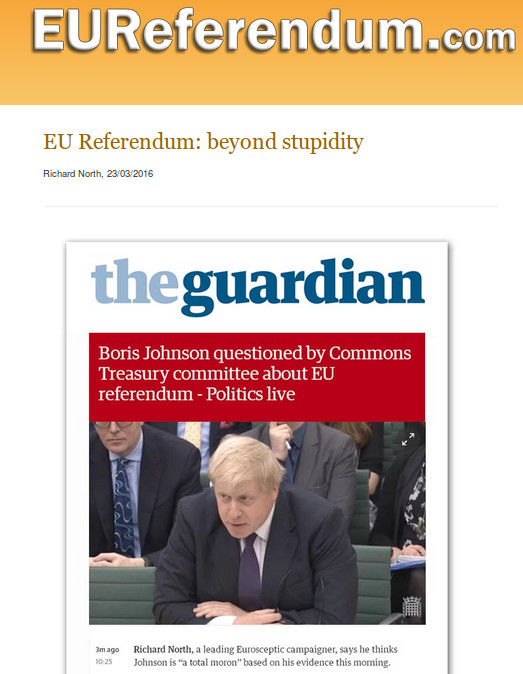
     Along with David Cameron, Boris Johnson, one of the main cast of actors: But who or what is directing this (virtual) "reality show"?


    One of the strangest of strange results that has been operating for at least the last 4 years as far as my own recollection enables me to have personally observed it is this:-

    • 1st RULE of the EUROPEAN UNION:-


    What are the Rules? Are we committed to follow these rules? Does the historic record confirm this is factual reality? 


    If the above, then so:-

    • Last RULE of the EUROPEAN UNION:-


    Generally when you buy a new appliance, you open up the "How To..." or "Instructions Manual" or if you play a sport you learn the rules of that sport. Why are our politicians not acting responsibly to the public to educate them on the rules?
    • The First Rule of the EU: "Ever Closer Union"
    • The Last Rule of the EU: "Article 50 Lisbon Treaty"
     Instead we get The Referendum Show:-


    The sheer banality and inanity of our journalists and politicians

    But I think the biggest joke is on the people who watch this and don't take a look at the rules, at the responsibilities of those rules in both the Remain and the Leave "emotionally incoherent and biased" drives:-

    The politicians don't believe the people really want or should want "something else".

    As per Lost Leonardo and for the last two years, apart from "Article 50" being side-lined and "Ever Closer Union" being side-lined for the last 43 Years (!) until of course David Cameron can "magically make it all ""go-away"" ":-


    There is a solution, despite the enormous, the prodigious energies expended by those in power to deter people; the one thing the politicians don't want people to do:-

    Spontaneity can often be a simple and honest reaction - if unpredictable

    Poor on all the doom, all the threats, all the begging, all the pleading, all the bullying, all the coercing, all the antipathy of these prestigious aggrandizing people, abusing their responsibilities by very simply not referring to the simple rules that were supposedly agreed and are if you read them so simple and so clear in meaning.

    It's your life and your choice, for the first time in 41 years. A lifetime in point of fact.

    Wednesday, 30 September 2015

    How about a nice game of chess?

    [SPOILER!] At the end of the movie "Wargames", the principle actors attempt to teach a computer about the concept of "futility" or "no-win" contests to feed this into the simulations the computer runs on a Nuclear War and learn the result of "Mutually Assured Destruction" is "not to play" when a win or loss condition are effectively the same result. What this demonstrates is that how we argue or frame our arguments or rules itself shapes the sort of answers we therefore derive and hence interpret.

    Before discussing the full relevance of the above, a reminder that when the UK joined the European Economic Community (EEC) via European Communities Act 1972 and then held a Post-Legislative Referendum in 1975 on membership with the wording of the Referendum Question:
    "Do you think that the United Kingdom should stay in the European Community (The Common Market)?"

    We come back to our concept of Can We Have Our Cake And Eat It Too? Using the historic evidence that hindsight of recording and reporting allows: We now know that the cake was much less a "Common Market" cake than a "Supranational Cake" with "Ever More Layers" or as per the Treaty of Rome:-
    • RESOLVED to continue the process of creating an ever closer union among the peoples of Europe, in which decisions are taken as closely as possible to the citizen in accordance with the principle of subsidiarity,
    • This Treaty marks a new stage in the process of creating an ever closer union among the peoples of Europe, in which decisions are taken as openly as possible and as closely as possible to the citizen
    • DETERMINED to lay the foundations of an ever closer union among the peoples of Europe,
    • The peoples of Europe, in creating an ever closer union among them,
     The wording of the above question therefore can be simply seen as very misleading in leading people to ask and answer a very different question and hence believe in a very different concept of "What is the EU?" This can be further demonstrated as pointed out via reviewing the reporting recorded at the time. Peter Hitchens provides a scan of the Campaign Documents in the 1975 Referendum here: The 1975 Common Market Referendum Campaign Documents


    Again the same forces in the News-Media of the time framed the debate using the inevitable "Heroes vs Villains" narrative tropes:

    Again this "vilification characterization of arguments process" was described previously: I've been expecting you...

    What can we learn from these examples? I would suggest:-
    "How we structure our arguments and hence how we classify the quality of the arguments themselves determines both the outcome and the quality of answers to the posed questions."
     And indeed this is highly relevant to how we approach Democracy. We must think about  how to argue before we then learn how to use the tools to argue before we then choose which arguments to make and with whom. The current form specifically concerns Referendums. It is probably a fair argument to make that the 1975 Referendum could be termed a "Top-Down" Referendum as opposed to a "Bottom-Up" Referendum from the people themselves. This categorization of the characteristics of a given referendum is well made: A Tale of Two Referendums: Elite Manipulation or Civic Engagement?

    A useful summary beyond the technical details of regulation and running back towards the principles: EU politics: Germany in stasis :-
    "The new movement, "Direct Democracy for Europe", Patzelt speaks about favourably. It certainly has "a chance", he says, a man who is demonstrably no great fan of representative democracy.

    Those who want more democracy must resort to other means - referendums initiated by citizens, regardless of elections. The problem with representative democracy is that, after the vote, the citizen has no voice. "The most important instrument of political influence between elections", he says, "is the referendum".

    However, not all referendums have the same value. If they are top down, they are a tool in the hands of professional politicians. The must work from the bottom up, with citizens deciding on the topics. He who fails to make this distinction will miss the opportunity of making a truly democratic system of government, Patzelt says."

    Coming back to the idea of "learning how to argue" as per the movie reference above in "Wargames", then we can reshape how we think about the upcoming 2017 EU Referendum question:-
     "Should the United Kingdom remain a member of the European Union or leave the European Union?"
    If we think of the question like the supercomputer in "Wargames" (WOPR) (War Operation Plan Response) only in terms of victory or defeat, Win or Lose, In or Out, Yes or No, Leave or Remain... then we are limiting ourselves to very narrow outcomes and hence a more limited future than is possible (in the film's case: Mutually Assured Destruction!).

    What we have to do is "learn how to argue" in such a way that we ask more useful questions:  
    "How about a nice game of chess?"

    Monday, 28 September 2015

    Can we have our cake and eat it too?

    To sum up how the EU has been sold for so long to the British public, we can think of the analogy of it being a cake. The argument begins that if we joined the EEC 'cake' we could all bake a bigger and better cake together; with each nation contributing it's own unique ingredients to the 'cake mix', at the time called the "Common Market". Of course reassurances were provided that each nation would still retain "property rights" over it's own contribution of national ingredients, and hence the additional EU layers above these were necessary to administrate this.

    Over time more layers were added, more nations joined and more policies powers were or "cake ingredients" were added. Each major layer was added with the signing of each of the Major New Treaties:-

    • Treaty of Lisbon (2007) 
    • EU Constitution Treaty (2005)
    • Treaty of Nice (2001)
    • Treaty of Amsterdam. (1997)
    • Treaty on European Union - Maastricht Treaty. (1992)
    • Single European Act. 1986
    • Schengen Agreement (1985)
    • Merger Treaty (1965) - Brussels Treaty
    • Treaties of Rome (1957): EEC and EURATOM treaties
    • Treaty of Paris (1951) - Treaty establishing the European Coal and Steel Community.
    Quoting the above source:-

    The European Union is based on the rule of law. This means that every action taken by the EU is founded on treaties that have been approved voluntarily and democratically by all EU member countries. For example, if a policy area is not cited in a treaty, the Commission cannot propose a law in that area.
    A treaty is a binding agreement between EU member countries. It sets out EU objectives, rules for EU institutions, how decisions are made and the relationship between the EU and its member countries.
    Treaties are amended to make the EU more efficient and transparent, to prepare for new member countries and to introduce new areas of cooperation – such as the single currency.
    Under the treaties, EU institutions can adopt legislation, which the member countries then implement.

    This is a very succinct summary of how our "Cake" is sold to us. As you can see our cake was always designed to add ever more layers to it.


     However in the combination of ingredients, the mixing, baking and designing of our cake, the question of the actual nature of the cake, what sort of cake are we actually trying to make, seems so simply to have been overlooked! What is a better cake? Is a bigger cake better? How much of each nation's ingredients actually contributes to making it better and do all of them agree on the sort of cake they would like to eat? Quoting the above introduction to The Great Deception by Christopher Booker and Richard North:-

    "The  purpose  of  this  book  is  to  tell  for  the  first  time  the  real  story  of  how, through  what  had  come  to  be  known  to  its insiders  as  ‘the  project’,  the continent’s  politicians  had  for  half  a  century  been  seeking  gradually  to construct and to impose on  their peoples a unique system of government. Not the  least  remarkable feature  of  this  political  experiment  had  been  how few people really understood its real nature, aims and origins.
     

    The  form  of  government  it  created  was  unique  because  it  was  designed  to place the nation states which belonged to it under a ‘supranational’ power, unaccountable to any electorate, ruling its citizens through the agency of each country’s  own  national  authorities.  Although  the  nation  states  and  their institutions  of  government  remained  outwardly  intact,  all  these  institutions, from  heads  of  state  and  parliaments  to  civil  services  and  judicial  systems,  in reality became increasingly subject to the decisions and laws of the new power that was above them all."

    However, bringing the past up to the present in 2015, our cake is much nearer to it's completion of being fully-baked and "ready to eat". And now people across Europe are beginning to see what sort of cake they are getting, the above "selling the idea of the cake" is no longer possible. We're moving from Pro-EU/"Let Them Eat Cake!" sales pitches to "How much of the cake is each nation getting or being charged for"!

    This is how our "EU Reform Cake" is now being sold to us today:-


     We are being told that we can change the cake or get a bigger and better slice with "less icing or nuts" on it or more "chocolate and sponge". But the actual cake has not really changed at all. And to understand why we have to understand how the cake is made in the first place. If we argue over the above ingredients, taste preferences we're being distracted from whether or not we ourselves can make and then bake our own cake to our own tastes and preferences! In my opinion that's what counts the most.

    And to illustrate this is the modern arguments on the EU aka "Cameron's Reform Fudge" in the style and spin of "The Middle Way Fallacy" argument:-


    We're now being sold "a slice of the EU Cake" as "EU Reform". But coming back to those layers and how the EU cake is made: The Treaty Of Rome (1957)

    • DETERMINED to lay the foundations of an ever-closer union among the peoples of Europe, 
    • RESOLVED to ensure the economic and social progress of their countries by common action to eliminate the barriers which divide Europe,
    The "Ever Closer Union" is as fundamental as the the self-raising flour in mixing the core ingredients when making a cake. It cannot be taken out. And if that you don't like that taste or it makes you feel ill or you think it's simply unhealthy then you have to decide to choose another cake.

    Arguing about how many chocolate buttons we get given on our slice or how thick it is, are completely missing this central point about our membership of the EU Supranational Organization. This cake analogy is a crude simplification, but for the complex and very fascinating full story then read The Great Deception from cover to cover.

    Effectively when it comes to answering the EU Referendum question we're not talking about a slice from one cake, we're talking about two very different cakes:-

    • Remain = Eating and paying for a small slice of the EU Cake
    • Leave = Baking our own full and complete Cake